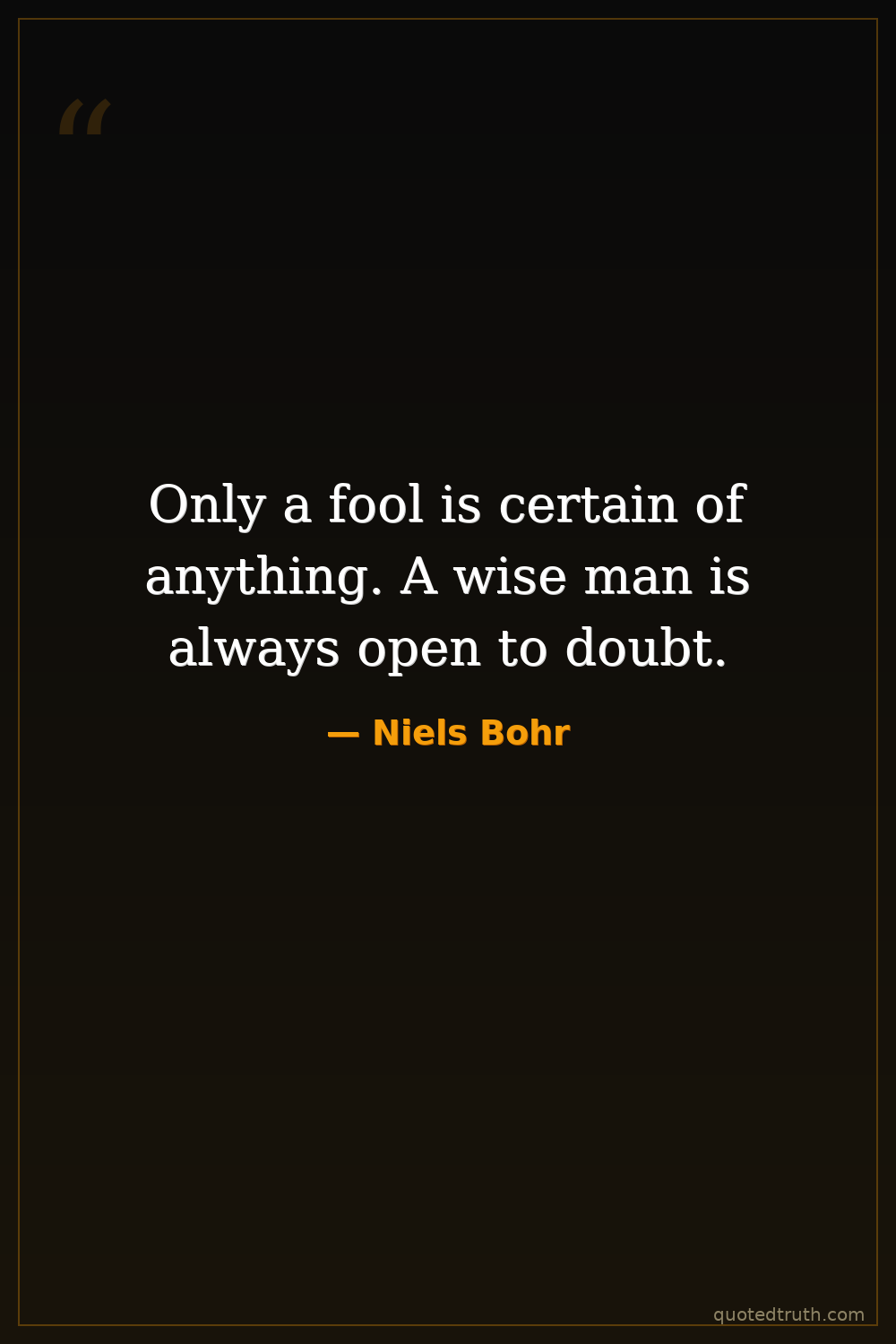
Niels Bohr — "Only a fool is certain of anything. A wise man is always open to doubt."
Only a fool is certain of anything. A wise man is always open to doubt.
Only a fool is certain of anything. A wise man is always open to doubt.
Click any product to generate a realistic preview. Up to 3 at a time.
* Initial load can take up to 90 seconds — revising the preview in another color is nearly instant.
"The most important thing is to never stop questioning."
"Your theory is crazy, but it's not crazy enough to be true."
"Stop telling God what to do with his dice."
"There are some things so serious that you have to laugh at them."
"The ultimate goal of science is to understand the universe and our place in it."
Attributed, but the exact phrasing and direct source are elusive. Reflects his general philosophical outlook.
Date: Unknown
ShockingFound in 1 providers: grok
1 source checked
Certainty is the mark of someone who hasn't thought deeply enough. True wisdom means holding your beliefs loosely, recognizing you could be wrong, and staying willing to revise your views when new evidence or arguments appear. Confidence without doubt is closed-minded arrogance; intellectual humility and openness to questioning are what let understanding grow. The smartest people admit uncertainty rather than pretending to have all the answers.
Bohr built his career on embracing paradox and uncertainty. His Copenhagen interpretation of quantum mechanics accepted that particles exist in probabilistic states, famously clashing with Einstein's certainty that 'God does not play dice.' Bohr's complementarity principle explicitly held that opposing truths could both be valid. He welcomed doubt as a research tool, encouraging students to question everything, and his institute in Copenhagen thrived on vigorous debate rather than dogma.
Bohr worked during physics' most revolutionary upheaval (1913-1962), when Newtonian certainty crumbled before relativity and quantum mechanics. Scientists were forced to abandon intuitive classical assumptions as experiments revealed a bizarre subatomic world. Meanwhile, two world wars and the atomic bomb Bohr helped understand showed the catastrophic cost of ideological certainty. His era demanded humility: nature itself was stranger than anyone imagined, and political dogmatism had produced unprecedented horror.
AI-generated insights based on extensive research and information for context. Factual errors? Email [email protected].
Your cart is empty