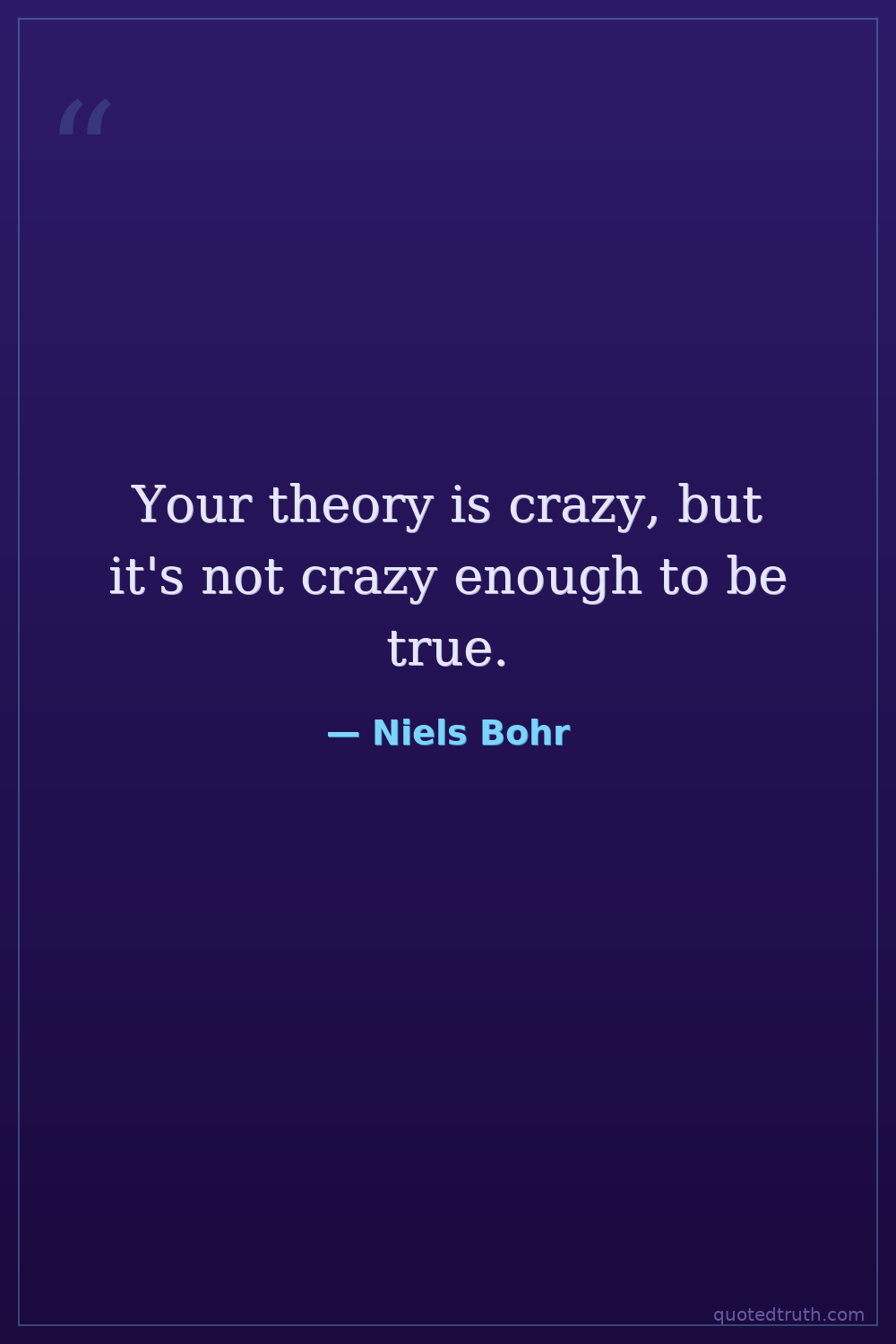
Niels Bohr — "Your theory is crazy, but it's not crazy enough to be true."
Your theory is crazy, but it's not crazy enough to be true.
Your theory is crazy, but it's not crazy enough to be true.
Click any product to generate a realistic preview. Up to 3 at a time.
* Initial load can take up to 90 seconds — revising the preview in another color is nearly instant.
"Physics is not about how the world is, it is about what we can say about the world."
"The great lesson of quantum theory is that there is no deep reality."
"Physics is an attempt to describe the world, and it is impossible to describe the world without describing ourselves."
"It is a great pity that human beings cannot find all of their satisfaction in scientific contemplativeness."
"The purpose of science is not to answer ultimate questions, but to make progress in understanding."
Found in 3 providers: deepseek,gemini,grok
3 sources checked
A genuine revolutionary idea must seem not just unconventional but profoundly, unsettlingly strange—because reality at its deepest level is stranger than ordinary imagination allows. If a new theory merely offends common sense, it probably hasn't broken far enough from old frameworks. True breakthroughs require abandoning assumptions so fundamental that the resulting picture strikes even open-minded experts as almost incomprehensible at first encounter.
Bohr spent decades defending ideas that defied classical intuition—electrons jumping orbits without traversing intervening space, measurement disturbing the measured, probability replacing certainty. He championed complementarity and battled Einstein repeatedly over quantum indeterminacy. Having personally crossed the threshold from classical to quantum physics, he knew viscerally that the theories that reshaped physics weren't merely odd; they required abandoning causality itself, something far beyond ordinary scientific heresy.
Early-to-mid twentieth century physics was convulsing. Relativity had already shattered Newtonian absolutes, then quantum mechanics dissolved determinism entirely. Bohr's Copenhagen Institute became ground zero for debates where leading physicists genuinely struggled to accept their own mathematical results. Against this backdrop—where correct theories routinely contradicted every physical intuition built over centuries—Bohr's standard for 'crazy enough' reflected hard-won collective experience that nature's deep structure consistently exceeded human imaginative comfort zones.
AI-generated insights based on extensive research and information for context. Factual errors? Email [email protected].
Your cart is empty