What it means
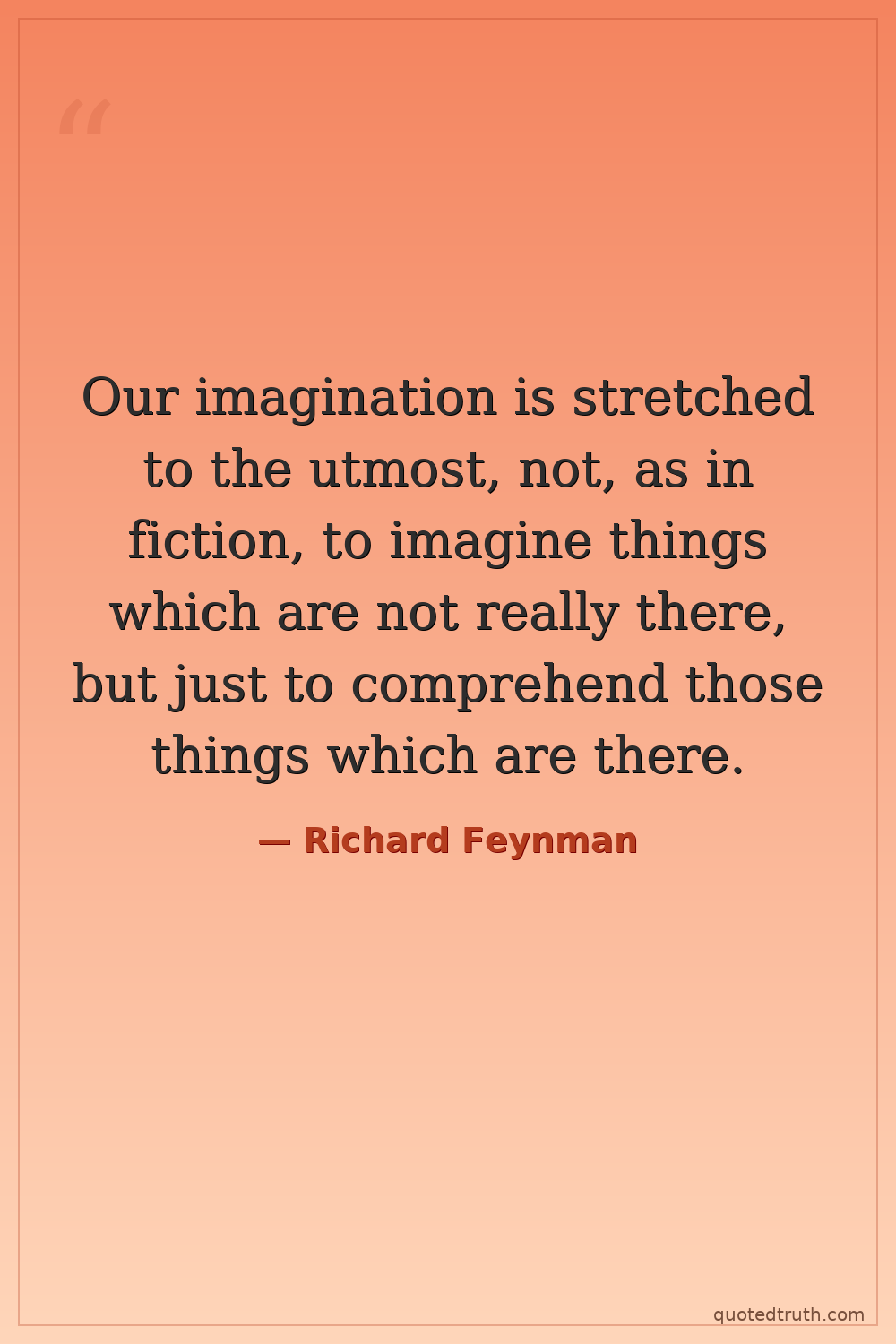
Reality is stranger and more demanding than anything fiction invents. True comprehension requires pushing imagination to its limits—not to conjure fantasy, but to genuinely grasp what actually exists in the universe. Understanding real phenomena, from subatomic particles to cosmic scales, taxes the mind far more than storytelling ever could. The challenge isn't inventing the impossible; it's truly grasping the genuinely real.
Relevance to Richard Feynman
Feynman spent his career making quantum electrodynamics—where electrons interact via virtual photons and probability clouds replace definite positions—intuitively accessible. He famously insisted nobody truly 'understands' quantum mechanics; it must be visualized through Feynman diagrams precisely because reality defies classical intuition. His Caltech lectures and popular books reflect this lifelong drive to stretch comprehension toward nature's actual, bewildering structure.
The era
Feynman worked during physics' golden era (1940s–1980s), when quantum mechanics, nuclear physics, and particle accelerators revealed a subatomic world utterly alien to human-scale experience. The Cold War arms race, Manhattan Project legacy, and space race made scientific imagination politically urgent. As television and science fiction boomed, Feynman's point was pointed: real physics—quarks, renormalization, path integrals—outpaced fiction's wildest inventions.
AI-generated insights based on extensive research and information for context. Factual errors? Email [email protected].