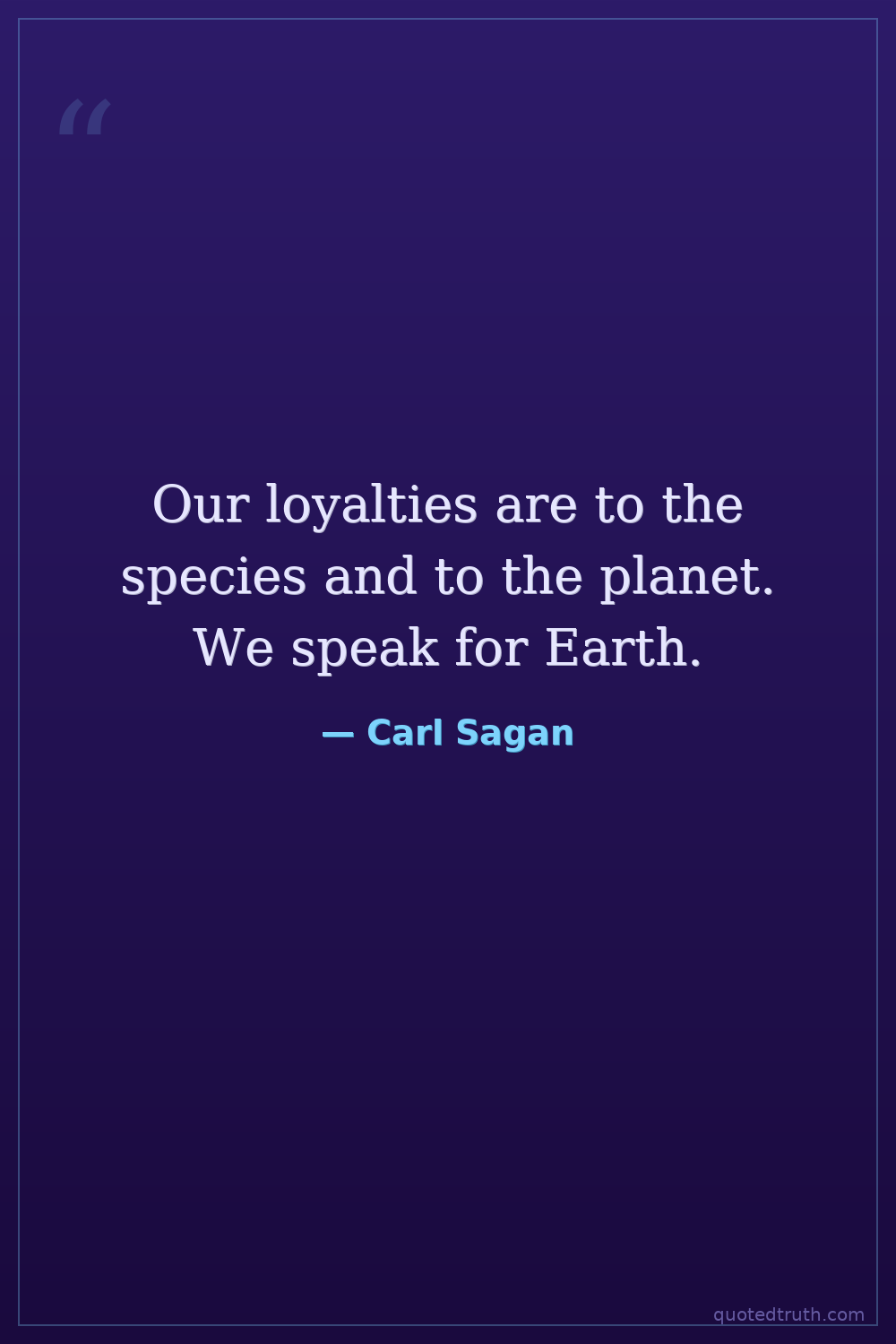
Carl Sagan — "Our loyalties are to the species and to the planet. We speak for Earth."
Our loyalties are to the species and to the planet. We speak for Earth.
Our loyalties are to the species and to the planet. We speak for Earth.
Click any product to generate a realistic preview. Up to 3 at a time.
* Initial load can take up to 90 seconds — revising the preview in another color is nearly instant.
"What an astonishing thing a book is. It's a flat object made of trees, with flexible parts on which are imprinted many curious squiggles. But one glance at it and you're inside the mind of another hum…"
"The beauty of a living thing is not the atoms that go into it, but the way those atoms are put together."
"The cosmos is all that is or ever was or ever will be. Our feeblest contemplations of the Cosmos stir up a tingling sensation, a slight challenge for the nerves, a faint foreboding, as if we were appr…"
"A book is made of paper, ink, and a little imagination."
"The total number of stars in the Universe is larger than all the grains of sand on all the beaches of the planet Earth."
Found in 1 providers: grok
1 source checked
We owe our deepest allegiance not to any nation, religion, or ideology, but to humanity as a whole and to the planet we share. Scientists — and ideally everyone — carry an obligation to advocate for Earth's welfare above tribal loyalties. Understanding the cosmos makes every human conflict seem small against our shared fate on this one fragile world.
Sagan spent his career dissolving borders that divide humanity. He co-designed the Voyager Golden Record (1977) as a message from all Earth's people to the cosmos. His Cosmos series (1980) framed humans as kin across all nations. He campaigned against nuclear weapons as a planetary existential threat. His 'Pale Blue Dot' meditation on the 1990 Voyager image made the identical argument visually: Earth is the only home we have.
The quote emerged during the Cold War, when nuclear-armed ideological blocs and nationalist tribalism threatened civilizational survival. The Space Age simultaneously offered a corrective perspective — Apollo's 'Earthrise' photo (1968) showed Earth as one fragile sphere. Environmentalism was rising through the 1970s–80s, with acid rain and ozone depletion making planetary stewardship urgent. Sagan saw science as the antidote to the parochialism tearing the world apart.
AI-generated insights based on extensive research and information for context. Factual errors? Email [email protected].
Your cart is empty