What it means
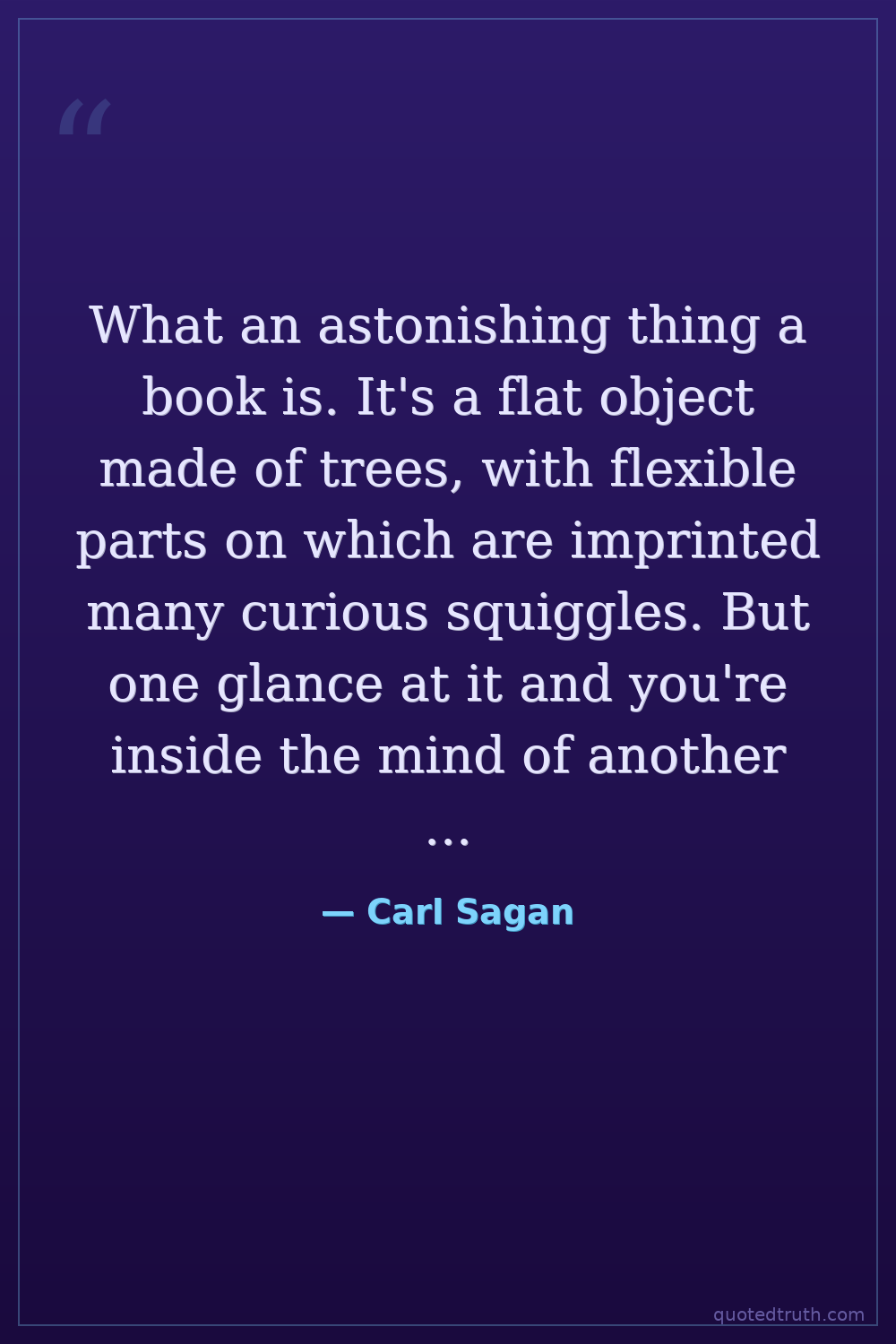
A book is physically mundane — flattened wood pulp covered in abstract marks — yet it performs something almost miraculous: it collapses the distance between two minds across any span of time or space. Those squiggles carry the full interior world of another conscious being directly into yours, making reading one of humanity's most profound acts of connection and empathy.
Relevance to Carl Sagan
Sagan spent his career bridging the cosmos and the human mind, believing science was ultimately about wonder and connection. As author of Cosmos, Contact, and Pale Blue Dot, he understood books as civilizational memory. His famous 'library of Alexandria' lament in Cosmos revealed how deeply he valued written knowledge as humanity's cumulative inheritance against the darkness of ignorance.
The era
Sagan delivered this in Cosmos: A Personal Voyage (1980) amid an early television age that many feared was displacing reading culture. The Cold War made information control a geopolitical weapon, while literacy rates globally remained uneven. His championing of books as democratic mind-bridges carried real urgency when access to knowledge — and the freedom to pursue it — was far from guaranteed.
AI-generated insights based on extensive research and information for context. Factual errors? Email [email protected].