Dalai Lama (14th) — "Our prime purpose in this life is to help others. And if you can't help them, at…"
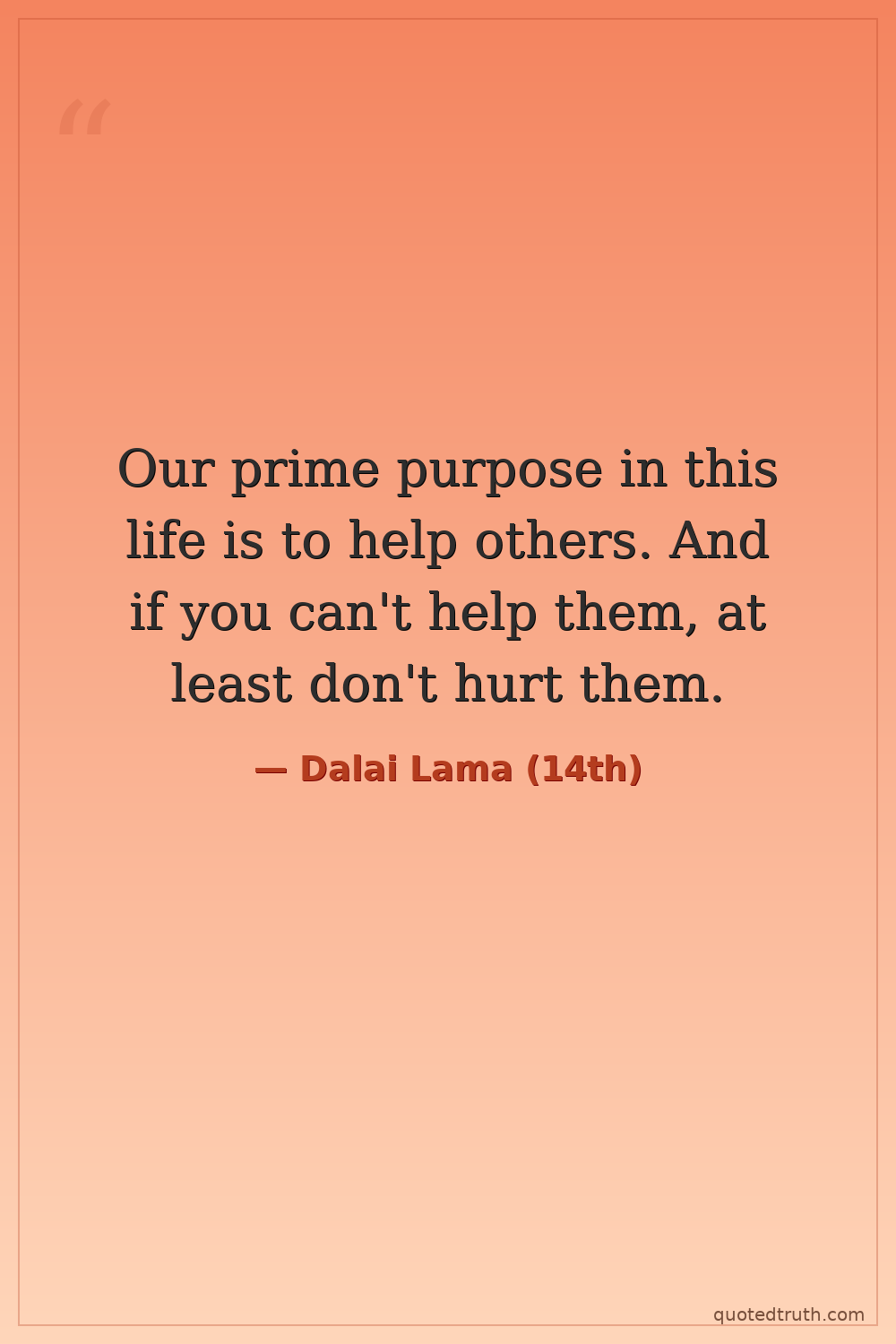
Our prime purpose in this life is to help others. And if you can't help them, at least don't hurt them.
Our prime purpose in this life is to help others. And if you can't help them, at least don't hurt them.
Click any product to generate a realistic preview. Up to 3 at a time.
* Initial load can take up to 90 seconds — revising the preview in another color is nearly instant.
"We need to understand that inner peace is the key to world peace."
"I am a simple Buddhist monk, nothing more. But I try my best to serve humanity."
"Sometimes I feel very sad when I see so much suffering in the world. But then I remember that I have a responsibility to help."
"If you want others to be happy, practice compassion. If you want to be happy, practice compassion."
"The purpose of our lives is to be happy."
Found in 1 providers: grok
1 source checked
Life's core purpose, this quote argues, is serving others — and when you can't actively improve someone's situation, the floor is simple: do no harm. It dismantles self-interest as a default life orientation. The two-tier structure — help first, then at minimum harmlessness — makes ethics practical and graduated, accessible to anyone regardless of resources or power. Compassion isn't optional; avoiding cruelty is the non-negotiable baseline.
Tenzin Gyatso was recognized as the 14th Dalai Lama at age two and exiled from Tibet in 1959 after China's military crackdown. Despite overseeing his people's occupation for over six decades, he consistently refused to endorse violence or hatred toward China. His 1989 Nobel Peace Prize honored that stance. The quote reflects his Bodhisattva commitment — the Buddhist vow to dedicate every lifetime to reducing the suffering of all sentient beings.
The 14th Dalai Lama came of age during the Cold War, China's Cultural Revolution — which destroyed thousands of Tibetan monasteries — and nuclear-era existential anxiety. Later decades brought 9/11, rising authoritarianism, and polarized social media cultures that reward outrage over empathy. Against that backdrop, a spiritual leader advocating minimum-harm ethics as a universal floor — not merely a Buddhist ideal — carried particular weight precisely because the era kept demonstrating what happens without it.
AI-generated insights based on extensive research and information for context. Factual errors? Email [email protected].
Your cart is empty