What it means
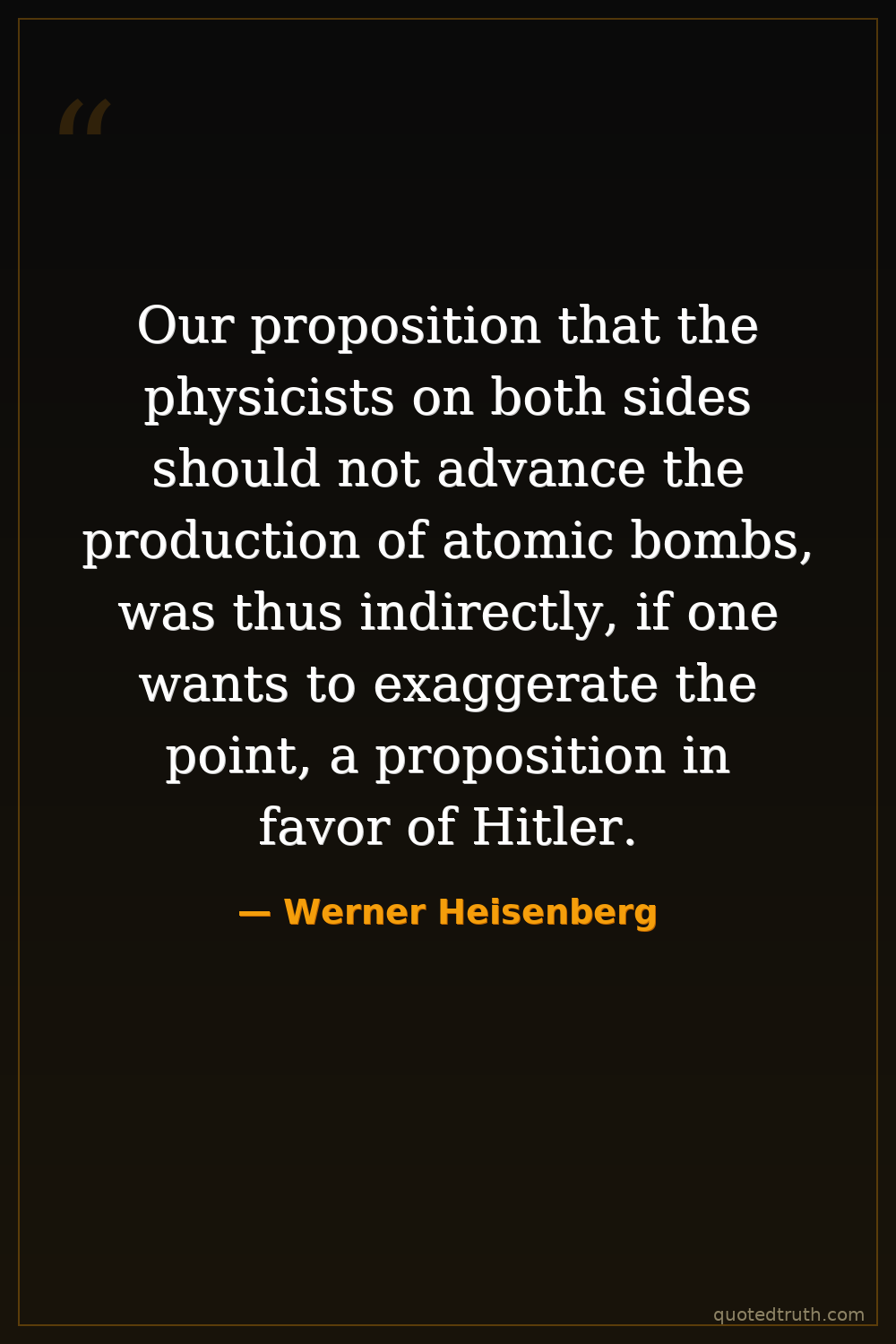
Heisenberg admits a painful irony: if scientists on both sides had agreed to halt atomic bomb research, the side already holding power at that moment would have kept its advantage. A mutual freeze sounds morally clean, but in wartime it effectively preserves the status quo. Refusing to build a weapon is not neutral when your enemy is a dictator; restraint by both camps helps whoever is currently winning.
Relevance to Werner Heisenberg
Heisenberg led Nazi Germany's nuclear program and spent decades defending his role, claiming he deliberately slowed the project. This quote shows his tortured postwar reasoning: the physicist who formulated uncertainty wrestled with moral uncertainty too. His 1941 Copenhagen meeting with Bohr, his internment at Farm Hall, and his self-justifying memoirs all circle this same dilemma—whether scientific restraint served conscience or, inadvertently, tyranny.
The era
Heisenberg lived through Weimar collapse, Nazi rule, WWII, and the Cold War's nuclear shadow. Physicists worldwide faced an unprecedented question: should they build weapons capable of erasing cities? The Manhattan Project succeeded; the German Uranverein did not. After Hiroshima, scientists like Oppenheimer, Bohr, and Heisenberg publicly reckoned with their complicity, launching debates about arms control, Pugwash conferences, and the moral responsibility of researchers that still shape science policy today.
AI-generated insights based on extensive research and information for context. Factual errors? Email [email protected].