What it means
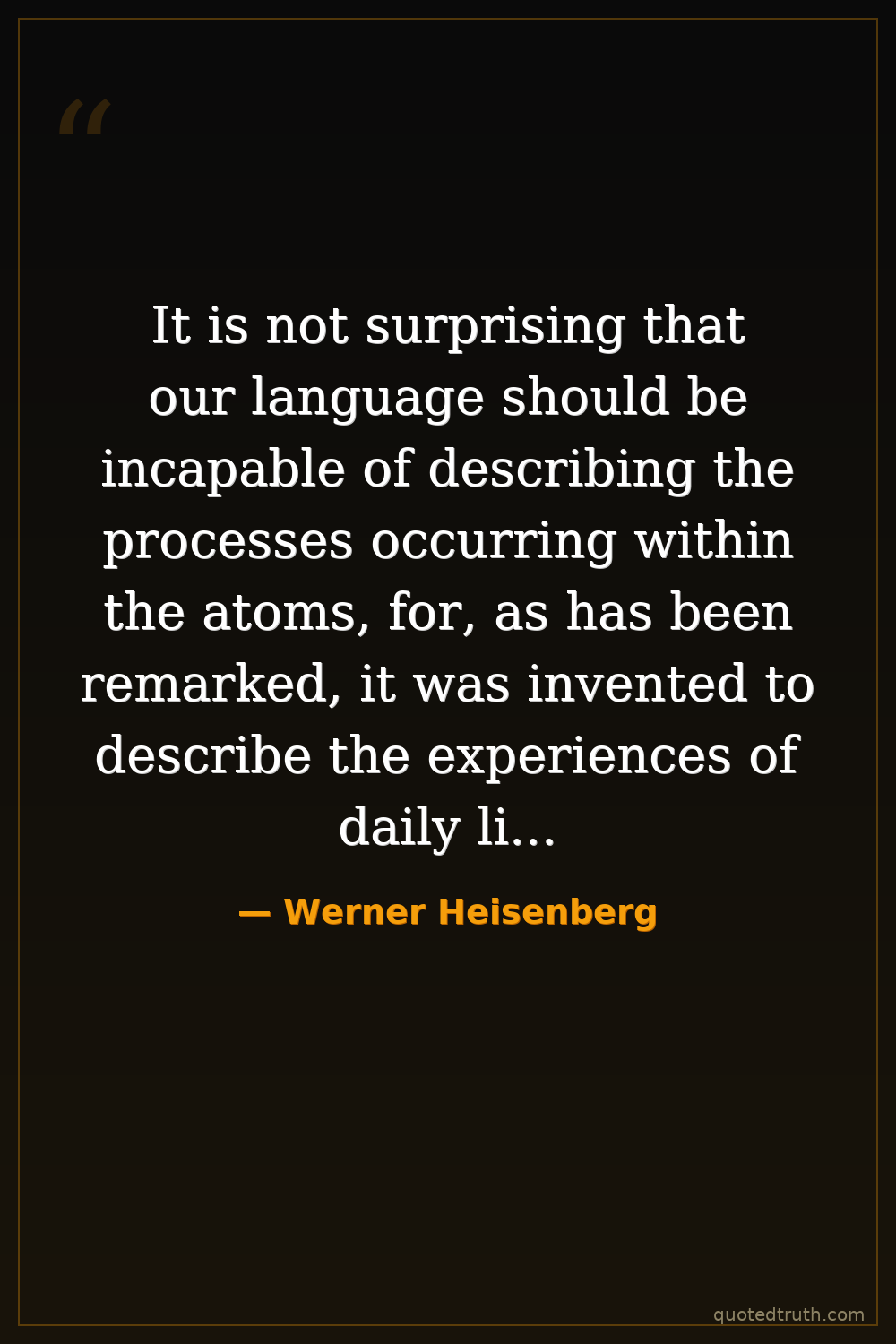
Everyday language evolved to handle the visible, macroscopic world—tables, trees, weather—where trillions of atoms average out into smooth, predictable behavior. When we try to use those same words to talk about what single atoms or electrons do, the vocabulary simply breaks down. The subatomic realm obeys rules our words were never shaped to capture, so any description of it will feel strange, paradoxical, or incomplete by ordinary standards.
Relevance to Werner Heisenberg
Heisenberg founded matrix mechanics and formulated the uncertainty principle, which revealed that particles cannot be pinned down with classical precision. He wrestled constantly with how to communicate quantum reality, eventually insisting that classical concepts like position and path fail at atomic scales. This remark captures his lifelong concern: physics had outrun ordinary speech, forcing scientists to rely on mathematics and accept that intuitive pictures of reality could mislead rather than clarify.
The era
In the 1920s and 1930s, quantum mechanics shattered the Newtonian worldview that had reigned for centuries. Heisenberg, Bohr, Schrodinger, and Born were rebuilding physics from scratch, producing results that defied common sense—wave-particle duality, probability clouds, indeterminacy. Philosophers and physicists alike debated whether human language and logic could even handle the new reality, making Heisenberg's comment a central concern of the scientific revolution reshaping modern thought.
AI-generated insights based on extensive research and information for context. Factual errors? Email [email protected].