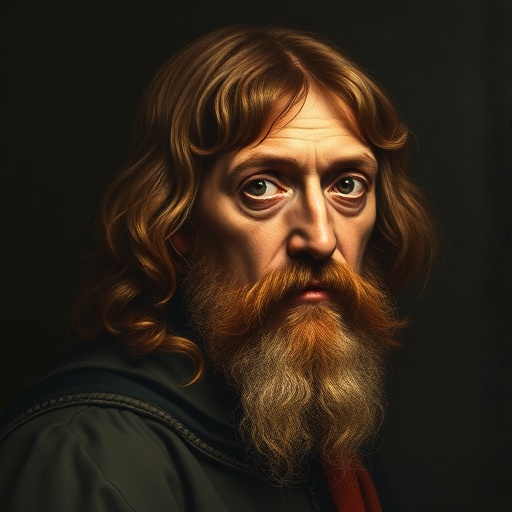
Nicolaus Copernicus — "It is not incredible that the earth moves, but that it stands still, that is inc…"
It is not incredible that the earth moves, but that it stands still, that is incredible.
It is not incredible that the earth moves, but that it stands still, that is incredible.
Click any product to generate a realistic preview. Up to 3 at a time.
* Initial load can take up to 90 seconds — revising the preview in another color is nearly instant.
"Therefore, I think that the earth is not the center of the universe, but rather the sun."
"The universe is a spherical whole, and of all possible forms, the sphere is the most perfect."
"Having thus assumed the motions which I ascribe to the earth, I have, after long and careful investigation, finally discovered that, if the motions of the other planets be related to the revolution of…"
"The world is spherical; whether it is finite or infinite is an open question."
"Finally we shall place the Sun himself at the center of the Universe."
Attributed, but direct quote in his writings is difficult to confirm.
Date: 16th Century (approx.)
Nature & WorldFound in 1 providers: grok
1 source checked
Most people assume the Earth stands still because we feel no motion beneath our feet. Copernicus inverts this intuition: a vast cosmos rotating daily around one small, stationary Earth requires far more explanation than the Earth simply moving through space. What feels obvious — stillness — is actually the harder claim to defend. He challenges readers to distrust everyday sensation when evidence and reason point toward a different and more elegant physical reality.
Copernicus spent decades developing his heliocentric model, publishing De Revolutionibus Orbium Coelestium in 1543, the year he died. As a Polish canon and mathematician, he understood the institutional risks of contradicting Ptolemaic cosmology. This quote captures his intellectual strategy: reframing Earth's motion not as wild speculation but as the rational conclusion, and geocentrism as the truly extraordinary claim needing justification. His life's work was this precise reversal of astronomical orthodoxy.
In the early 16th century, Ptolemaic geocentrism — Earth fixed at the universe's center — was both Church doctrine and scientific consensus, underpinning calendar systems and theology alike. The Renaissance had begun questioning ancient authorities, but overturning Aristotle on cosmology carried real danger. Catholic-Protestant tensions made cosmological claims politically charged. Copernicus was so aware of this that he delayed publication for years, dedicating the work to Pope Paul III hoping to soften the blow.
AI-generated insights based on extensive research and information for context. Factual errors? Email [email protected].
Your cart is empty