What it means
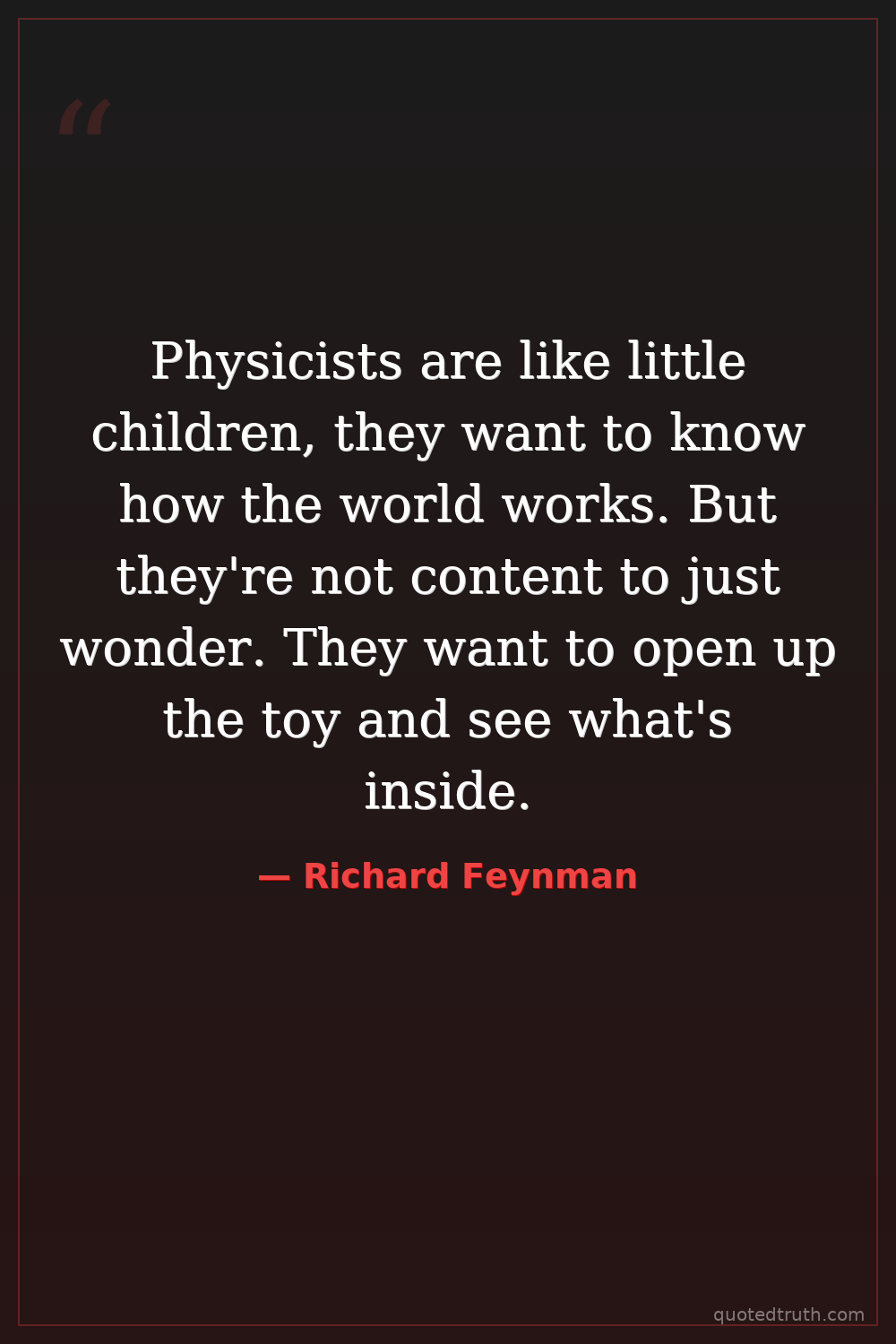
Scientists driven by curiosity don't settle for surface-level wonder — they dig into mechanisms, demand actual explanations, and won't rest until they understand the underlying machinery of reality. Childlike curiosity is the starting point, but the scientific drive compels you past admiration into investigation, dismantling things to expose how they truly function rather than accepting appearances at face value.
Relevance to Richard Feynman
Feynman was legendary for this exact quality — he taught himself to crack safes, rebuilt radios as a kid, and famously demonstrated the Challenger disaster cause by simply dropping an O-ring into ice water. His Caltech lectures rejected rote formulas, insisting students understand the deep 'why.' Quantum electrodynamics itself required dismantling classical physics assumptions entirely to reveal the probabilistic machinery underneath.
The era
Feynman worked during the postwar golden age of physics (1940s–1980s), when the atom had just been split, the Standard Model was being assembled, and scientists genuinely believed fundamental laws were discoverable within a generation. Cold War competition accelerated government funding for basic research, creating a culture where deep curiosity was institutionally rewarded and physicists were cultural heroes pursuing ultimate truths about nature.
AI-generated insights based on extensive research and information for context. Factual errors? Email [email protected].