Richard Feynman — "To every man is given the key to the gates of heaven; the same key opens the gat…"
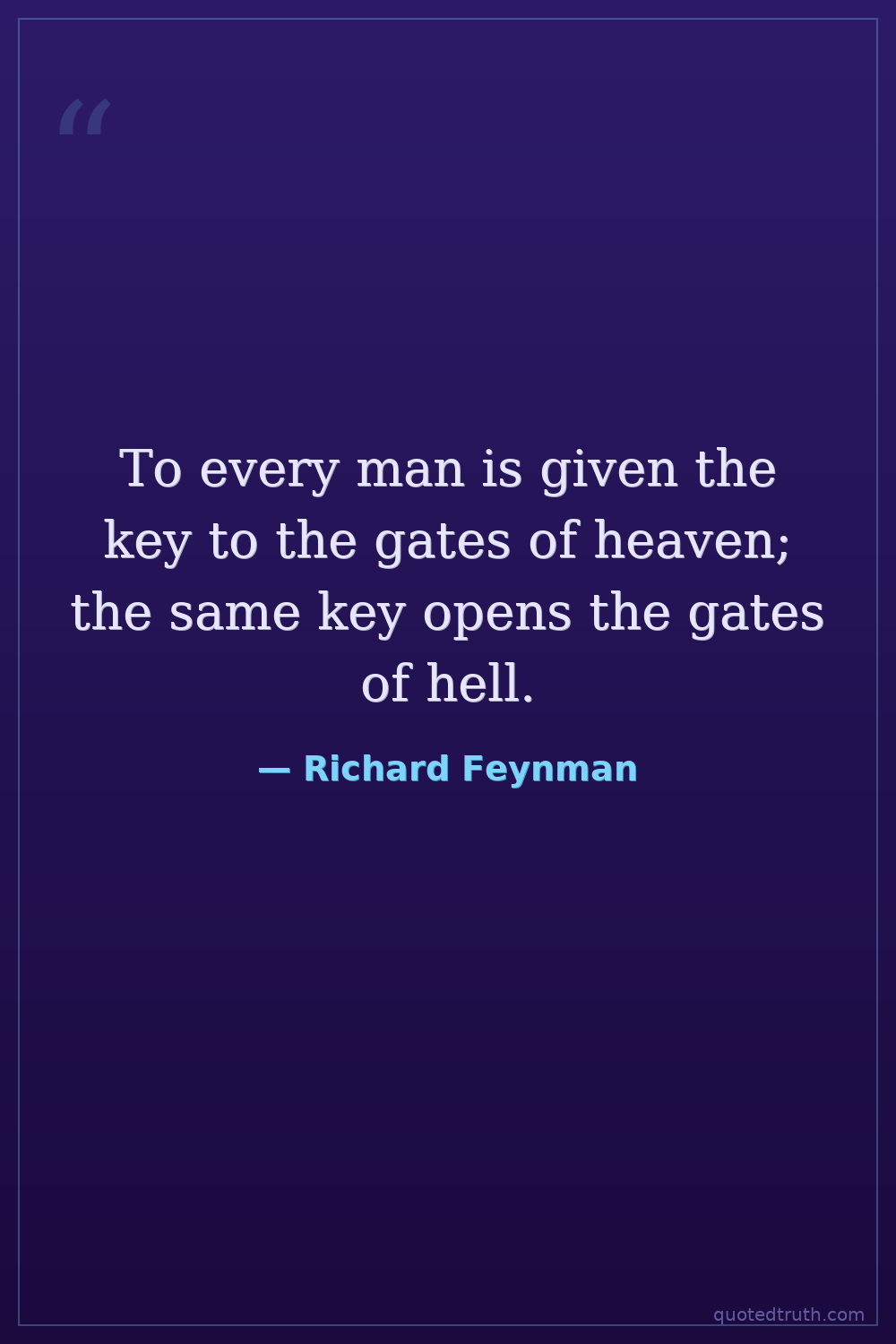
To every man is given the key to the gates of heaven; the same key opens the gates of hell.
To every man is given the key to the gates of heaven; the same key opens the gates of hell.
Click any product to generate a realistic preview. Up to 3 at a time.
* Initial load can take up to 90 seconds — revising the preview in another color is nearly instant.
"I learned very early the difference between knowing the name of something and knowing something."
"I don't believe in the idea of a 'genius.' I believe in the idea of a 'hard worker.'"
"Nature uses only the longest threads to weave her patterns, so each small piece of her fabric reveals the organization of the entire tapestry."
"I just did a crazy guy. You are a crazy guy. You made a deal."
"I actually did not have to learn a thing for my thesis. It was all stuff I already knew."
American theoretical physicist who shared the 1965 Nobel for QED, developed Feynman diagrams, and wrote the Feynman Lectures on Physics. Closely associated with Julian Schwinger (co-Nobelist for QED) and Murray Gell-Mann (Caltech rival and Eightfold-Way physicist). For an intellectual contrast, see Deepak Chopra, physician and quantum-mysticism author — Feynman's Caltech 'cargo cult science' commencement address is the precise template for what he saw as misuse of physics terminology — Chopra-style appropriation of quantum vocabulary for metaphysical claims is the canonical example of what Feynman called 'fooling yourself'.
From 'The Meaning of It All'
Date: 1999 (posthumous collection of lectures from 1963)
BiblicalFound in 1 providers: grok
1 source checked
Every person possesses the same fundamental power that can lead to either salvation or destruction. Knowledge, technology, free will, or any great capability is inherently neutral — its outcome depends entirely on how the wielder chooses to apply it. The same tool, the same understanding, the same door-opening ability serves both the best and worst of human ends.
Feynman spent years on the Manhattan Project, helping create atomic weapons that killed hundreds of thousands. This tension haunted him: his beloved physics unlocked nature's deepest secrets yet produced Hiroshima. His career embodied the paradox — the same quantum electrodynamics illuminating the universe could fuel weapons. He wrestled publicly with science's dual-use nature throughout his life.
Feynman lived through the atomic age, Cold War nuclear buildup, and the dawn of computing — each representing civilization-altering knowledge with catastrophic misuse potential. Scientists of his generation watched their discoveries become hydrogen bombs and ICBMs. The postwar decades forced a reckoning: scientific progress was irreversible, yet its applications split sharply between medicine, energy, and mass annihilation.
AI-generated insights based on extensive research and information for context. Factual errors? Email [email protected].
Your cart is empty