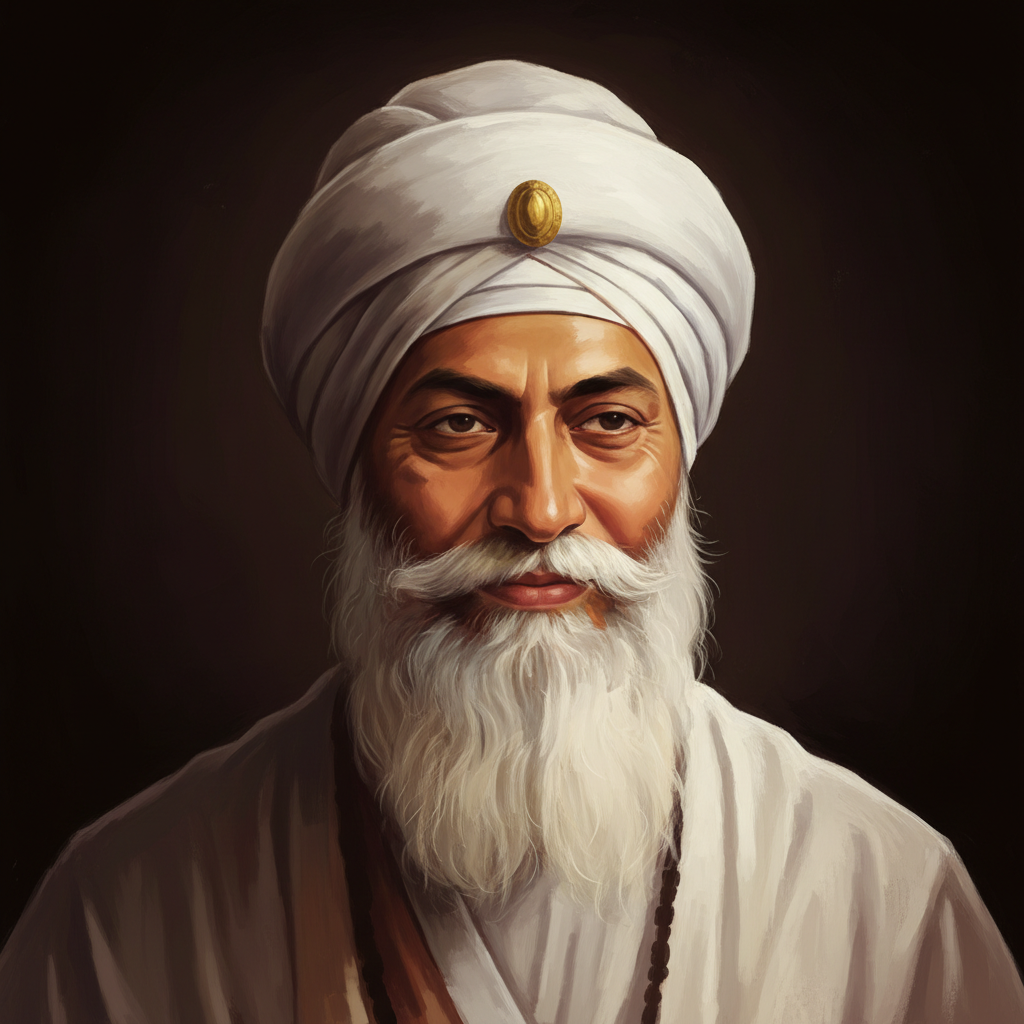
Guru Nanak — "Required prayers alone would be ineffective if those who offered them had their …"
Required prayers alone would be ineffective if those who offered them had their minds on worldly problems, instead of on God.
Required prayers alone would be ineffective if those who offered them had their minds on worldly problems, instead of on God.
Click any product to generate a realistic preview. Up to 3 at a time.
* Initial load can take up to 90 seconds — revising the preview in another color is nearly instant.
"He who considers himself humble, is the highest of all."
"Hindus are getting Spiritually ruined by worshiping their idols all life and the Muslims by bowing their heads towards Mecca (believing that God exists only in Mecca); but both do not understand/reali…"
"Through suffering, one learns to love God."
"To call woman inferior is to condemn humanity."
"He who practices truth, contentment, and kindness, and who is free from ego, he is truly a Brahmin."
Founder of Sikhism and the first of the Ten Sikh Gurus, whose teachings of one universal God and rejection of caste shaped Punjab. Closely associated with Kabir (mystical poet whose verses appear in the Sikh Guru Granth Sahib). For an intellectual contrast, see Brahmanical orthodoxy, the Hindu caste-and-ritual establishment of his era — Sikhism was founded as a deliberate alternative to both Hindu ritual hierarchy and Islamic exclusivism — Nanak's universalism was a structural rejection of caste and priestly mediation.
Found in 1 providers: gemini
1 source checked
Simply reciting prayers out of habit or obligation accomplishes nothing if your attention is somewhere else. If you're mumbling sacred words while mentally scrolling through your bills, grudges, or schedule, the ritual is empty. What matters is genuine focus and inner devotion, not the performance of worship. Going through the motions while chasing worldly concerns cancels out whatever spiritual value the prayer was supposed to carry in the first place.
Guru Nanak founded Sikhism by rejecting ritualism in both Hinduism and Islam, insisting that sincere remembrance of God (Naam Simran) mattered more than ceremonies, pilgrimages, or recitation. He famously traveled across South Asia challenging empty priestly practices, and taught that a householder working honestly with God in mind was holier than a monk mumbling mantras. This saying captures his core doctrine that intention and inner focus define true worship, not external observance.
In early 16th-century Punjab, Guru Nanak lived amid tense Hindu-Muslim coexistence under the emerging Mughal Empire, where both traditions had grown heavy with ritual: Brahmanical rites, caste purity, Islamic formal prayers, and pilgrimages. Ordinary people performed obligations mechanically while priests and mullahs gatekept salvation. Nanak's message landed as radical reform, stripping religion down to sincere devotion and ethical living, and directly confronting the era's obsession with outward observance over inner state.
AI-generated insights based on extensive research and information for context. Factual errors? Email [email protected].
Your cart is empty