Thomas Edison — "Restlessness is discontent and discontent is the first necessity of progress. Sh…"
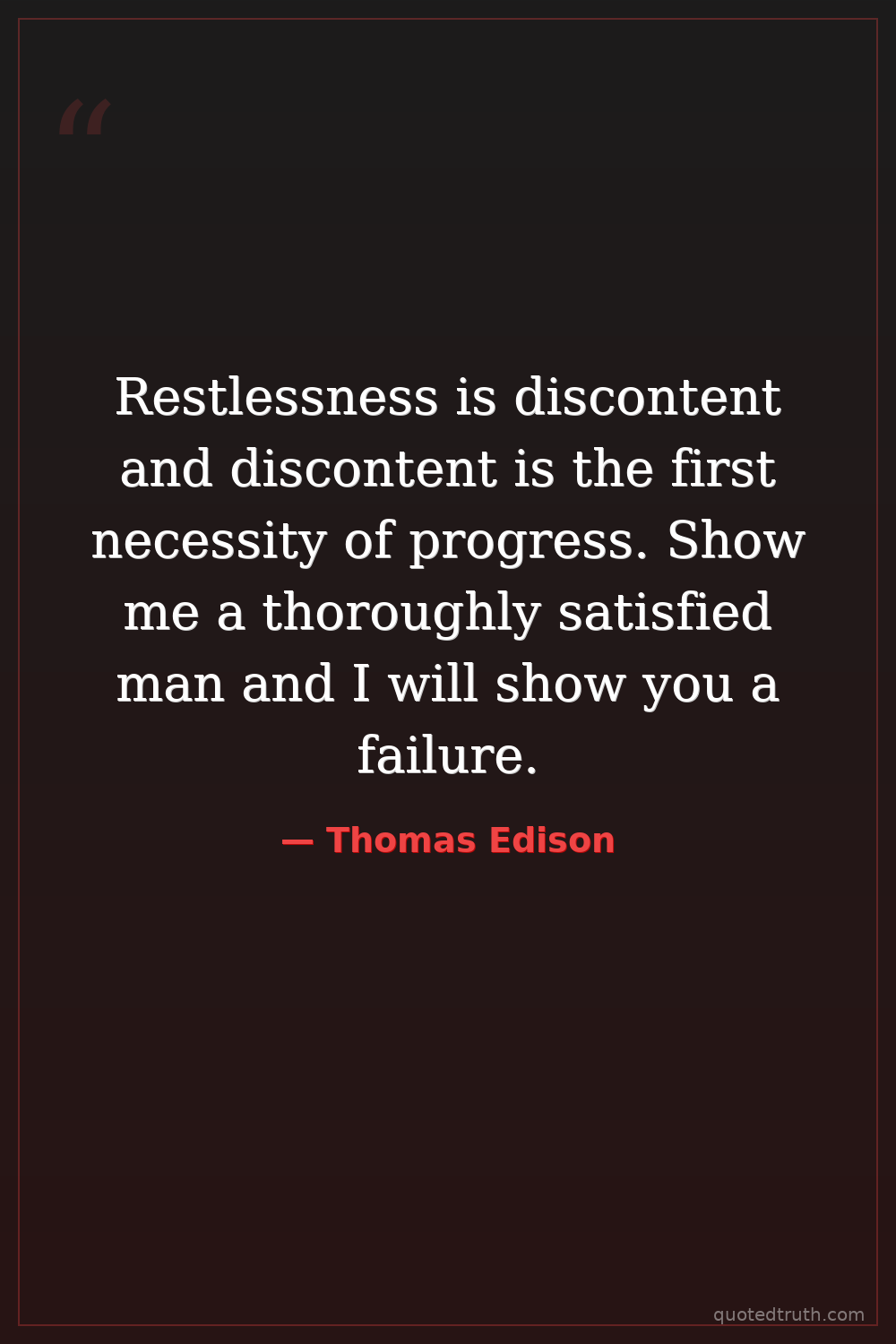
Restlessness is discontent and discontent is the first necessity of progress. Show me a thoroughly satisfied man and I will show you a failure.
Restlessness is discontent and discontent is the first necessity of progress. Show me a thoroughly satisfied man and I will show you a failure.
Click any product to generate a realistic preview. Up to 3 at a time.
* Initial load can take up to 90 seconds — revising the preview in another color is nearly instant.
"It is not because things are difficult that we do not dare; it is because we do not dare that they are difficult."
"Non-violence leads to the highest ethics, which is the goal of all evolution. Until we stop harming all other living beings, we are still savages."
"The chief function of the body is to carry the brain around."
"I have never seen a man who was afraid of a woman. I have seen men who were afraid of women's tongues. I have seen men who were afraid of women's brains. I have seen men who were afraid of women's str…"
"I have no respect for the man who says he is too busy to read. He is too busy to live."
Found in 1 providers: grok
1 source checked
Being unsatisfied with how things are is what drives people to improve them. If you're perfectly content, you have no reason to build, fix, or create anything new. That itch of dissatisfaction is the engine behind every breakthrough. A person who feels they've arrived and needs nothing more has stopped growing, and in Edison's view, stopping equals failing, no matter how comfortable the stopping point looks.
Edison held 1,093 US patents and famously iterated through thousands of filament materials before landing on carbonized bamboo for the light bulb. He ran Menlo Park as an invention factory, constantly chasing the next problem even after commercial success with the phonograph and electric grid. His refusal to settle, working 18-hour days into his 80s, embodies the restless dissatisfaction he describes here as the fuel for invention.
Edison worked during the Second Industrial Revolution (1870s-1920s), when electricity, telephony, and mass production were remaking daily life. America was transitioning from agrarian to industrial, and the self-made inventor-entrepreneur became a cultural hero. Gilded Age optimism about progress through technology was at its peak, and figures like Edison, Tesla, and Ford were framing discontent with the status quo as a virtue, not a vice, fueling the startup-style innovation culture of the era.
AI-generated insights based on extensive research and information for context. Factual errors? Email [email protected].
Your cart is empty