What it means
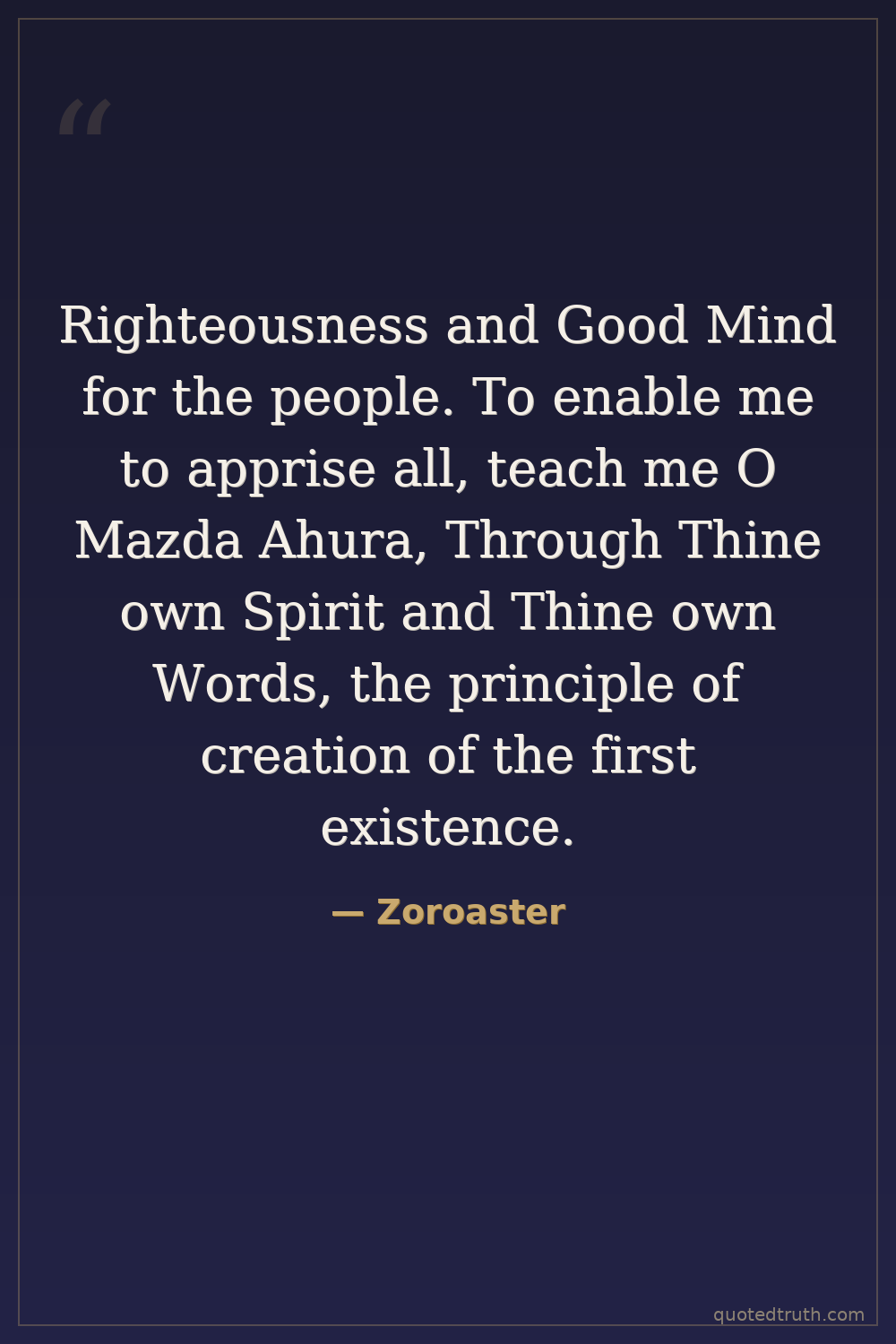
The speaker prays for righteousness and a good, clear mind to benefit ordinary people. He asks the supreme god to personally instruct him, through divine spirit and sacred speech, about how existence itself began and what principle underlies creation. The request is both moral and intellectual: he wants to live rightly, understand origins, and then share that understanding with everyone around him rather than hoard it.
Relevance to Zoroaster
Zoroaster presented himself as a prophet in direct dialogue with Ahura Mazda, and this exact pleading voice defines his Gathas, the hymns scholars credit to him personally. His core doctrine paired Asha (righteousness) with Vohu Manah (Good Mind) as twin paths to the divine, and he saw himself as a teacher commissioned to spread that ethic. Asking to be taught so he can 'apprise all' matches his missionary role perfectly.
The era
Zoroaster lived in ancient eastern Iran, likely between 1500 and 1000 BCE, amid polytheistic Indo-Iranian tribes worshipping many daevas through animal sacrifice and ritual intoxication. Society was pastoral, violent, and clan-based. His monotheistic focus on one wise creator, ethical dualism, and personal moral accountability was radical, challenging the priestly establishment. Questions about cosmic origins were the domain of competing oral traditions, so petitioning the god directly for creation's principle was a bold theological move.
AI-generated insights based on extensive research and information for context. Factual errors? Email [email protected].