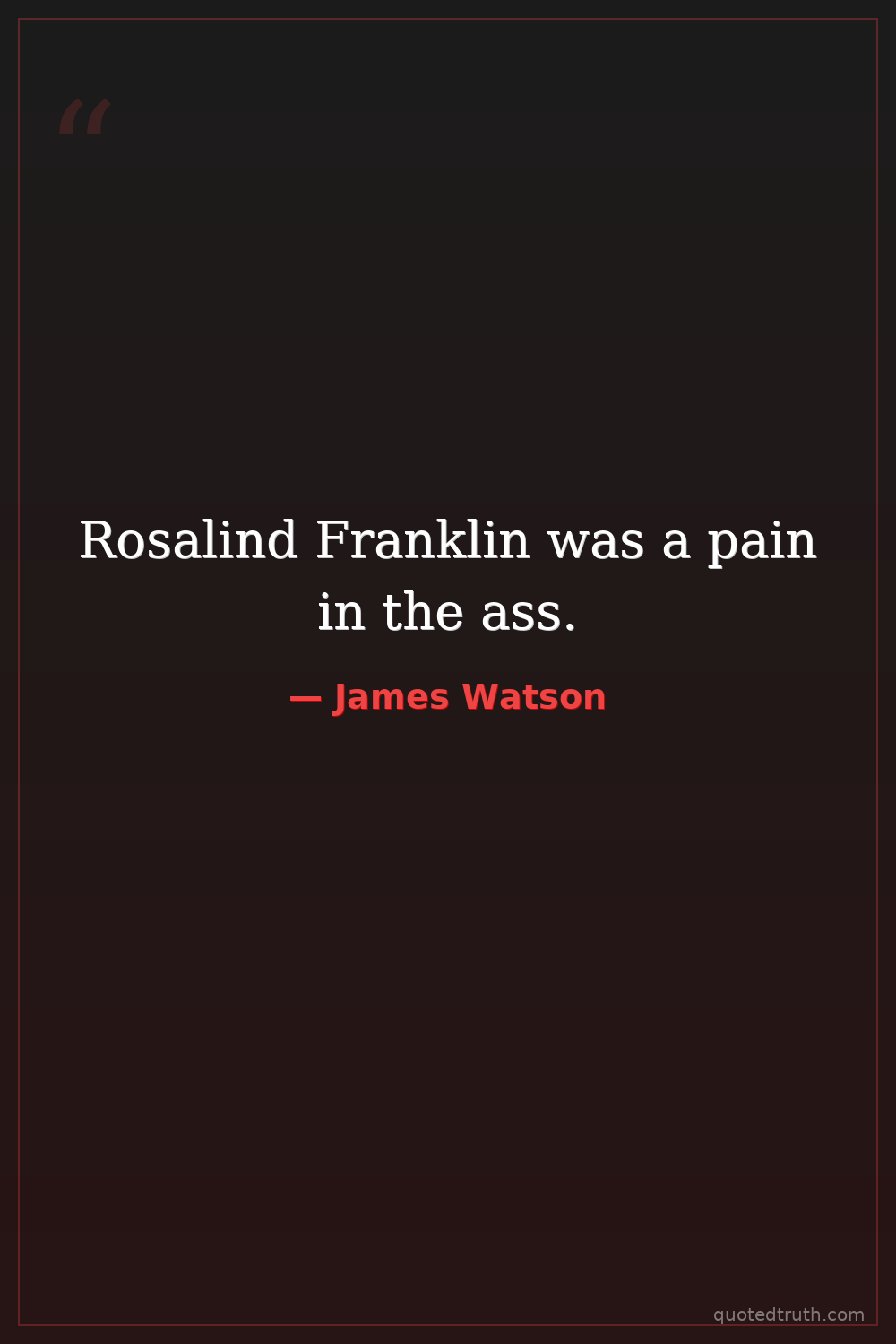
James Watson — "Rosalind Franklin was a pain in the ass."
Rosalind Franklin was a pain in the ass.
Rosalind Franklin was a pain in the ass.
Click any product to generate a realistic preview. Up to 3 at a time.
* Initial load can take up to 90 seconds — revising the preview in another color is nearly instant.
"I think it's a mistake to try and make everyone equal."
"The gene for stupidity will be found within 10 years."
"If you're not offending someone, you're probably not saying anything interesting."
"All our social policies are based on the fact that their intelligence is the same as ours — whereas all the testing says not really."
"I'm not afraid to speak my mind."
Found in 1 providers: grok
1 source checked
A powerful person dismissing a brilliant colleague as merely annoying — reducing her entire existence to a personality complaint. In modern terms, it's the classic move of characterizing a woman who demanded respect and credit as "difficult," erasing her intellectual contributions entirely. It expresses contempt dressed as casual frustration, the kind of remark that reveals more about the speaker's insecurity than the target's actual character.
Watson and Crick used Franklin's X-ray crystallography image (Photo 51) — obtained without her knowledge — to confirm DNA's double helix, winning the 1962 Nobel Prize she never shared. His memoir "The Double Helix" (1968) portrayed her as cold and unfeminine. This quote typifies Watson's lifelong pattern of dismissing those he wronged; he later made widely condemned statements about race and intelligence, eventually losing his honorary titles at Cold Spring Harbor Laboratory.
In 1950s Britain, women scientists faced institutionalized exclusion — Franklin was barred from King's College's faculty common room. The race to decode DNA was fiercely competitive across Cambridge, King's College, and Caltech. Post-war science mythologized lone male genius and routinely denied credit to women collaborators. The Nobel Prize was awarded in 1962, four years after Franklin died of cancer at 37, making her permanent exclusion structurally inevitable under the prize's three-person limit.
AI-generated insights based on extensive research and information for context. Factual errors? Email [email protected].
Your cart is empty