Neil deGrasse Tyson — "Science is not a battle between good and evil. It's a battle between ignorance a…"
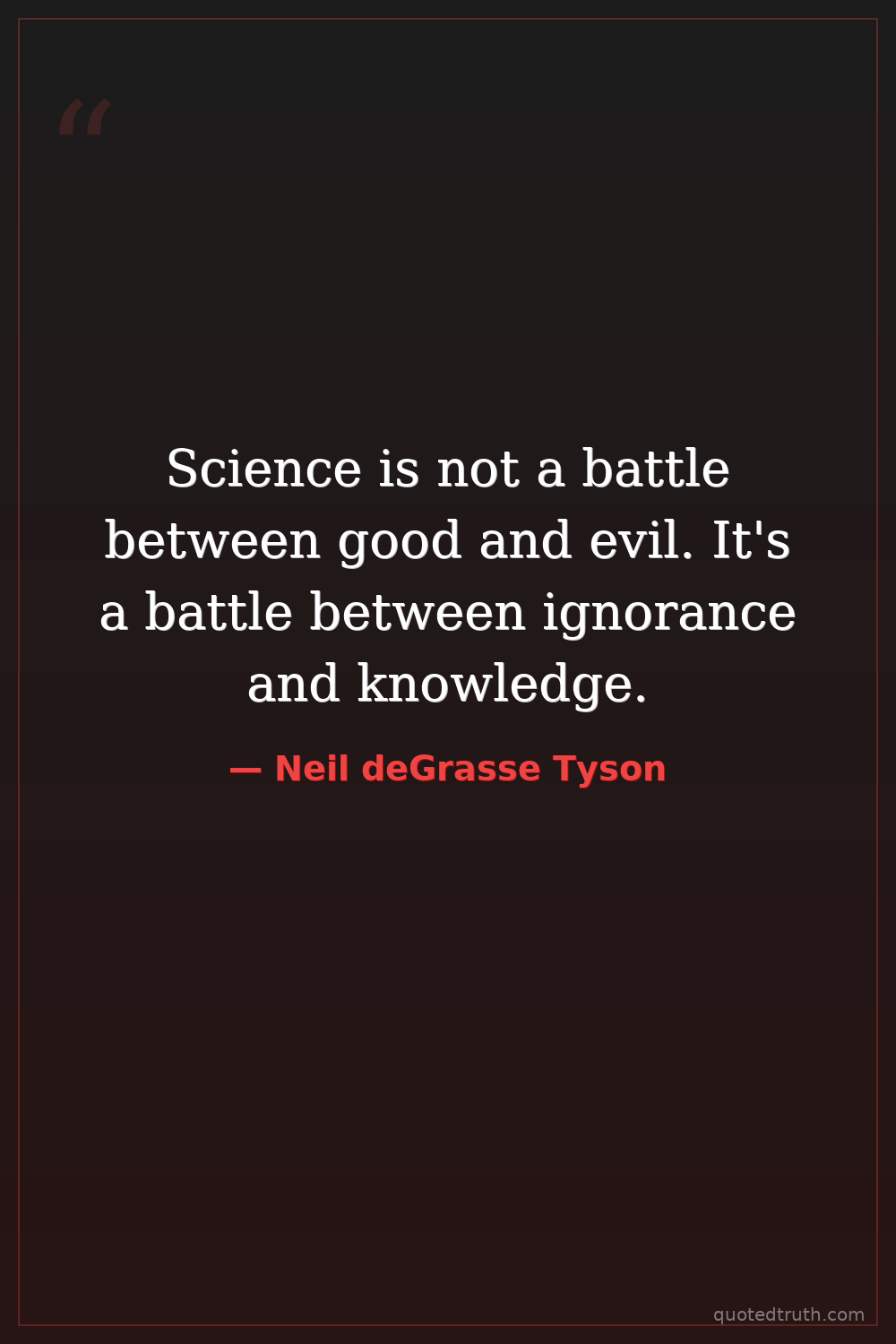
Science is not a battle between good and evil. It's a battle between ignorance and knowledge.
Science is not a battle between good and evil. It's a battle between ignorance and knowledge.
Click any product to generate a realistic preview. Up to 3 at a time.
* Initial load can take up to 90 seconds — revising the preview in another color is nearly instant.
"Intelligent design, as I understand it, means that you have an intelligent designer somewhere. And the problem with that is, if you’re going to invoke an intelligent designer, you have to ask, 'Who de…"
"The universe is a place of wonder. And we are all part of that wonder."
"Earth is a small planet, and we are not alone. We are not alone in the universe, and we are not alone on this planet."
"I don't have a problem with people believing in God. I have a problem with people believing in things that are demonstrably false."
"The universe is expanding, and so should our minds."
American astrophysicist, Hayden Planetarium director, and Cosmos: A Spacetime Odyssey host who carries the Carl Sagan public-science mantle. Closely associated with Bill Nye (fellow science communicator) and Brian Greene (theoretical physicist and string-theory popularizer). For an intellectual contrast, see Ken Ham, founder of Answers in Genesis and the Creation Museum — Ham's career has been organized around defending biblical 6-day creationism — exactly the science-education position Tyson's mainstream-science communication is structured to refute.
Found in 1 providers: grok
1 source checked
Science doesn't divide people into heroes and villains. When someone rejects climate data or vaccine evidence, they aren't evil — they're operating on incomplete information. The real conflict is between what humanity knows and what it doesn't yet understand. Progress happens by closing that knowledge gap through evidence and inquiry, not by demonizing those who disagree. Understanding this distinction keeps scientific debate constructive rather than tribal.
Tyson built his career bridging expert knowledge and public understanding — hosting StarTalk, reviving Cosmos, and writing for general audiences. He consistently avoids condemning science skeptics as morally bankrupt, instead diagnosing the problem as missing education. This mirrors his own origin: a kid from the Bronx who found astrophysics through curiosity, not institutional privilege. His mission is always to illuminate, never to shame those who haven't yet encountered the evidence.
Tyson's active career spans a period of intense science politicization — climate denial became a partisan identity, COVID-19 vaccines triggered mass conspiracy movements, and social media accelerated misinformation faster than institutions could correct it. In this climate, framing scientific disagreement as moral warfare only deepened tribal divisions. Tyson's reframe — ignorance versus knowledge — offered a path that could persuade rather than alienate the unconvinced, urgently needed when public health literally depended on it.
AI-generated insights based on extensive research and information for context. Factual errors? Email [email protected].
Your cart is empty