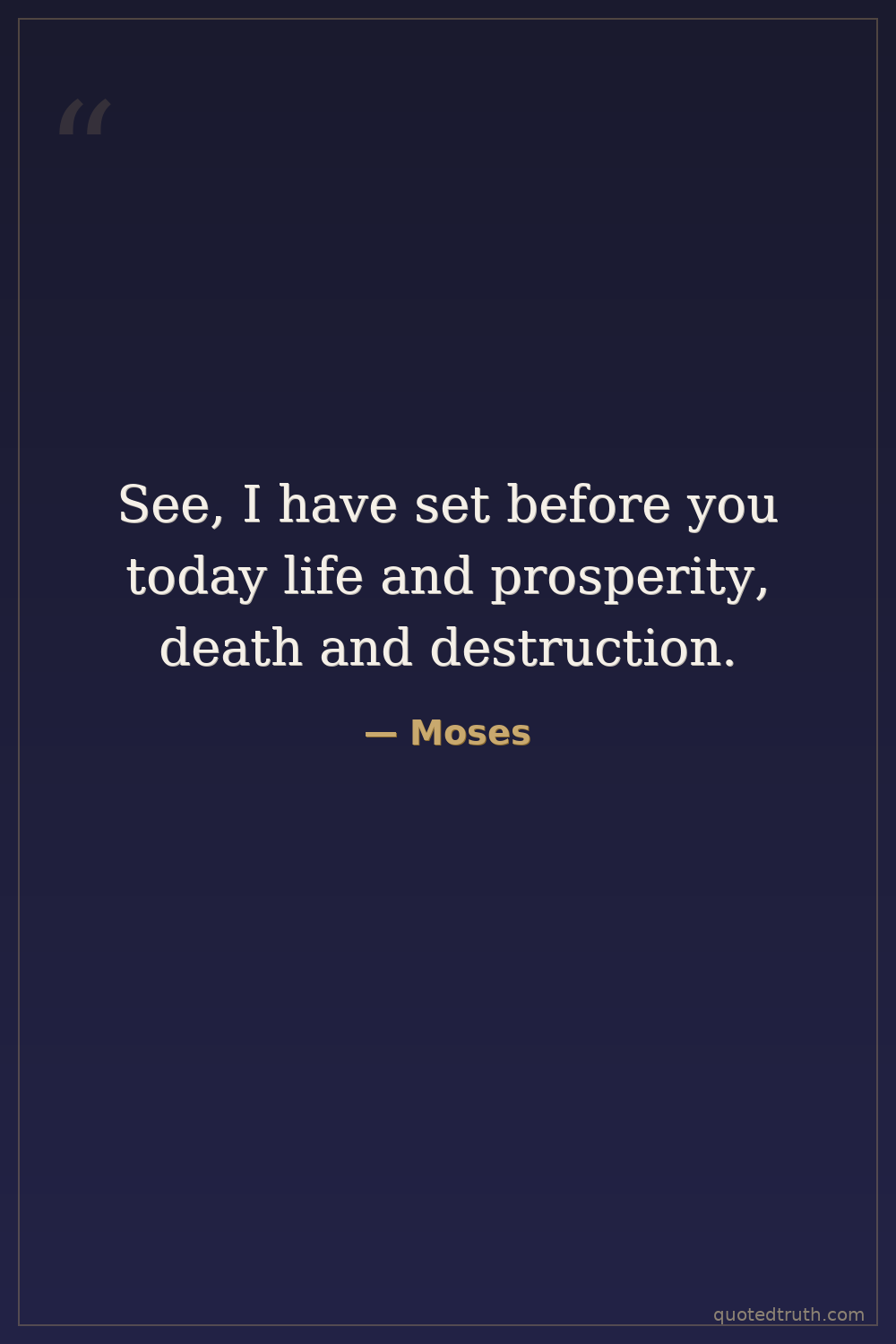
Moses — "See, I have set before you today life and prosperity, death and destruction."
See, I have set before you today life and prosperity, death and destruction.
See, I have set before you today life and prosperity, death and destruction.
Click any product to generate a realistic preview. Up to 3 at a time.
* Initial load can take up to 90 seconds — revising the preview in another color is nearly instant.
"Observe the Sabbath day by keeping it holy, as the Lord your God has commanded you."
"Hear now, ye rebels; must we fetch you water out of this rock?"
"O Lord, I have not spoken to the people since I was a baby."
"As ye have spoken in mine ears, so will I do to you:"
"You shall not give false testimony against your neighbor."
From a declaration of choices and consequences (Deuteronomy 30:15).
Date: c. 13th Century BCE (Traditional)
PhilosophicalFound in 1 providers: gemini
1 source checked
This statement presents a stark choice: the path you take determines whether you thrive or perish. It tells listeners that their decisions carry real weight, framing life as a daily fork where obedience to moral principles leads to flourishing while abandoning them leads to ruin. The speaker is not predicting fate but handing responsibility back to the audience, insisting they own the outcome of how they live.
Moses delivered this near the end of his life while addressing the Israelites before they entered Canaan without him. As lawgiver who received the Ten Commandments at Sinai, his entire mission was binding a freed slave nation to a covenant code. This ultimatum captures his role perfectly: he spent forty years mediating between God and people, and his final act was framing obedience to the Law as a literal survival choice for the nation he shaped.
Around the 13th century BCE, ancient Near Eastern peoples lived under suzerain treaties where vassal kings pledged loyalty in exchange for protection, with blessing-and-curse clauses enforcing terms. Moses's framing mirrors that treaty structure, recasting Israel's relationship with Yahweh in language his audience recognized. Surrounding Canaanite cultures practiced polytheism and child sacrifice, so committing to one ethical God with a written moral code was radical, and the stakes of abandoning it felt concrete amid hostile neighbors.
AI-generated insights based on extensive research and information for context. Factual errors? Email [email protected].
Your cart is empty