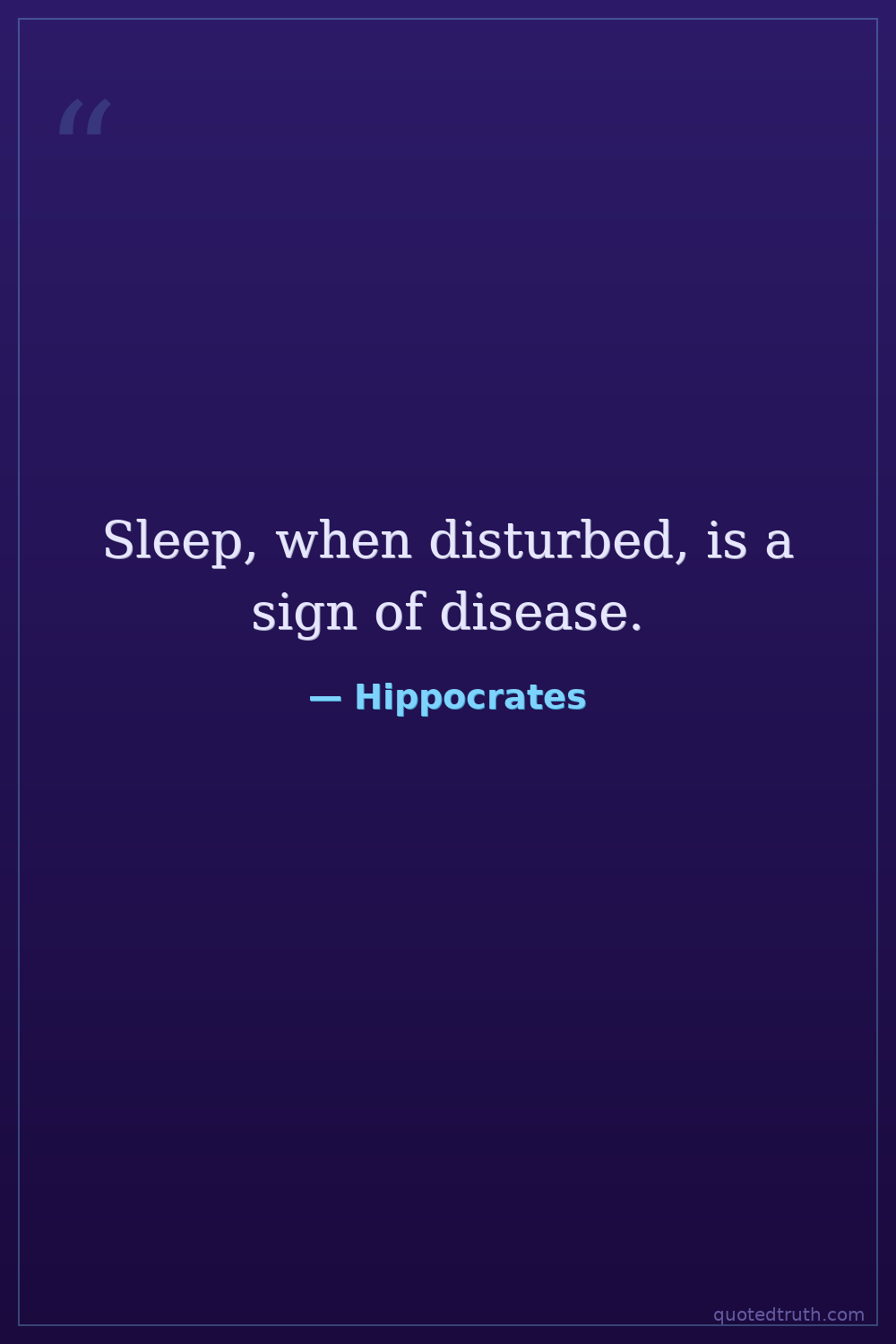
Hippocrates — "Sleep, when disturbed, is a sign of disease."
Sleep, when disturbed, is a sign of disease.
Sleep, when disturbed, is a sign of disease.
Click any product to generate a realistic preview. Up to 3 at a time.
* Initial load can take up to 90 seconds — revising the preview in another color is nearly instant.
"The healthy man does not think about his health."
"The body is the garden of the soul."
"The love of wisdom is the mother of all good things."
"If a man has a pain in his knee, and it is on the outer side, it is a sign that he will have a fever."
"If a man takes a bath, and has a fever, and afterward he has a chill, that is bad."
Found in 1 providers: grok
1 source checked
Disrupted sleep is not merely inconvenient—it signals that something is wrong inside the body. When sleep becomes fragmented, elusive, or abnormal in pattern, a disease process is likely at work. This positions sleep quality as a diagnostic indicator rather than a personal habit. Modern medicine confirms this: fever, infection, pain, and dozens of conditions disturb normal sleep rhythms. Disturbed sleep is the body broadcasting distress.
Hippocrates built medicine on systematic bedside observation—watching patients breathe, eat, move, and sleep to identify patterns predictive of outcomes. His Hippocratic Corpus documents hundreds of such clinical notes, sleep among them. He rejected supernatural explanations for illness, insisting the body itself reveals disease through observable signs. This quote embodies his core conviction: nature, not gods, governs health, and the attentive physician reads nature's signals directly from the patient's body.
In 5th-century BCE Greece, illness was widely attributed to divine punishment or demonic interference. Temples of Asclepius offered prayer and ritual as cures. Against this backdrop, Hippocrates and his school on the island of Cos insisted disease had natural, physical causes observable at the bedside. Without laboratories or instruments, physicians relied entirely on bodily signs—pulse, urine, breathing, and sleep. Noting sleep disturbances as diagnostic was radical empiricism in an age of superstition.
AI-generated insights based on extensive research and information for context. Factual errors? Email [email protected].
Your cart is empty