Thomas Edison — "So far as the religion of the day is concerned, it is a damned fake … Religion i…"
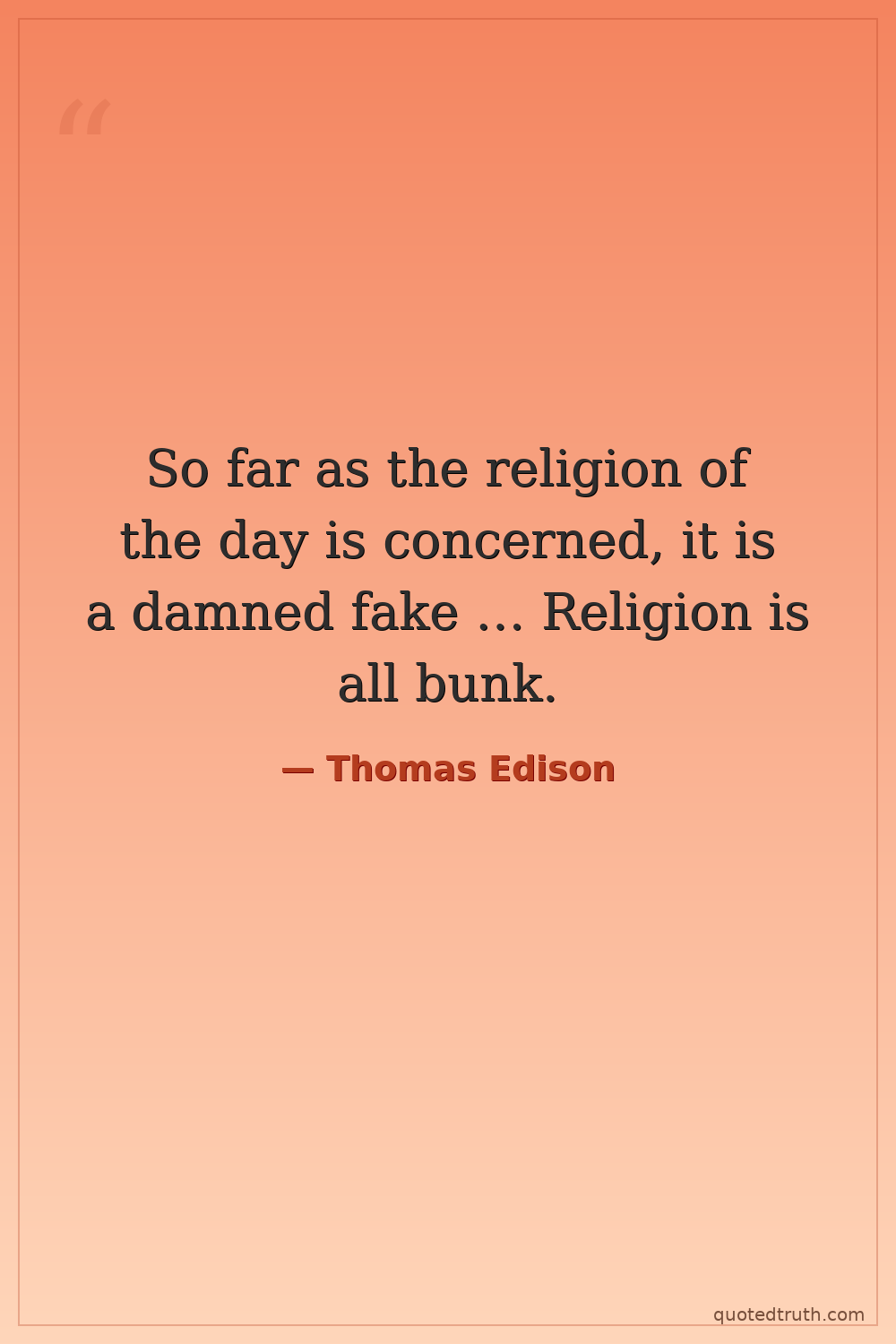
So far as the religion of the day is concerned, it is a damned fake … Religion is all bunk.
So far as the religion of the day is concerned, it is a damned fake … Religion is all bunk.
Click any product to generate a realistic preview. Up to 3 at a time.
* Initial load can take up to 90 seconds — revising the preview in another color is nearly instant.
"My life has been a series of experiments."
"There will be more women than men inventors in the future."
"I don't think there's any substitute for a good idea."
"I am a good listener, but I also have a great deal of patience."
"I have not failed 10,000 times. I have successfully found 10,000 ways that will not work."
An even more direct and raw expression of his anti-religious views.
Date: Late 19th - early 20th century (approximate)
GeneralFound in 1 providers: gemini
1 source checked
Edison flatly rejects organized religion as fraudulent and worthless. He is not nuancing a spiritual position or critiquing one denomination; he is dismissing the entire institutional apparatus of worship, doctrine, and clergy as deception dressed up as truth. In plain terms: the religion people practice around him is a scam, and the teachings sold as sacred are empty nonsense unworthy of a thinking person's belief.
Edison built his life on empirical testing, thousands of filament trials, measurable results. Faith claims that resisted laboratory verification struck him as the opposite of his method. He openly called himself a freethinker, denied a personal God in a 1910 New York Times interview, and admired Thomas Paine. For an inventor who trusted only what electrodes and instruments confirmed, clergy-mediated revelation looked like the pre-scientific superstition his workshop was replacing.
Edison spoke during America's early-twentieth-century clash between Protestant orthodoxy and scientific naturalism, the years leading to the 1925 Scopes Monkey Trial. Darwin, Huxley, and Ingersoll had made public unbelief speakable, and industrialists like Edison, Ford, and Carnegie wielded cultural authority rivaling preachers. Newspapers eagerly quoted inventor-celebrities on theology, and Edison's 1910 remarks triggered nationwide pulpit denunciations, illustrating how electricity and evolution were dismantling the nineteenth-century religious consensus.
AI-generated insights based on extensive research and information for context. Factual errors? Email [email protected].
Your cart is empty