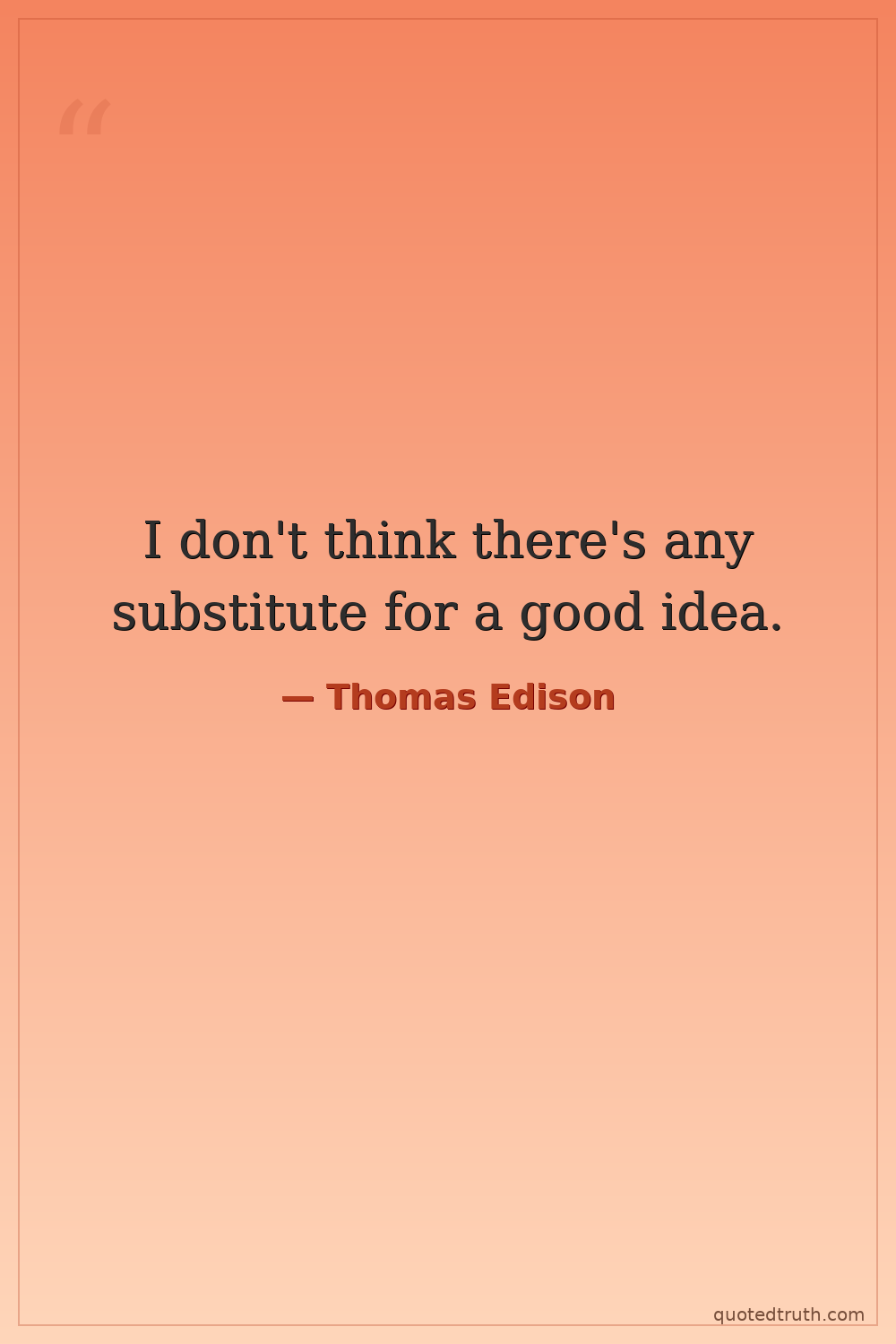
Thomas Edison — "I don't think there's any substitute for a good idea."
I don't think there's any substitute for a good idea.
I don't think there's any substitute for a good idea.
Click any product to generate a realistic preview. Up to 3 at a time.
* Initial load can take up to 90 seconds — revising the preview in another color is nearly instant.
"I owe my success to the fact that I never had a watch. I never knew what time it was, so I never stopped working."
"My life has been a series of experiments."
"We don't know a millionth of one percent about anything."
"Opportunity is missed by most people because it is dressed in overalls and looks like work."
"To invent, you need a good imagination and a pile of junk."
Found in 1 providers: grok
1 source checked
Nothing beats a genuinely original, useful idea. You can have money, connections, hard work, fancy tools, or clever marketing, but none of those can replace the actual spark of insight at the center of a breakthrough. Effort and resources amplify a strong idea, yet they cannot manufacture one or paper over its absence. Without that core concept worth pursuing, everything built around it is just activity without direction or lasting value.
Edison built his career on ideas others dismissed or had not imagined: a practical incandescent bulb, the phonograph, the motion picture camera, and the industrial research lab itself. He filed 1,093 U.S. patents, but consistently said execution followed the seed concept. His famous line about genius being one percent inspiration and ninety-nine percent perspiration still begins with that inspiration, the idea he refused to treat as optional or replaceable.
Edison worked from the 1870s through the 1920s, the height of the Second Industrial Revolution, when electricity, telegraphy, and mass manufacturing were rewiring daily life. Capital, patents, and industrial labs were becoming the dominant engines of progress, and inventors were increasingly treated as employees of corporations like Westinghouse and GE. In that climate, asserting that the raw idea still mattered most pushed back against a rising belief that scale, money, and organization alone drove innovation.
AI-generated insights based on extensive research and information for context. Factual errors? Email [email protected].
Your cart is empty