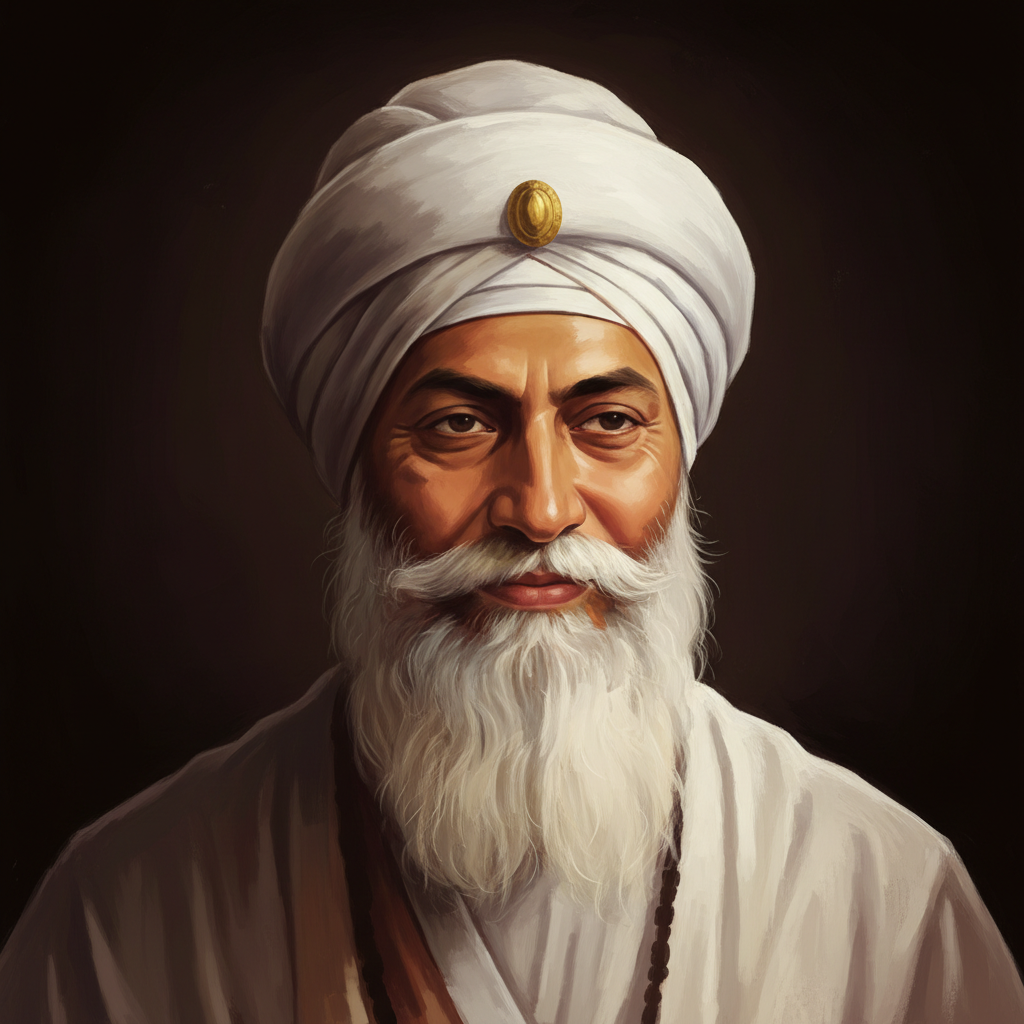
Guru Nanak — "Speak the truth, live the truth, and practice the truth."
Speak the truth, live the truth, and practice the truth.
Speak the truth, live the truth, and practice the truth.
Click any product to generate a realistic preview. Up to 3 at a time.
* Initial load can take up to 90 seconds — revising the preview in another color is nearly instant.
"The greatest wealth is to be without desires."
"Those who call themselves kings are butchers of the people."
"Guru Nanak taught that depriving others of their rights is a serious moral offense."
"He who has no faith in himself can never have faith in God."
"Like the juggler, deceiving by his tricks, one is deluded by egotism, falsehood and illusion."
Founder of Sikhism and the first of the Ten Sikh Gurus, whose teachings of one universal God and rejection of caste shaped Punjab. Closely associated with Kabir (mystical poet whose verses appear in the Sikh Guru Granth Sahib). For an intellectual contrast, see Brahmanical orthodoxy, the Hindu caste-and-ritual establishment of his era — Sikhism was founded as a deliberate alternative to both Hindu ritual hierarchy and Islamic exclusivism — Nanak's universalism was a structural rejection of caste and priestly mediation.
Found in 1 providers: gemini
1 source checked
This saying calls for complete alignment between what you say, how you live, and what you do. It's not enough to speak honestly once; truth must guide your daily choices, relationships, and habits until it becomes who you are. Honesty without integrity in action is hollow, and private virtue without public expression is incomplete. Authenticity means your words, behavior, and values all match, leaving no gap between belief and conduct.
Guru Nanak built Sikhism on the conviction that honest living outranks ritual. He famously taught kirat karo (earn by honest labor), naam japo (remember the divine), and vand chhako (share with others), rejecting caste, priestly monopolies, and performative piety. As a traveling teacher who confronted hypocrisy in both Hindu and Muslim clergy, he modeled this threefold truth by working as an accountant, meditating publicly, and founding communal kitchens open to all.
In early-16th-century Punjab, Guru Nanak lived under the Delhi Sultanate and the early Mughal conquest, amid rigid caste hierarchies, forced conversions, and heavy temple and mosque taxation. Religious identity was weaponized politically, and ordinary people faced corrupt clergy, ritualism without ethics, and sectarian violence between Hindus and Muslims. Against this backdrop, insisting that truth must be spoken, lived, and practiced was a radical egalitarian challenge to empty ceremony and institutional hypocrisy on all sides.
AI-generated insights based on extensive research and information for context. Factual errors? Email [email protected].
Your cart is empty