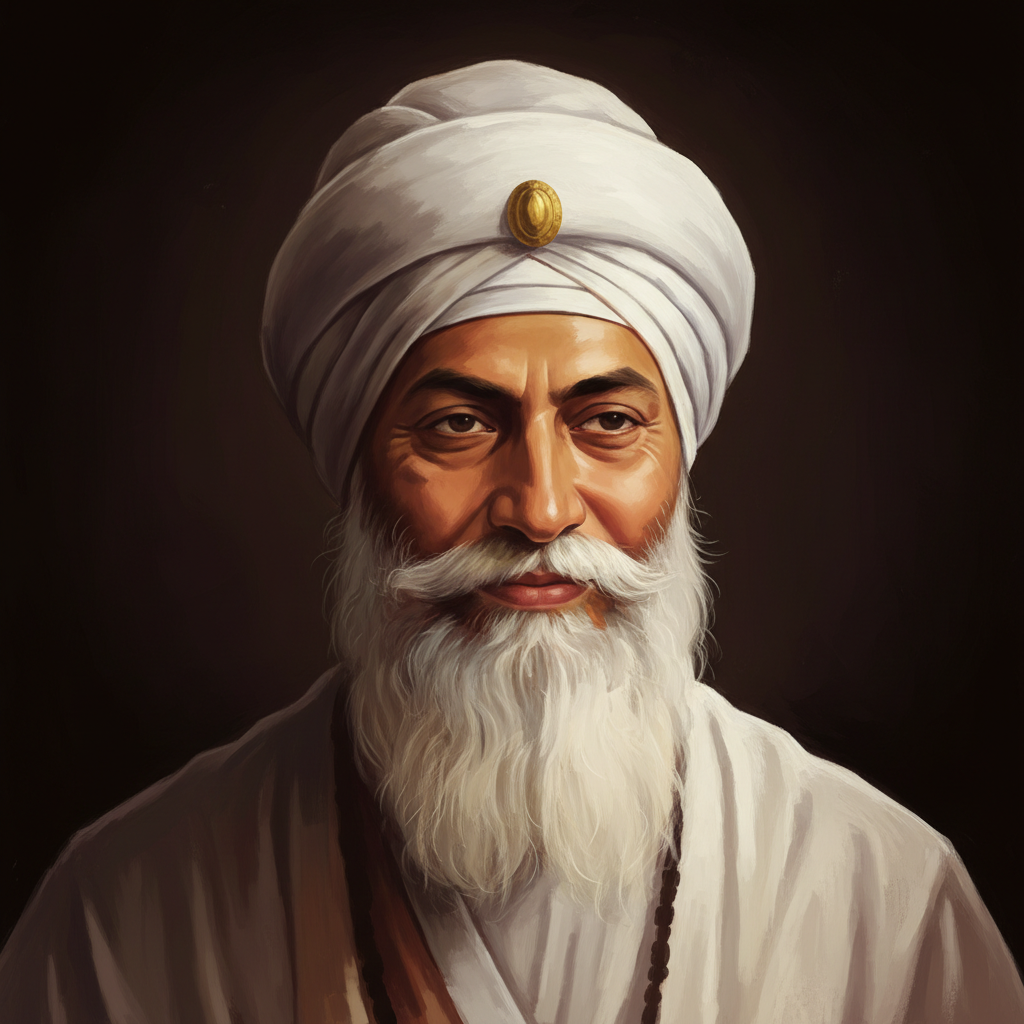
Guru Nanak — "Those who call themselves kings are butchers of the people."
Those who call themselves kings are butchers of the people.
Those who call themselves kings are butchers of the people.
Click any product to generate a realistic preview. Up to 3 at a time.
* Initial load can take up to 90 seconds — revising the preview in another color is nearly instant.
"Live a life of honesty and integrity. And try not to spill your tea on yourself."
"The blessings of God are for all, without discrimination."
"Be the wisdom your support. Be the compassion your guide and listen to the Divine Music that beats in every heart."
"The sun and moon, O Lord, are Thy lamps; the firmament Thy salver; the orbs of the stars the pearls encased in it."
"Without fear, there is no love for God."
Founder of Sikhism and the first of the Ten Sikh Gurus, whose teachings of one universal God and rejection of caste shaped Punjab. Closely associated with Kabir (mystical poet whose verses appear in the Sikh Guru Granth Sahib). For an intellectual contrast, see Brahmanical orthodoxy, the Hindu caste-and-ritual establishment of his era — Sikhism was founded as a deliberate alternative to both Hindu ritual hierarchy and Islamic exclusivism — Nanak's universalism was a structural rejection of caste and priestly mediation.
Found in 1 providers: deepseek
1 source checked
Leaders who claim authority over others are actually destroyers of the people they govern. Power without accountability, compassion, or justice turns rulers into predators. The title of king—or any authority figure—grants no moral legitimacy on its own. Those who exploit, tax, oppress, or wage war on their own subjects are not protectors but killers. True leadership serves people; everything else is dressed-up violence.
Guru Nanak (1469–1539) personally witnessed Babur's devastating invasion of the Punjab, composing anguished verses about the carnage at Eminabad. He rejected all hierarchy—caste, priestly, political—and founded the langar, a free community kitchen asserting radical equality. His travels across India, Arabia, and Central Asia exposed him to rulers' abuses firsthand. His willingness to condemn even Babur publicly by name shows his commitment to justice over personal political safety.
Nanak's lifetime spanned the collapse of the Lodi Sultanate and Babur's conquest of northern India in 1526. Common people across the Punjab endured brutal taxation, forced labor, and warfare under successive rulers. Babur's troops sacked towns with extreme violence. Political legitimacy rested on military force alone, not the welfare of subjects. Nanak's critique arrived when the gap between rulers' claimed divine authority and their actual predatory behavior was nakedly visible to all.
AI-generated insights based on extensive research and information for context. Factual errors? Email [email protected].
Your cart is empty