What it means
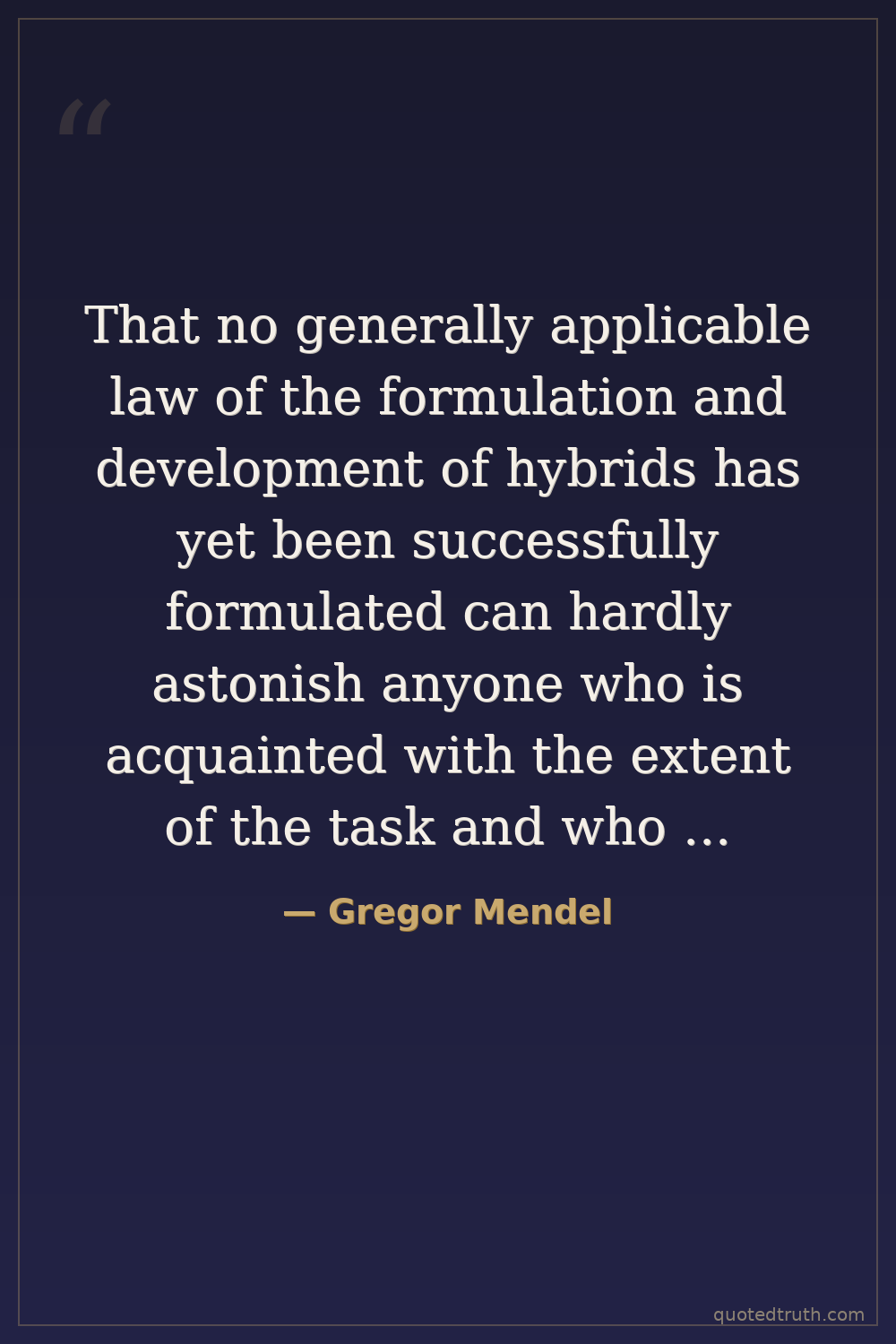
Mendel is saying no one should be surprised that science hasn't yet produced a universal law governing how hybrid offspring form and develop, because anyone who grasps the problem's scope understands how grueling these experiments are. It's intellectual humility paired with implicit ambition: the absence of a general law isn't failure, it's honest acknowledgment of complexity — while quietly signaling he may be about to change that.
Relevance to Gregor Mendel
Mendel spent eight years cultivating roughly 29,000 pea plants in the Brünn monastery garden, hand-counting thousands of seeds across generations with no statistical precedent to guide him. A trained physicist turned botanist, he understood experimental difficulty from the inside. This quote mirrors his patient, methodical character — and his awareness that others had failed not from lack of effort but from underestimating the problem he had just quietly solved.
The era
Darwin's 'On the Origin of Species' appeared in 1859, just seven years before Mendel published, making heredity biology's most urgent unsolved problem. Blending inheritance — the idea traits mix like paint — dominated thinking, making hybrid patterns seem hopelessly chaotic. Chromosomes were invisible; statistics weren't yet applied to biology. Experimental botany barely existed as a discipline. Mendel's observation that no law had been found was accurate — and he was writing the paper that would establish one.
AI-generated insights based on extensive research and information for context. Factual errors? Email [email protected].