Guru Nanak — "That one plant should be sown and another be produced cannot happen; whatever se…"
That one plant should be sown and another be produced cannot happen; whatever seed is sown, a plant of that kind even comes forth.
That one plant should be sown and another be produced cannot happen; whatever seed is sown, a plant of that kind even comes forth.
Click any product to generate a realistic preview. Up to 3 at a time.
* Initial load can take up to 90 seconds — revising the preview in another color is nearly instant.
"Death would not be called bad, O people, if one knew how to truly die."
"There is but One God. His Name is Truth. He is the Creator. He fears none. He is without enmity. He is timeless, unborn, self-existent. By the Guru's Grace, He is met."
"The world is a house of clay, O Nanak, and the soul is a guest."
"The world is burning in the fire of desire, greed, attachment, and ego."
"I bow at His feet constantly and pray to Him. The Guru, the True Guru, has shown me the Way."
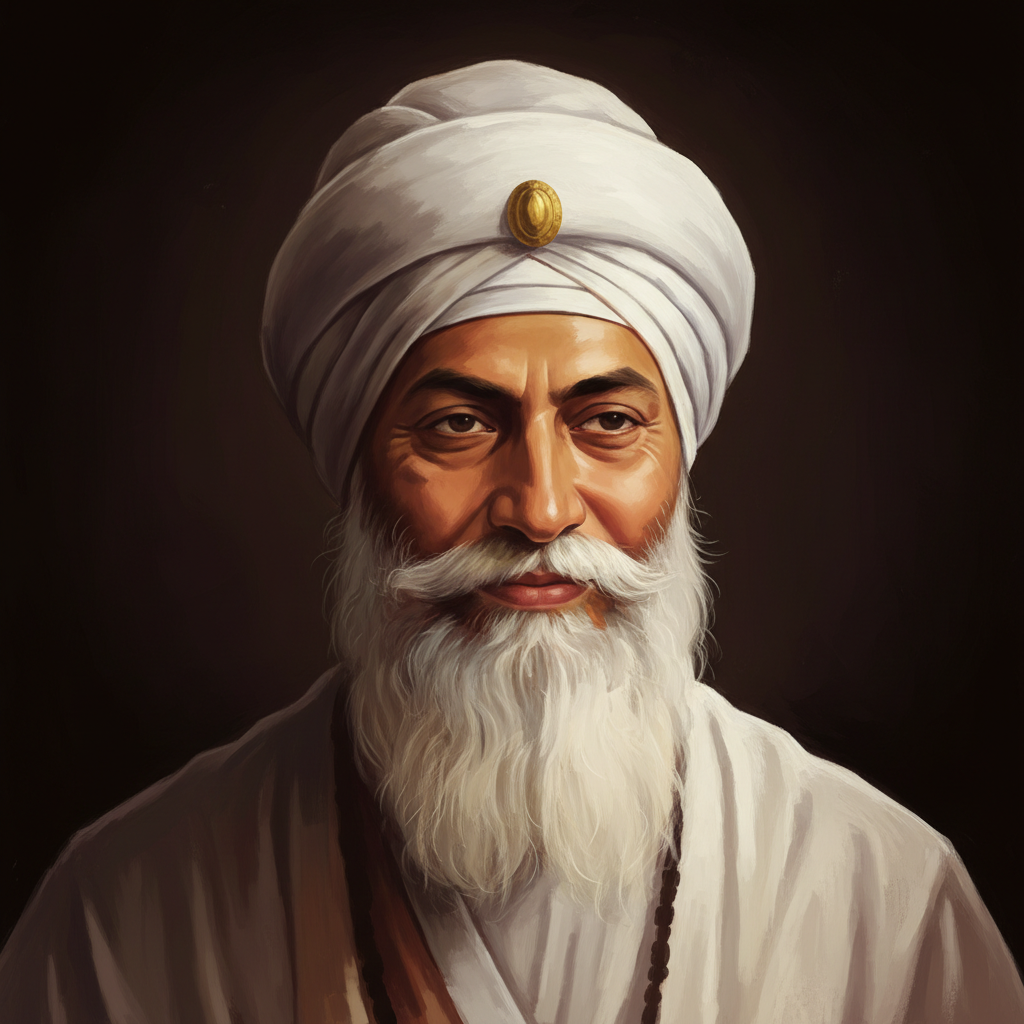
Founder of Sikhism and the first of the Ten Sikh Gurus, whose teachings of one universal God and rejection of caste shaped Punjab. Closely associated with Kabir (mystical poet whose verses appear in the Sikh Guru Granth Sahib). For an intellectual contrast, see Brahmanical orthodoxy, the Hindu caste-and-ritual establishment of his era — Sikhism was founded as a deliberate alternative to both Hindu ritual hierarchy and Islamic exclusivism — Nanak's universalism was a structural rejection of caste and priestly mediation.
Found in 1 providers: gemini
1 source checked
Your actions determine your outcomes with absolute certainty. Whatever you put into the world — kindness, greed, devotion, cruelty — that same quality returns to you. There are no exceptions or shortcuts. The universe operates on a precise moral accounting: you reap exactly what you sow, in character and consequence, making personal responsibility the foundation of a meaningful life.
Guru Nanak traveled thousands of miles across South Asia, Central Asia, and Arabia teaching that authentic spiritual living required righteous action, not ritual performance. He rejected caste privilege and priestly shortcuts, insisting each person's deeds shaped their spiritual standing. This agricultural metaphor reflects his grounded, vernacular teaching style — speaking to farmers and laborers in imagery drawn from their daily reality.
In 15th–16th century Punjab, caste hierarchies promised spiritual merit through birth, while religious establishments sold rituals as shortcuts to divine favor. Mughal political power intertwined with religious authority, creating systems where wealth and status could seemingly override moral conduct. Guru Nanak's teaching directly challenged this — asserting that cosmic justice was incorruptible, making every person equally accountable regardless of social position.
AI-generated insights based on extensive research and information for context. Factual errors? Email [email protected].
Your cart is empty