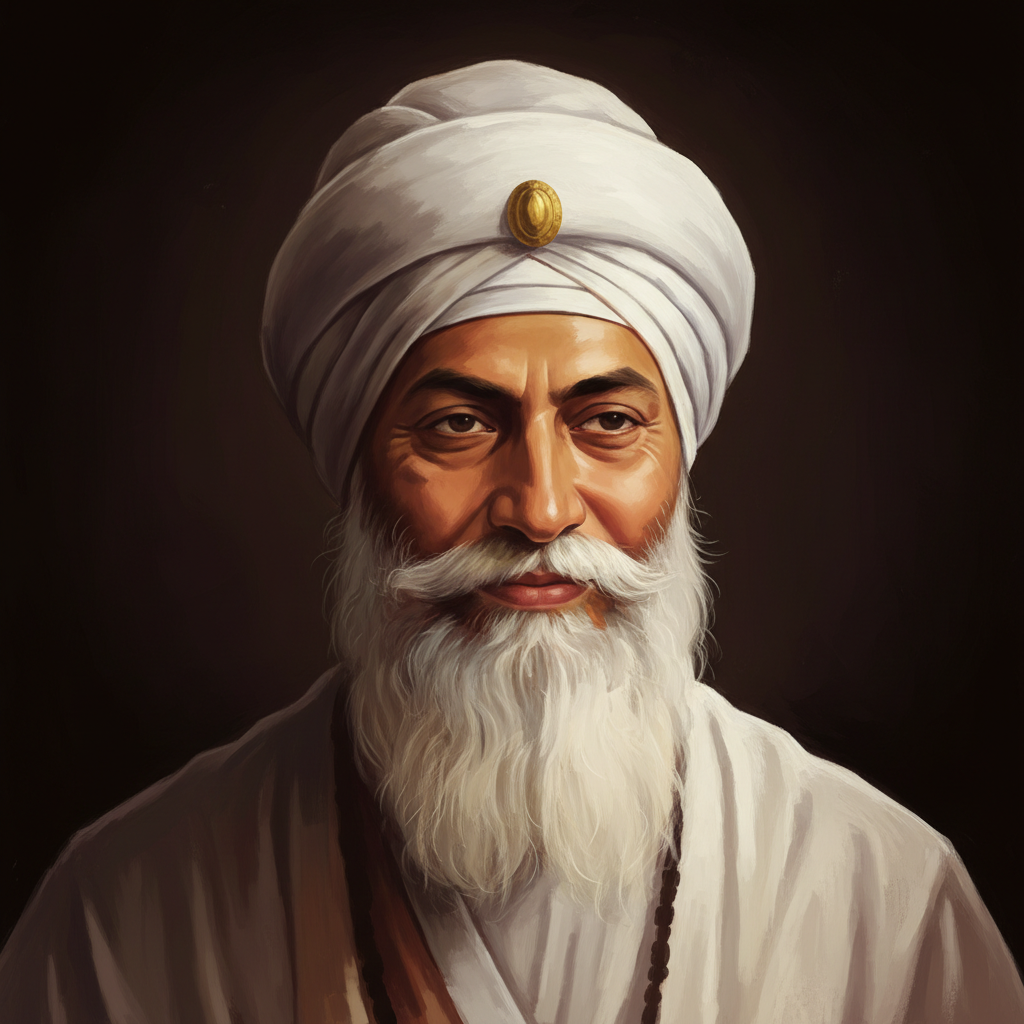
Guru Nanak — "Death would not be called bad, O people, if one knew how to truly die."
Death would not be called bad, O people, if one knew how to truly die.
Death would not be called bad, O people, if one knew how to truly die.
Click any product to generate a realistic preview. Up to 3 at a time.
* Initial load can take up to 90 seconds — revising the preview in another color is nearly instant.
"The whole world is a manifestation of the Lord."
"Injustice has no place in God's order because He is absolute just."
"Only by His Grace, can one be saved."
"Through shallow intellect, the mind becomes shallow, and one eats the fly, along with the sweets."
"The Dhoop (burnt incense), lamps and the Naivaed (an offering of eatables presented to deity or idol. All of them become false) by smell. (Then, O Rabb!) If Your Poojaa can be done only with these thi…"
Founder of Sikhism and the first of the Ten Sikh Gurus, whose teachings of one universal God and rejection of caste shaped Punjab. Closely associated with Kabir (mystical poet whose verses appear in the Sikh Guru Granth Sahib). For an intellectual contrast, see Brahmanical orthodoxy, the Hindu caste-and-ritual establishment of his era — Sikhism was founded as a deliberate alternative to both Hindu ritual hierarchy and Islamic exclusivism — Nanak's universalism was a structural rejection of caste and priestly mediation.
Found in 2 providers: grok,gemini
2 sources checked
The saying argues that death itself is not the problem. What matters is how a person lives and prepares inwardly before it arrives. If someone learns to die well, by surrendering ego, attachments, and selfish desires while still alive, then the actual moment of death loses its terror and stigma. A life emptied of pride and filled with devotion turns dying into a natural passage rather than a disaster to be feared or mourned.
Guru Nanak, the founding Sikh Guru born in 1469 in Punjab, built his teachings around dissolving the ego (haumai) and merging with the divine Naam. He rejected empty ritual after his legendary disappearance in the Bein river, emerging to declare there is no Hindu, no Muslim. This verse mirrors his core message that inner death of selfhood, not physical dying, is the real spiritual achievement guiding a devotee toward union with Ik Onkar.
Guru Nanak lived from 1469 to 1539, during the collapse of the Delhi Sultanate and Babur's Mughal invasions of Punjab, which he witnessed and lamented in his Babarvani hymns. Hindu and Muslim communities were locked in ritualism, caste hierarchy, and sectarian conflict. Death from war, famine, and plague was constant. Against this backdrop, reframing death as a spiritual discipline rather than a calamity offered ordinary people dignity and agency in an age of political chaos and religious division.
AI-generated insights based on extensive research and information for context. Factual errors? Email [email protected].
Your cart is empty