What it means
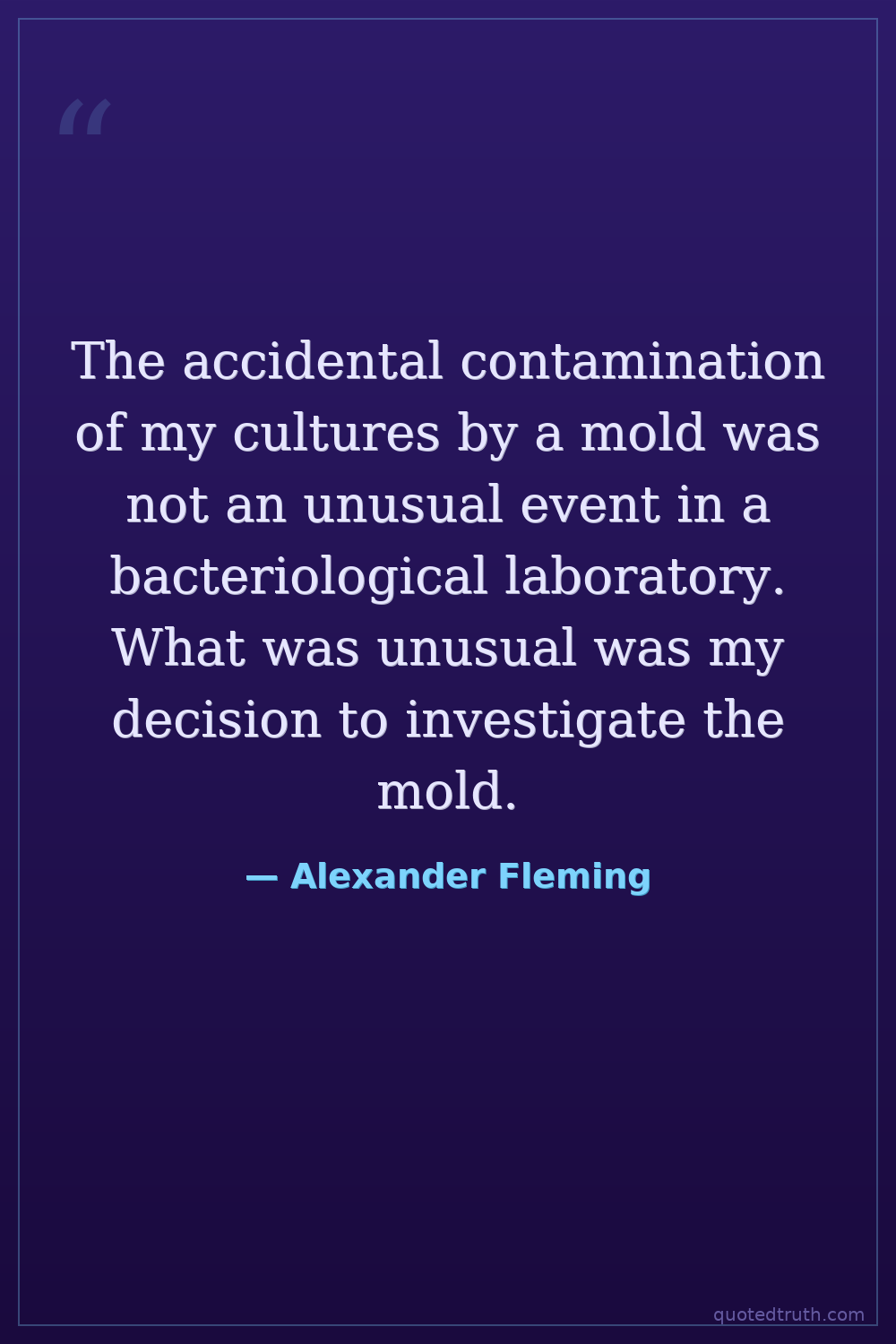
Accidents happen constantly in any laboratory—contaminated cultures are routine, unremarkable nuisances. What separates landmark discovery from discarded experiment is the investigator's decision to ask 'why?' rather than start over. Fleming draws a precise distinction: luck delivers the opportunity, but curiosity seizes it. Any number of scientists encountered identical contaminations and saw only ruin. The truly rare ingredient in scientific breakthrough is not chance but the disciplined choice to treat anomaly as invitation.
Relevance to Alexander Fleming
Fleming spent decades at St. Mary's Hospital London as a bacteriologist, developing expertise in microbial behavior that trained his eye for the unexpected. He had already discovered lysozyme in 1922 by noticing a strange effect in cultures—establishing a personal pattern of interrogating anomalies. His disciplined curiosity, combined with years of hands-on lab work, made him uniquely primed to recognize that a killing zone around contaminating mold was scientifically significant rather than merely inconvenient.
The era
Fleming made this observation in 1928, when bacterial infections—pneumonia, sepsis, scarlet fever—were leading causes of death and surgery routinely killed through wound infection. World War I had shown that battlefield bacteria often killed more soldiers than enemy fire. The 1918 influenza pandemic's bacterial complications had killed tens of millions. Medicine had no reliable antimicrobial treatments. The desperate need for bacterial control meant Fleming's curiosity, once followed, eventually unlocked the antibiotic era and transformed twentieth-century medicine irreversibly.
AI-generated insights based on extensive research and information for context. Factual errors? Email [email protected].