What it means
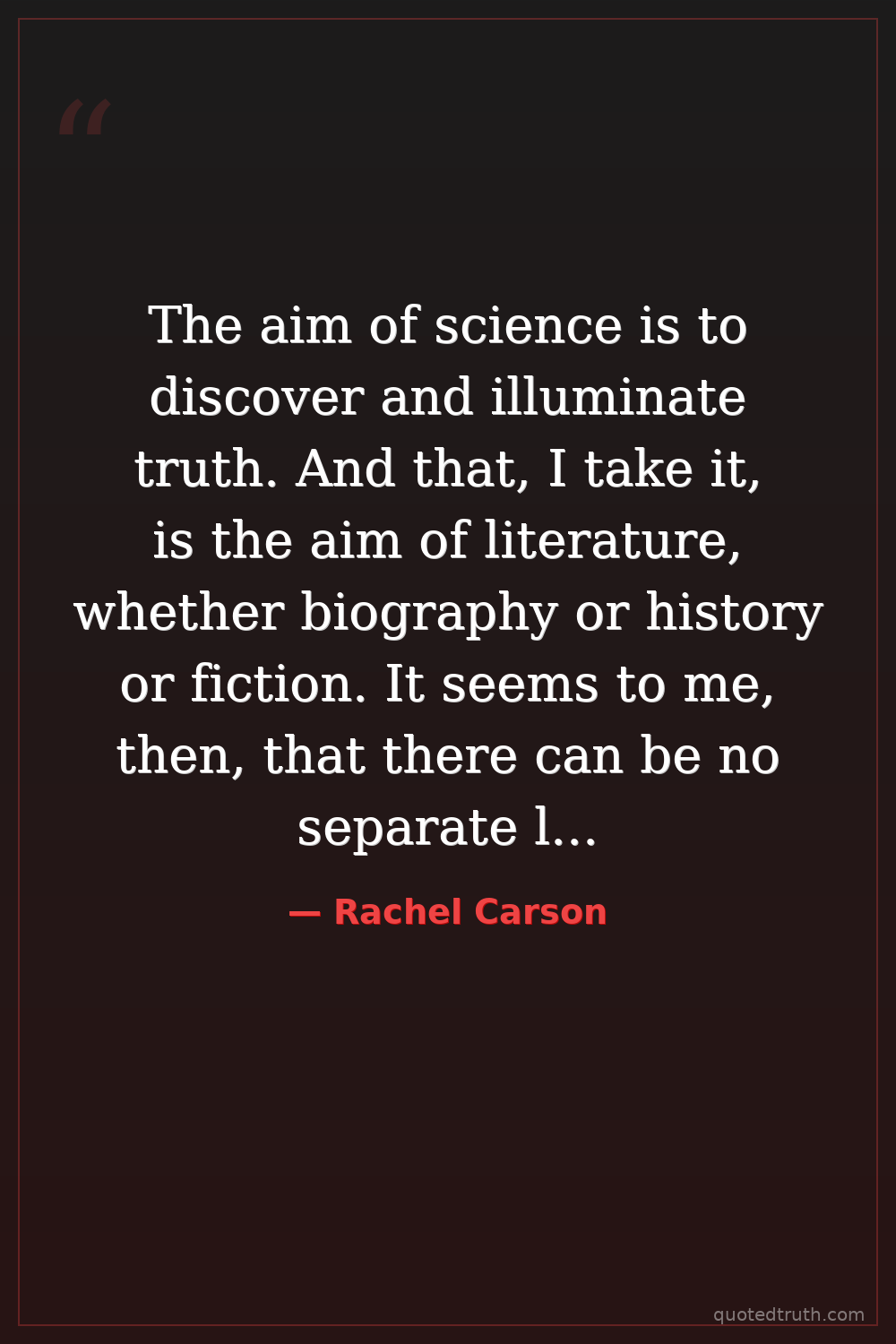
Science and literature share the same core purpose — uncovering and communicating truth. Carson argues that since both disciplines aim to illuminate reality, whether through data, narrative, or biography, treating science writing as its own separate genre is artificial. Good scientific communication is simply good literature. The two aren't competing disciplines but unified endeavors, both serving human understanding by making truth accessible and meaningful.
Relevance to Rachel Carson
Carson lived this philosophy — she was a marine biologist who wrote prose beautiful enough to win the 1952 National Book Award for The Sea Around Us. Silent Spring reads as both rigorous scientific argument and urgent narrative. She rejected the idea that scientists should write only for specialists; truth-telling required reaching ordinary readers. Her career proved that scientific precision and literary craft not only coexist but reinforce each other.
The era
Carson wrote during the 1950s-60s, when C.P. Snow's 'Two Cultures' debate declared science and humanities irreconcilably split. Post-WWII science grew increasingly jargon-heavy and specialist-directed, distancing itself from public understanding. Meanwhile, nuclear weapons and chemical pesticides showed how dangerous scientific ignorance could be. Carson's insistence that science belongs within literature was both a rebuke to academic silos and a democratic argument that citizens deserve truth explained clearly.
AI-generated insights based on extensive research and information for context. Factual errors? Email [email protected].