What it means
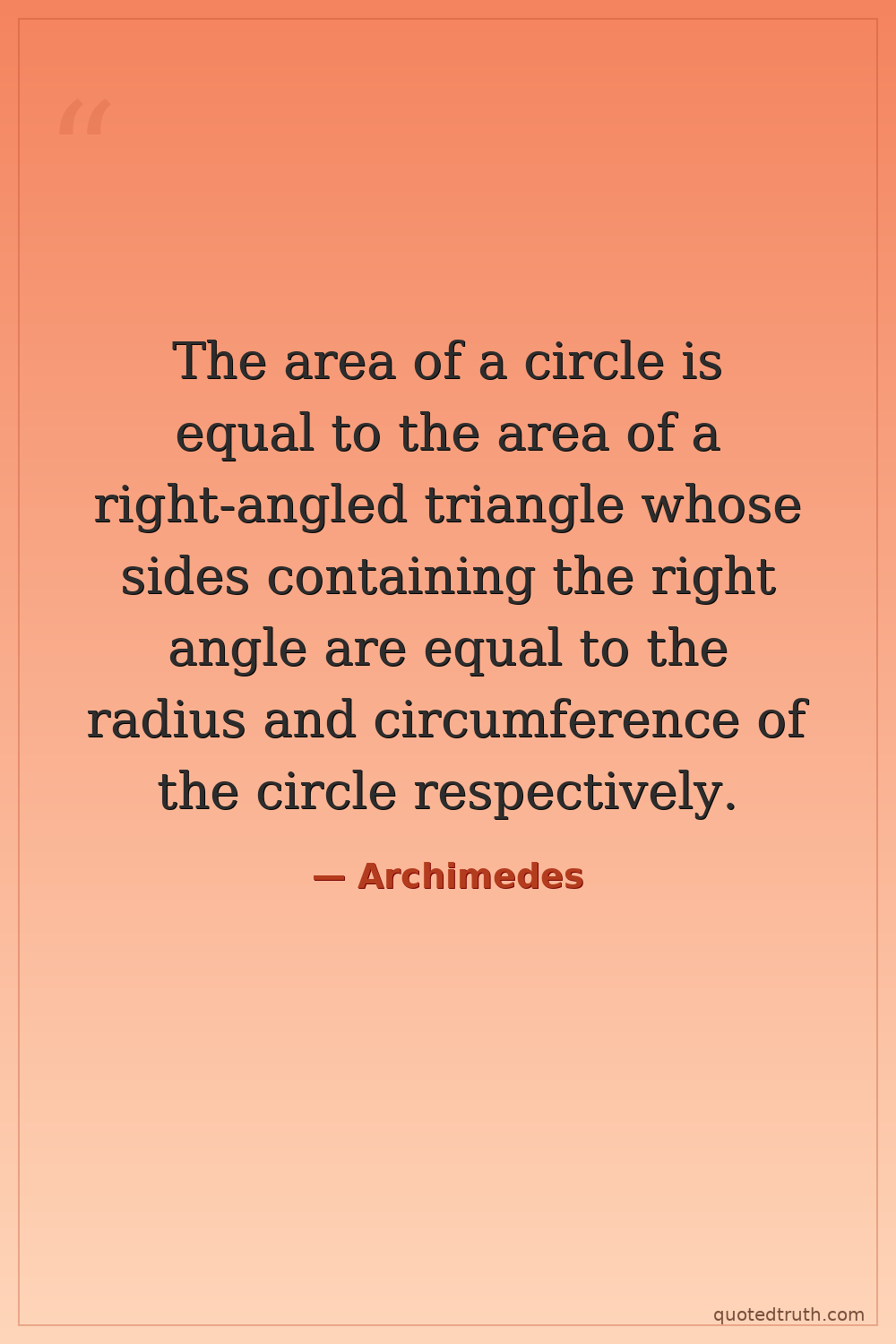
A circle's area equals the area of a right triangle whose two shorter sides are the circle's radius and circumference. Since triangle area equals half base times height, this means circle area equals ½ × radius × circumference — which simplifies to πr². It converts an abstract curved region into a flat, measurable shape, expressing a profound geometric truth: circular area is fully determined by just two of its own fundamental measurements.
Relevance to Archimedes
Archimedes of Syracuse devoted his life to translating curved, irrational geometric forms into precise calculable quantities. This theorem appears in his treatise 'Measurement of a Circle,' alongside his famous bound of π between 223/71 and 22/7, computed using 96-sided polygons. His method of exhaustion — approaching curved areas with infinite sequences of polygons — prefigured integral calculus by 1,800 years. This relentless drive to make the immeasurable measurable defined his entire career.
The era
In 3rd-century BC Greek mathematics, there was no algebraic notation — geometric equivalence was the only rigorous language for mathematical truth. Euclid had recently formalized planar geometry, but circular areas remained poorly defined. Greek engineers, astronomers, and military strategists urgently needed accurate circle calculations for architecture, planetary models, and siege engines — Archimedes himself built catapults defending Syracuse. Making circular area computable through a simple triangle was both a theoretical breakthrough and a practical tool for the ancient world.
AI-generated insights based on extensive research and information for context. Factual errors? Email [email protected].