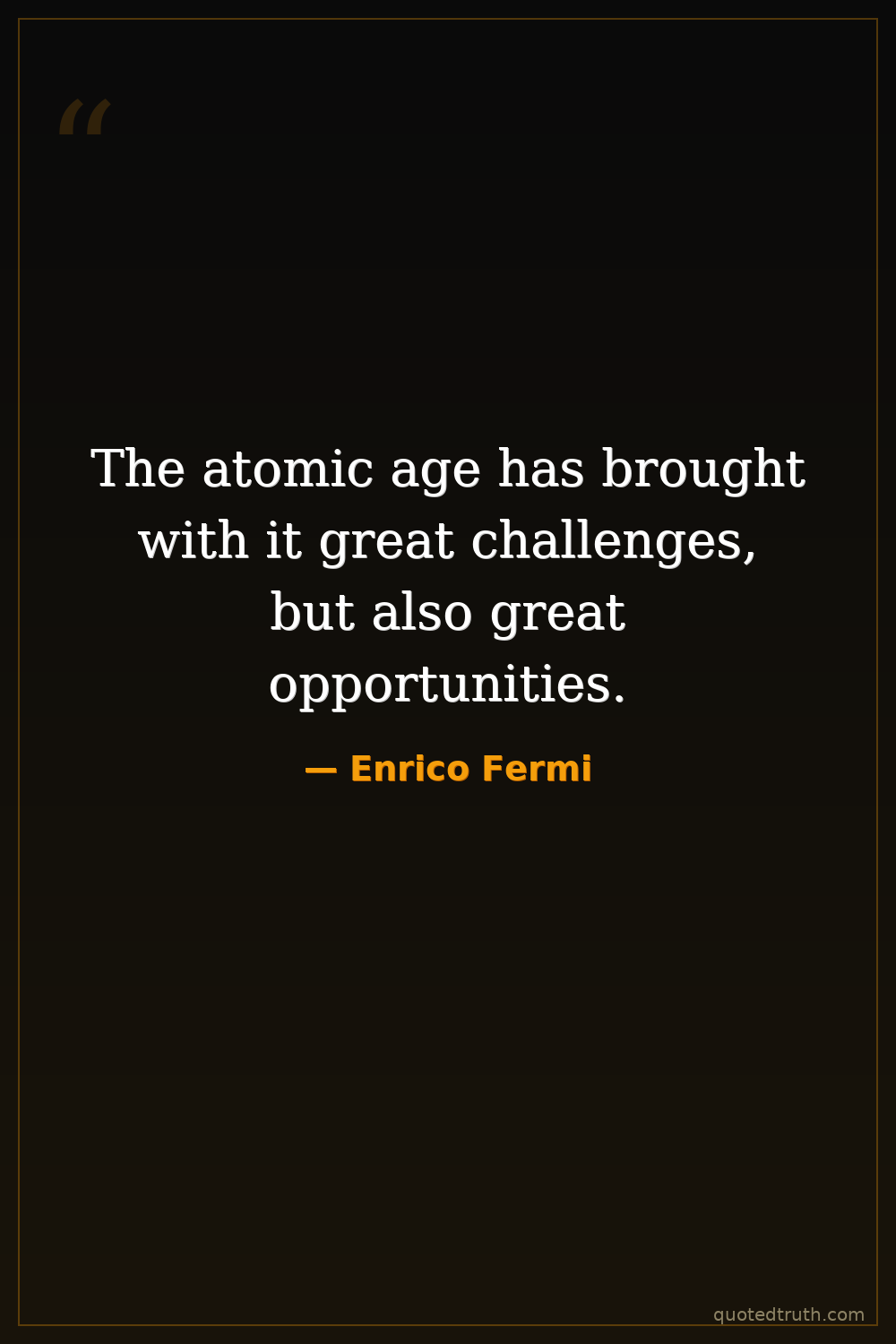
Enrico Fermi — "The atomic age has brought with it great challenges, but also great opportunitie…"
The atomic age has brought with it great challenges, but also great opportunities.
The atomic age has brought with it great challenges, but also great opportunities.
Click any product to generate a realistic preview. Up to 3 at a time.
* Initial load can take up to 90 seconds — revising the preview in another color is nearly instant.
"It is not good to try to stop knowledge from going forward. Ignorance is never better than knowledge."
"It seems to me that we have started an avalanche."
"Don't ever do a calculation without knowing the answer."
"The greatest adventure of all is to explore the unknown."
"I am not an optimist. I am a realist. I believe that we must be prepared for the worst, and hope for the best."
Found in 1 providers: grok
1 source checked
Nuclear technology introduced dangers—weapons of mass destruction, radioactive fallout, arms race escalation—but simultaneously opened doors to clean energy, medical imaging, cancer treatment, and deeper scientific understanding of matter. The quote acknowledges both sides without dismissing either: transformative progress carries real risk, but risk doesn't cancel out genuine potential. A balanced, unsentimental stance on breakthrough technology that applies equally to any civilization-altering discovery.
Fermi built the world's first artificial nuclear reactor (Chicago Pile-1, December 1942) and contributed centrally to the Manhattan Project, making him a direct architect of the atomic age he describes. A physicist of extraordinary practical intuition, he witnessed both the triumph of controlled fission and the devastation of Hiroshima. His legendary estimation approach—weigh all consequences honestly, calculate carefully, then act—mirrors this same dual-sided thinking.
The quote reflects the late 1940s–early 1950s, when atomic bombs had destroyed Hiroshima and Nagasaki (1945), the Soviet Union tested its first nuclear device (1949), and hydrogen bomb development was underway. Existential fear ran alongside genuine optimism: the Atomic Energy Act (1946) and early civilian reactor programs embodied the same tension between military catastrophe and the promise of cheap, limitless electric power.
AI-generated insights based on extensive research and information for context. Factual errors? Email [email protected].
Your cart is empty