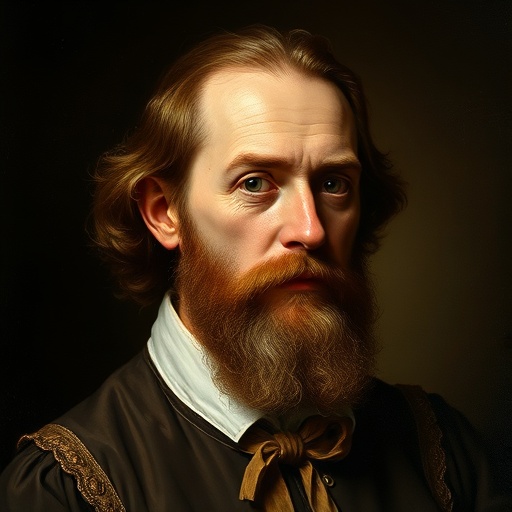
William Harvey — "The body is a machine, but it is a divine machine."
The body is a machine, but it is a divine machine.
The body is a machine, but it is a divine machine.
Click any product to generate a realistic preview. Up to 3 at a time.
* Initial load can take up to 90 seconds — revising the preview in another color is nearly instant.
"The whole world is a theatre, and all the men and women merely players."
"The semen is the efficient cause and the egg the material cause of generation."
"The truth is always simple, but the way to it is complex."
"All we know is that the blood is in motion, but what sets it in motion is God’s secret."
"The motion of the blood is constant and circular."
English physician whose On the Motion of the Heart and Blood in Animals (1628) demonstrated blood circulation, overturning 1,400 years of Galenic medicine. Closely associated with Francis Bacon (his contemporary in the new English empiricism). For an intellectual contrast, see Galenic medicine, the 2nd-century Greek medical tradition (humors, blood-as-consumed-fuel) — Harvey calculated that the heart pumps more blood per hour than the body could possibly produce as fuel — a single quantitative observation that demolished the entire Galenic-Aristotelian medical worldview. The cleanest example in medical history of arithmetic disproving 14 centuries of authority.
A statement combining mechanistic understanding with a sense of divine creation.
Date: Uncertain (attributed)
BiblicalFound in 1 providers: gemini
1 source checked
The human body operates according to mechanical principles and predictable physical laws, yet it possesses an extraordinary complexity and perfection that transcends mere machinery. It functions with breathtaking precision and elegance that no human craftsman could replicate, suggesting something greater than purely material origins underlies its design and operation.
Harvey's meticulous dissections and quantitative experiments revealed the heart as a mechanical pump driving blood in a closed circulatory loop, overturning Galenic mysticism with measurable mechanics. Yet Harvey, a deeply religious man practicing in an era when anatomy and theology intertwined, never reduced life to pure mechanism, insisting divine craftsmanship explained the heart's astonishing efficiency.
The early modern period witnessed fierce tension between emerging mechanistic science, championed by Descartes who called the body a machine, and traditional religious worldviews. Harvey published his circulation discovery in 1628, when natural philosophers struggled to reconcile empirical observation with Scripture. Calling the body divine acknowledged God's handiwork while legitimizing scientific investigation, a crucial diplomatic balance in an era when challenging Galen risked professional and religious censure.
AI-generated insights based on extensive research and information for context. Factual errors? Email [email protected].
Your cart is empty