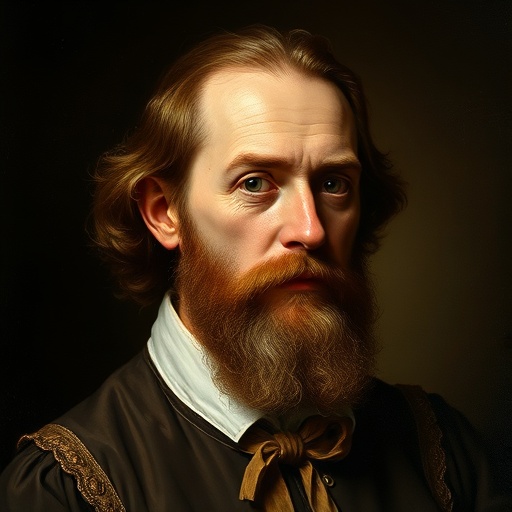
William Harvey — "All we know is that the blood is in motion, but what sets it in motion is God’s …"
All we know is that the blood is in motion, but what sets it in motion is God’s secret.
All we know is that the blood is in motion, but what sets it in motion is God’s secret.
Click any product to generate a realistic preview. Up to 3 at a time.
* Initial load can take up to 90 seconds — revising the preview in another color is nearly instant.
"The physician must be a philosopher, for there is not so great a difference between them."
"The circulation of the blood is the greatest discovery ever made in medicine."
"The blood in the animal body is impelled in a circle, and is in a state of ceaseless motion."
"The blood flows from the right ventricle through the lungs to the left auricle."
"The more accurately we search into the wonderful works of God, the more a reason we shall find to admire them."
English physician whose On the Motion of the Heart and Blood in Animals (1628) demonstrated blood circulation, overturning 1,400 years of Galenic medicine. Closely associated with Francis Bacon (his contemporary in the new English empiricism). For an intellectual contrast, see Galenic medicine, the 2nd-century Greek medical tradition (humors, blood-as-consumed-fuel) — Harvey calculated that the heart pumps more blood per hour than the body could possibly produce as fuel — a single quantitative observation that demolished the entire Galenic-Aristotelian medical worldview. The cleanest example in medical history of arithmetic disproving 14 centuries of authority.
Found in 1 providers: deepseek
1 source checked
We can observe and measure the fact that blood moves through the body, but the ultimate animating force behind life itself remains beyond human understanding. Science reveals mechanisms and patterns, yet the deeper question of why life exists at all, what gives the body its vital spark, lies outside what empirical investigation can answer.
Harvey spent decades meticulously proving blood circulates continuously, published in De Motu Cordis in 1628. Yet despite overturning Galenic medicine through rigorous observation and experiment, he remained devoutly humble about final causes. This reflects his empiricist discipline: describe what is observable, acknowledge what is not.
The early modern period saw natural philosophy increasingly challenging Church-sanctioned Galenic medicine, yet investigators like Harvey navigated carefully between empirical discovery and theological deference. Claiming too much about life's animating principle risked heresy. Attributing ultimate causation to God was both sincere conviction and prudent positioning in a religiously charged intellectual climate.
AI-generated insights based on extensive research and information for context. Factual errors? Email [email protected].
Your cart is empty