Guru Nanak — "The body is the field of karma in this age; whatever you plant, you shall harves…"
The body is the field of karma in this age; whatever you plant, you shall harvest.
The body is the field of karma in this age; whatever you plant, you shall harvest.
Click any product to generate a realistic preview. Up to 3 at a time.
* Initial load can take up to 90 seconds — revising the preview in another color is nearly instant.
"To call woman inferior is to condemn humanity."
"Do not fear, for God is with you. Also, maybe bring a jacket, it's getting chilly."
"Your Mercy is my social status."
"To conquer the mind is to conquer the world."
"He who is born, is bound to die. The only thing certain is death. All else is illusion."
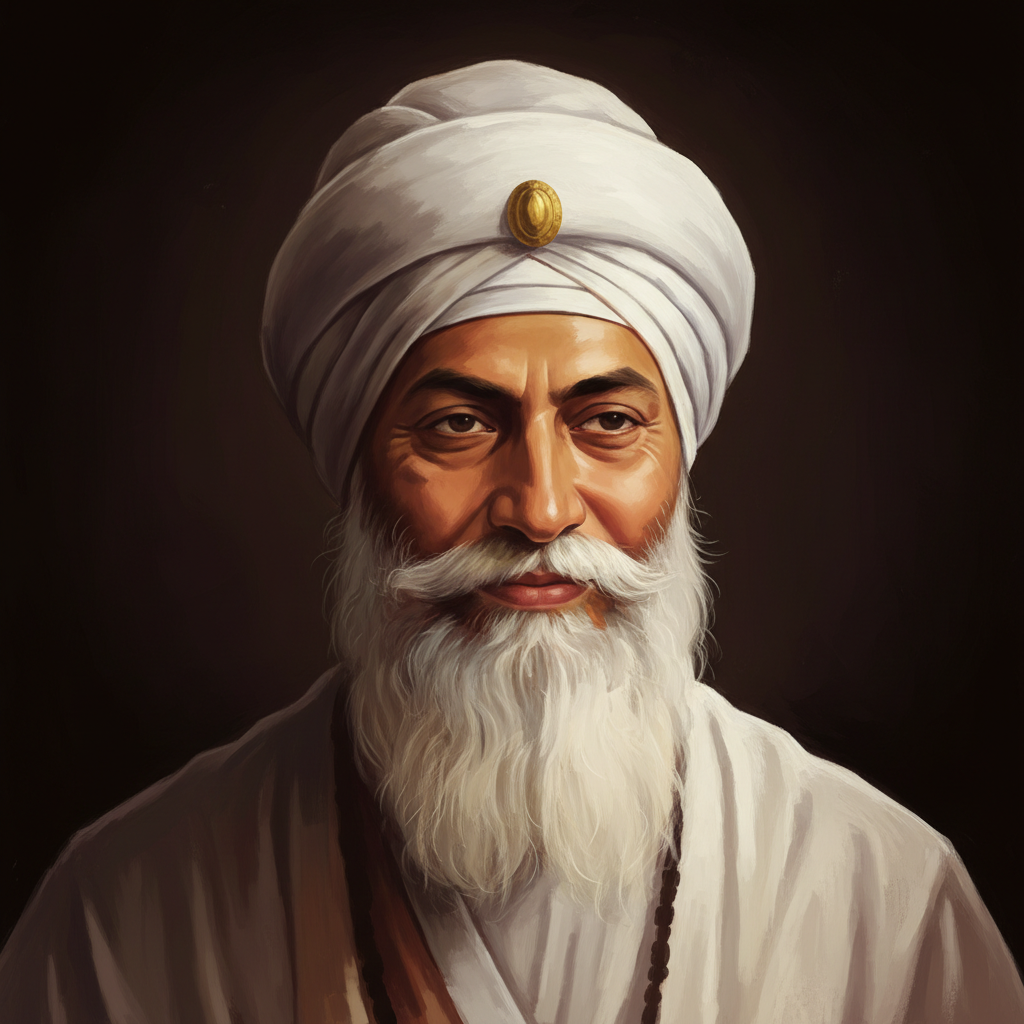
Founder of Sikhism and the first of the Ten Sikh Gurus, whose teachings of one universal God and rejection of caste shaped Punjab. Closely associated with Kabir (mystical poet whose verses appear in the Sikh Guru Granth Sahib). For an intellectual contrast, see Brahmanical orthodoxy, the Hindu caste-and-ritual establishment of his era — Sikhism was founded as a deliberate alternative to both Hindu ritual hierarchy and Islamic exclusivism — Nanak's universalism was a structural rejection of caste and priestly mediation.
Found in 1 providers: deepseek
1 source checked
Your physical life is where your actions take root and grow into results. Every choice you make, kind or cruel, honest or deceitful, is a seed you are planting in yourself. Sooner or later those seeds ripen into the circumstances you live through. You cannot separate what you do from who you become or what comes back to you. The body is the working ground; the harvest is unavoidable and personal.
Guru Nanak taught that liberation comes through honest living, not ritual or caste status. He rejected empty ceremony and insisted each person is accountable for their own conduct through the principles of kirat karo, naam japo, and vand chhako. Having walked thousands of miles across South Asia and the Middle East engaging farmers, clerics, and rulers, he used agricultural imagery ordinary people grasped instantly, framing the human body itself as the plot where ethical action decides spiritual outcome.
In early modern Punjab, Hindu caste orthodoxy and Islamic rule under the Lodi and early Mughal dynasties shaped daily life. Salvation was widely tied to birth, priestly mediation, pilgrimages, and ritual purity. Nanak, living roughly 1469 to 1539, witnessed Babur's invasions, peasant suffering, and sectarian conflict. By declaring the body itself the arena of karma, he democratized spiritual responsibility, bypassing Brahmins and mullahs and empowering laborers, women, and low-caste people to shape their own destinies through conduct.
AI-generated insights based on extensive research and information for context. Factual errors? Email [email protected].
Your cart is empty