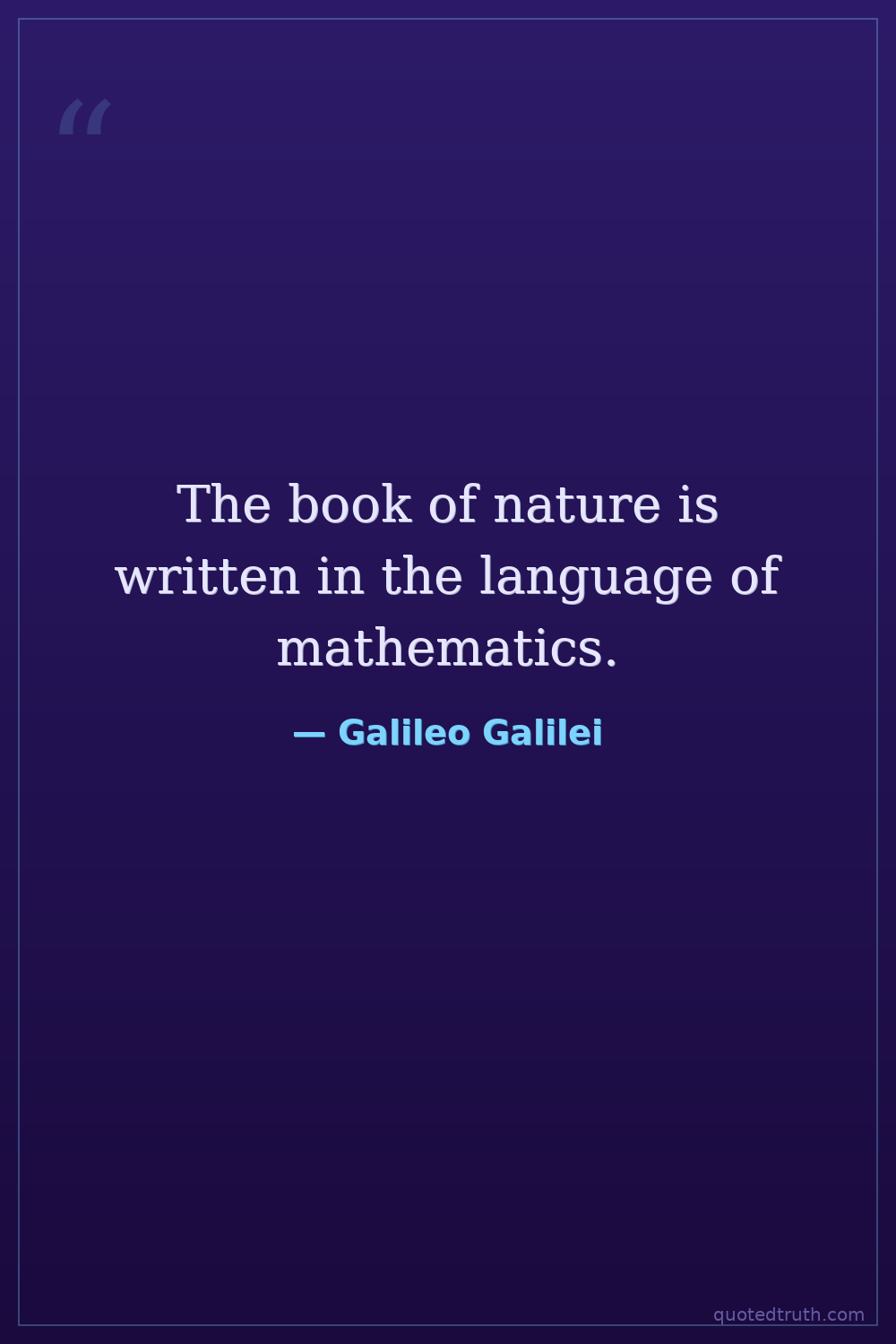
Galileo Galilei — "The book of nature is written in the language of mathematics."
The book of nature is written in the language of mathematics.
The book of nature is written in the language of mathematics.
Click any product to generate a realistic preview. Up to 3 at a time.
* Initial load can take up to 90 seconds — revising the preview in another color is nearly instant.
"Measure what is measurable, and make measurable what is not so."
"The senses, being the interpreters of natural effects, are the only door to scientific knowledge."
"The difficulties in the study of the infinite arise because we attempt, with our finite minds, to discuss the infinite, assigning to it those properties which we give to the finite and limited; but th…"
"I give infinite thanks to God, who has been pleased to make me the first observer of admirable things unrevealed to bygone ages."
"The book of nature is a book of a single language, the language of mathematics."
Found in 1 providers: grok
1 source checked
Reality itself operates according to mathematical principles — geometry, ratios, and equations aren't human inventions imposed on the world but are the actual structure of physical phenomena. To understand nature, you must read its mathematical grammar. Qualitative descriptions and philosophical arguments are insufficient; precise quantitative measurement and mathematical reasoning are the only reliable paths to genuine knowledge about how the universe works.
Galileo embodied this belief by replacing Aristotelian verbal reasoning with experiments and equations. He described falling bodies using mathematical ratios, analyzed projectile motion geometrically, and used his telescope's observations to produce quantitative data. Condemned by the Inquisition partly for privileging empirical mathematics over theological authority, Galileo staked his career and freedom on the conviction that God's creation was fundamentally mathematical in structure.
In early modern Europe, natural philosophy was dominated by Aristotelian scholasticism — qualitative, verbal, and tied to Church doctrine. The Scientific Revolution was dismantling this framework. Copernicus had proposed heliocentrism mathematically, Kepler was deriving planetary laws algebraically, and Galileo's insistence on mathematical description of motion directly challenged centuries of philosophical tradition, marking the birth of physics as a mathematically grounded empirical science.
AI-generated insights based on extensive research and information for context. Factual errors? Email [email protected].
Your cart is empty