What it means
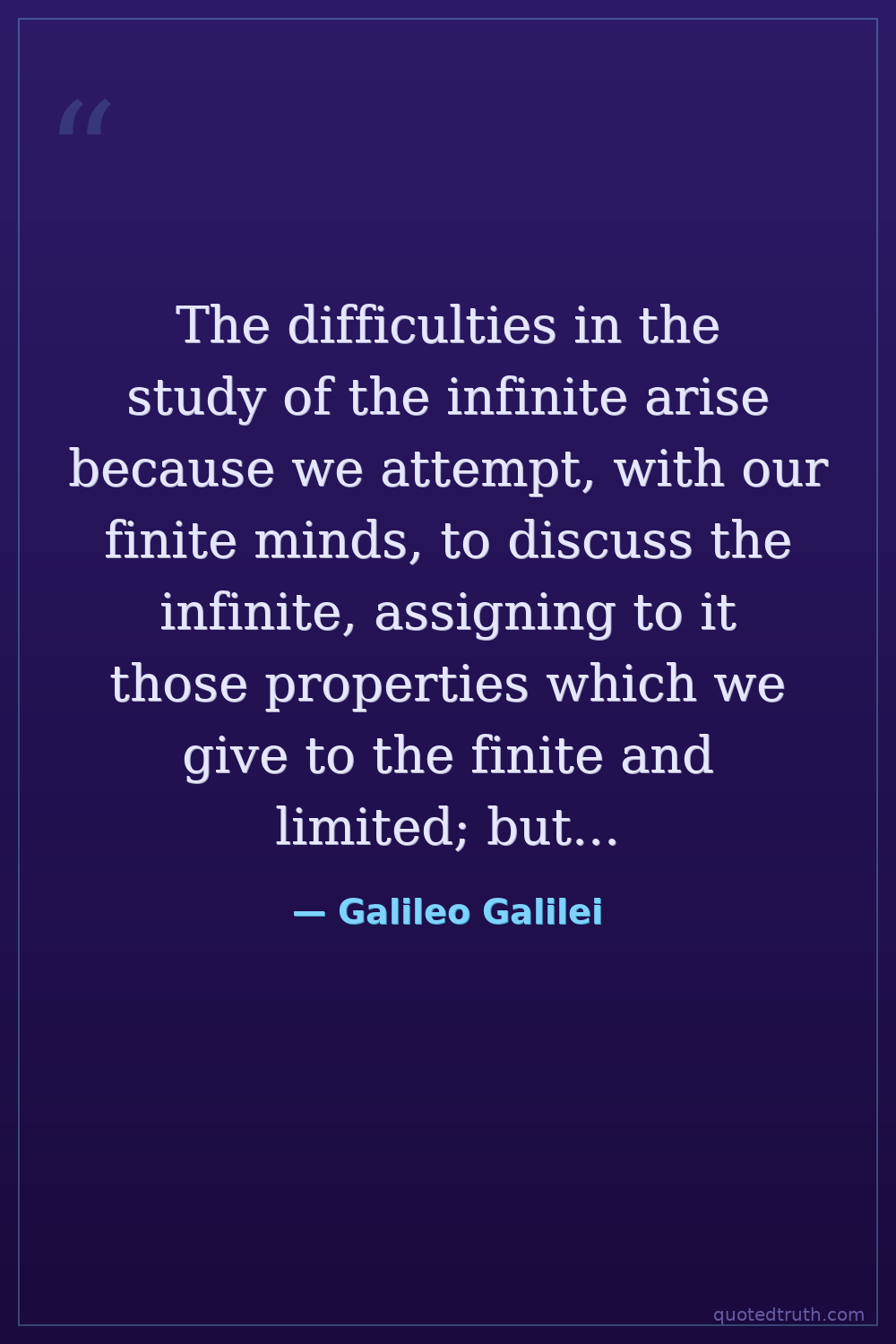
When humans try to understand infinity, we make the mistake of applying rules that only work for regular, countable things. Infinity doesn't follow the same logic as finite numbers — you can't meaningfully say one infinite set is bigger or smaller than another using ordinary comparison. Our limited minds need different frameworks entirely to even approach such concepts without falling into contradiction.
Relevance to Galileo Galilei
Galileo spent his career confronting what finite instruments and human senses could reveal about an apparently boundless universe. His telescopic observations forced him to grapple with cosmic scales dwarfing human intuition. This reflection shows his mathematical discipline — recognizing where rigorous reasoning must yield to humility, the same intellectual honesty that drove his conflict with dogma claiming certain knowledge about all things.
The era
The early modern period saw Europe wrestling with whether the universe was finite and Earth-centered or vast and decentralized. Copernicus and Kepler had shattered cosmic boundaries; Galileo's telescope revealed countless new stars. Simultaneously, Renaissance mathematics lacked formal tools for infinity — Cantor's set theory was two centuries away — making Galileo's caution about infinite quantities remarkably prescient for his age.
AI-generated insights based on extensive research and information for context. Factual errors? Email [email protected].