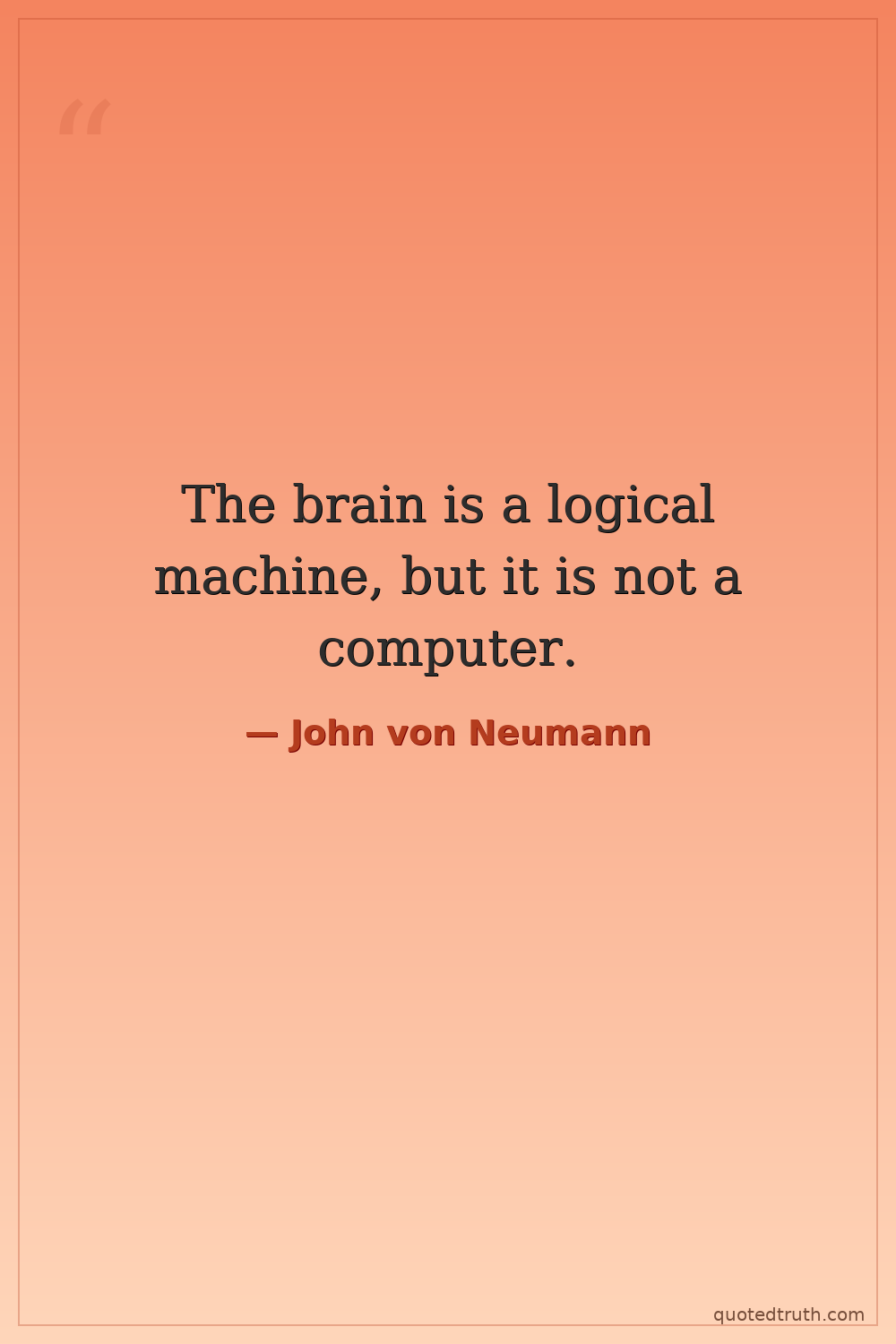
John von Neumann — "The brain is a logical machine, but it is not a computer."
The brain is a logical machine, but it is not a computer.
The brain is a logical machine, but it is not a computer.
Click any product to generate a realistic preview. Up to 3 at a time.
* Initial load can take up to 90 seconds — revising the preview in another color is nearly instant.
"The world is not as simple as we would like it to be."
"If people do not believe that mathematics is simple, it is only because they do not realize how complicated life is."
"The world is not logical, it is psychological."
"The only way to do great work is to love what you do."
"It is not at all certain that the mathematical method is appropriate for the description of the world."
Interview or lecture, distinguishing between biological and artificial computation.
Date: 1950s
Life & AgingFound in 1 providers: grok
1 source checked
The brain processes information through logical operations — pattern recognition, reasoning, inference — but doesn't function like a digital computer. Computers execute precise sequential instructions with binary states and deterministic outcomes. The brain is massively parallel, fault-tolerant, probabilistic, and analog. Calling the brain a computer oversimplifies it into something it fundamentally isn't. The quote insists on respecting the distinction between logical behavior and the specific mechanical architecture of computing machines.
Von Neumann literally designed the architecture defining modern computers — the stored-program model bearing his name. As both computer architect and neuroscience explorer, he was uniquely qualified to draw this line. His final manuscript, "The Computer and the Brain" (1958), examined neural versus computational systems in depth. His game theory work further demonstrated his understanding of complex, adaptive decision-making that defies simple algorithmic reduction.
In the 1950s, the first stored-program computers were just emerging — ENIAC, EDVAC, UNIVAC — and early AI optimism ran high after McCarthy's 1956 Dartmouth conference coined "artificial intelligence." Norbert Wiener's cybernetics movement blurred lines between brains and machines. Many scientists expected computers to soon replicate human thought. Von Neumann's distinction warned against this conflation at the precise moment the field needed the caution most.
AI-generated insights based on extensive research and information for context. Factual errors? Email [email protected].
Your cart is empty