Rachel Carson — "The chemical war is not a war against insects alone, it is a war against the ear…"
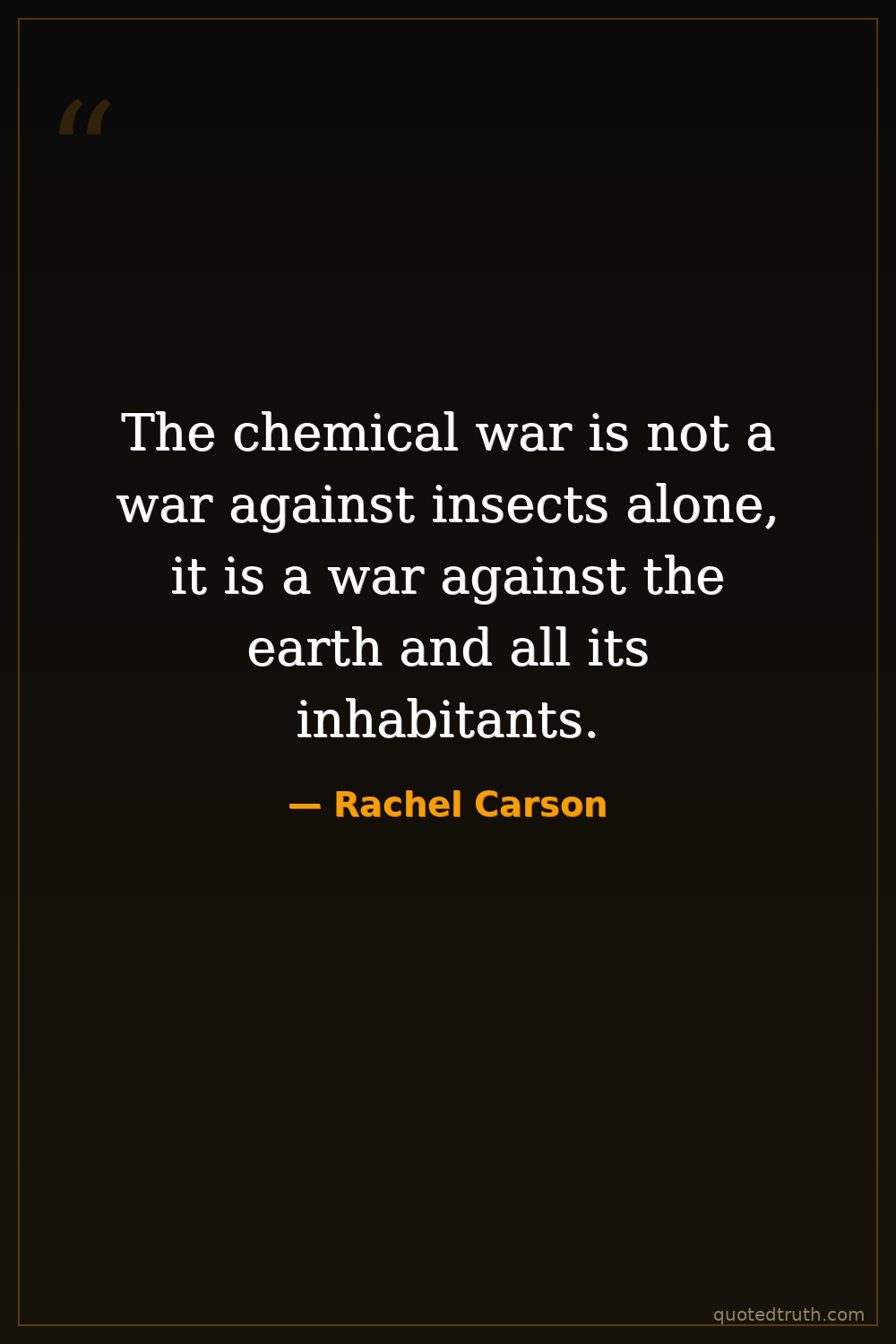
The chemical war is not a war against insects alone, it is a war against the earth and all its inhabitants.
The chemical war is not a war against insects alone, it is a war against the earth and all its inhabitants.
Click any product to generate a realistic preview. Up to 3 at a time.
* Initial load can take up to 90 seconds — revising the preview in another color is nearly instant.
"Those who contemplate the beauty of the earth find reserves of strength that will endure as long as life lasts."
"The 'control of nature' is a phrase conceived in arrogance, born of the Neanderthal age of biology and philosophy, when it was supposed that nature exists for the convenience of man."
"We are part of nature, and when we destroy nature, we destroy ourselves."
"The more we understand the intricate web of life, the more we will appreciate its fragility."
"The winds, the sea, and the moving tides are what they are. If there is wonder and beauty and majesty in them, science will discover these qualities."
Found in 1 providers: grok
1 source checked
Pesticides don't only kill their intended targets — they contaminate soil, water, birds, fish, and humans through interconnected food chains. Carson uses 'war' deliberately: like warfare, chemical spraying is indiscriminate, killing far beyond the designated enemy. The true target becomes the entire web of life. Once toxins enter an ecosystem, no species escapes unaffected, including the humans who deployed the chemicals in the first place.
Carson spent 15 years with the U.S. Fish and Wildlife Service studying how toxins move through marine and terrestrial food webs. Her Silent Spring research documented DDT accumulating in raptors — thinning eggshells, collapsing breeding populations. She believed humanity was not separate from nature but embedded within it. This quote reflects her core conviction: an attack on one part of the living world is an attack on all of it, including us.
Post-World War II America embraced synthetic pesticides — DDT had controlled malaria during the war and was hailed as a miracle. By the 1950s, government agencies were conducting mass aerial sprayings of towns and forests with little oversight. No federal law required ecological testing before chemicals reached market. Alarming wildlife die-offs were already being reported when Carson published Silent Spring in 1962, directly confronting an era of uncritical chemical optimism backed by powerful agricultural and chemical industry lobbies.
AI-generated insights based on extensive research and information for context. Factual errors? Email [email protected].
Your cart is empty