What it means
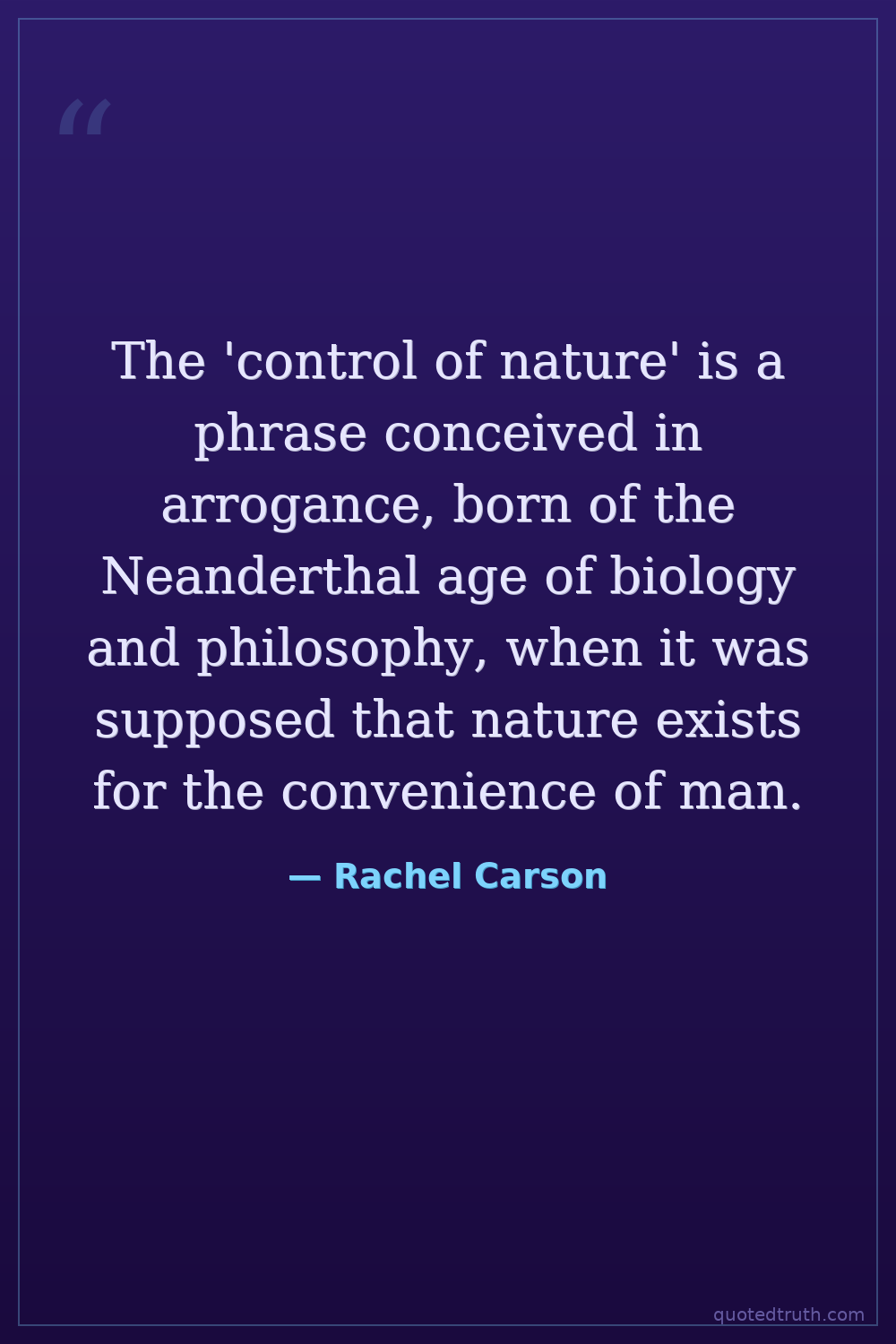
The idea that humans can 'control' nature is rooted in primitive arrogance — a worldview that wrongly assumes the natural world exists purely to serve human needs. Carson challenges the notion that technological mastery over nature constitutes progress. She frames it instead as intellectual immaturity: nature is not a resource to be dominated but a complex system operating on its own terms, wholly indifferent to human convenience.
Relevance to Rachel Carson
Carson was a marine biologist whose landmark 1962 book Silent Spring documented how DDT and other pesticides devastated bird populations and ecosystems. This quote appears in that book's closing chapter. Her earlier works — The Sea Around Us and Under the Sea-Wind — expressed deep reverence for nature's self-governing complexity. Having watched chemical companies aggressively poison ecosystems while calling it pest control, Carson's rejection of humanity's self-appointed role as nature's master was both personal and scientific.
The era
In the 1950s and 60s, synthetic pesticides like DDT were marketed as technological triumphs — once celebrated for protecting WWII troops from malaria. Government agencies aerially sprayed millions of acres with little ecological study. The broader postwar era was defined by supreme confidence in technology: nuclear power, the space race, mass chemical agriculture. Carson published Silent Spring in 1962 directly challenging this consensus — that science could and should bend nature to human will with no ecological reckoning.
AI-generated insights based on extensive research and information for context. Factual errors? Email [email protected].