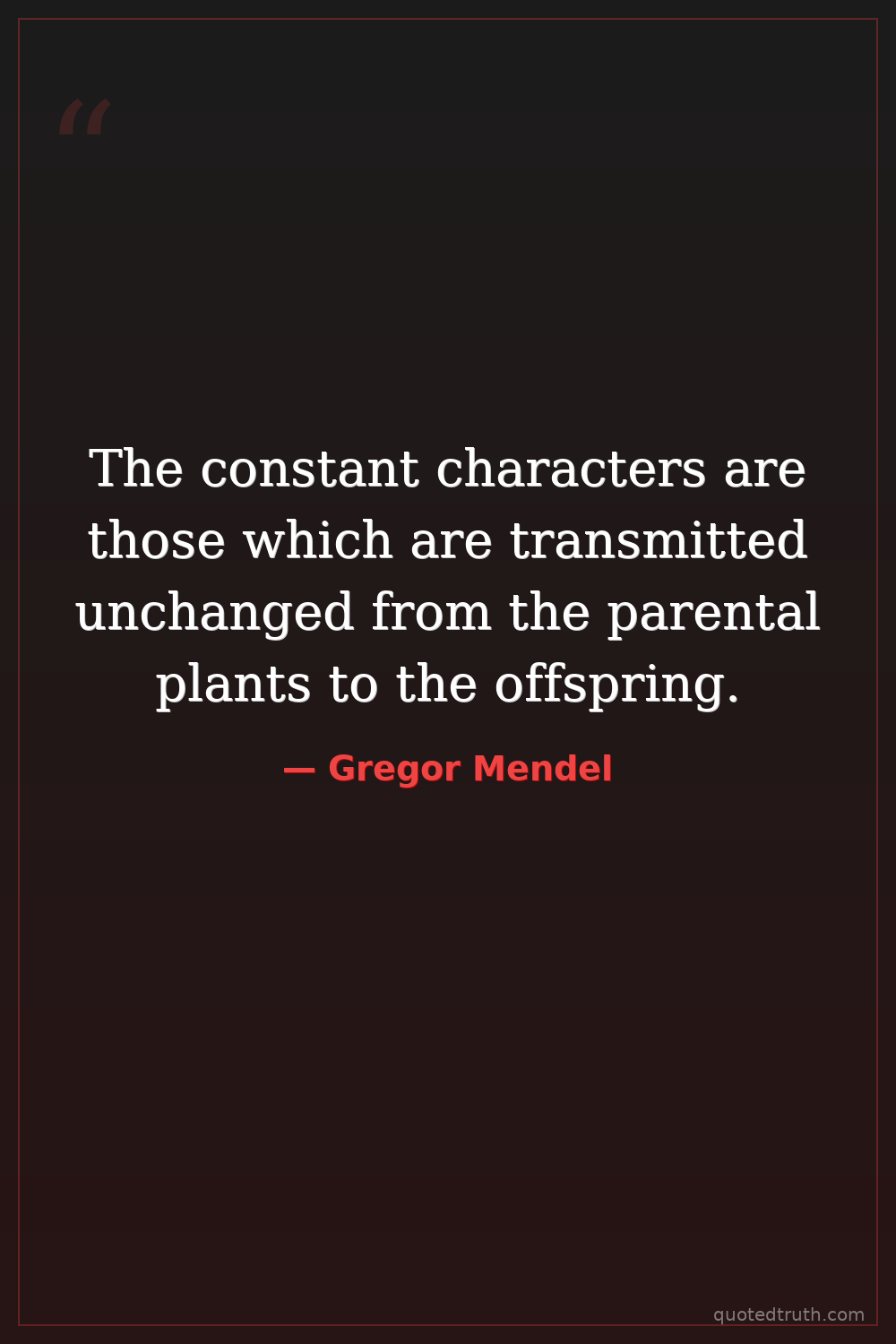
Gregor Mendel — "The constant characters are those which are transmitted unchanged from the paren…"
The constant characters are those which are transmitted unchanged from the parental plants to the offspring.
The constant characters are those which are transmitted unchanged from the parental plants to the offspring.
Click any product to generate a realistic preview. Up to 3 at a time.
* Initial load can take up to 90 seconds — revising the preview in another color is nearly instant.
"The development of every living thing is based on a preordained plan."
"The constant characters which appear in the various generations of a hybrid are those which are transmitted unchanged from the parental plants."
"My scientific work brought me such satisfaction, and I am convinced the entire World will recognize the results of these studies."
"I have been called a fool, but time will prove me right."
"The numerical relations of the different forms in the successive generations are constant."
Found in 1 providers: grok
1 source checked
Certain traits pass from parent to offspring exactly as they are, without blending or alteration. In modern terms, this describes stable inherited characteristics — what we now understand as expressions of dominant or fixed alleles. Mendel observed that some features reappear identically across generations. This directly contradicted the then-dominant blending inheritance theory and established that heredity operates through discrete, stable units rather than mixing like paint.
Mendel spent eight years cross-breeding pea plants in his monastery garden in Brno, tracking thousands of plants across generations. This quote captures his central experimental distinction between 'constant' and 'hybrid' characters, documented in his 1866 paper 'Versuche über Pflanzenhybriden,' ignored during his lifetime. His monastic discipline and rigorous quantitative record-keeping let him perceive patterns others missed, reflecting his identity as a patient, methodical observer working at the edge of institutional science.
Mendel worked in the 1850s–1860s, just as Darwin's 'On the Origin of Species' (1859) created urgent demand for a mechanism of heredity. The prevailing blending inheritance theory couldn't explain trait persistence across generations. Working in Habsburg-controlled Moravia, Mendel operated at the intersection of monastery scholarship and emerging empiricism. His findings were presented in 1865 but ignored for 35 years, rediscovered in 1900 as the mechanistic foundation evolutionary theory had been missing.
AI-generated insights based on extensive research and information for context. Factual errors? Email [email protected].
Your cart is empty