Gregor Mendel — "The constant characters which appear in the various generations of a hybrid are …"
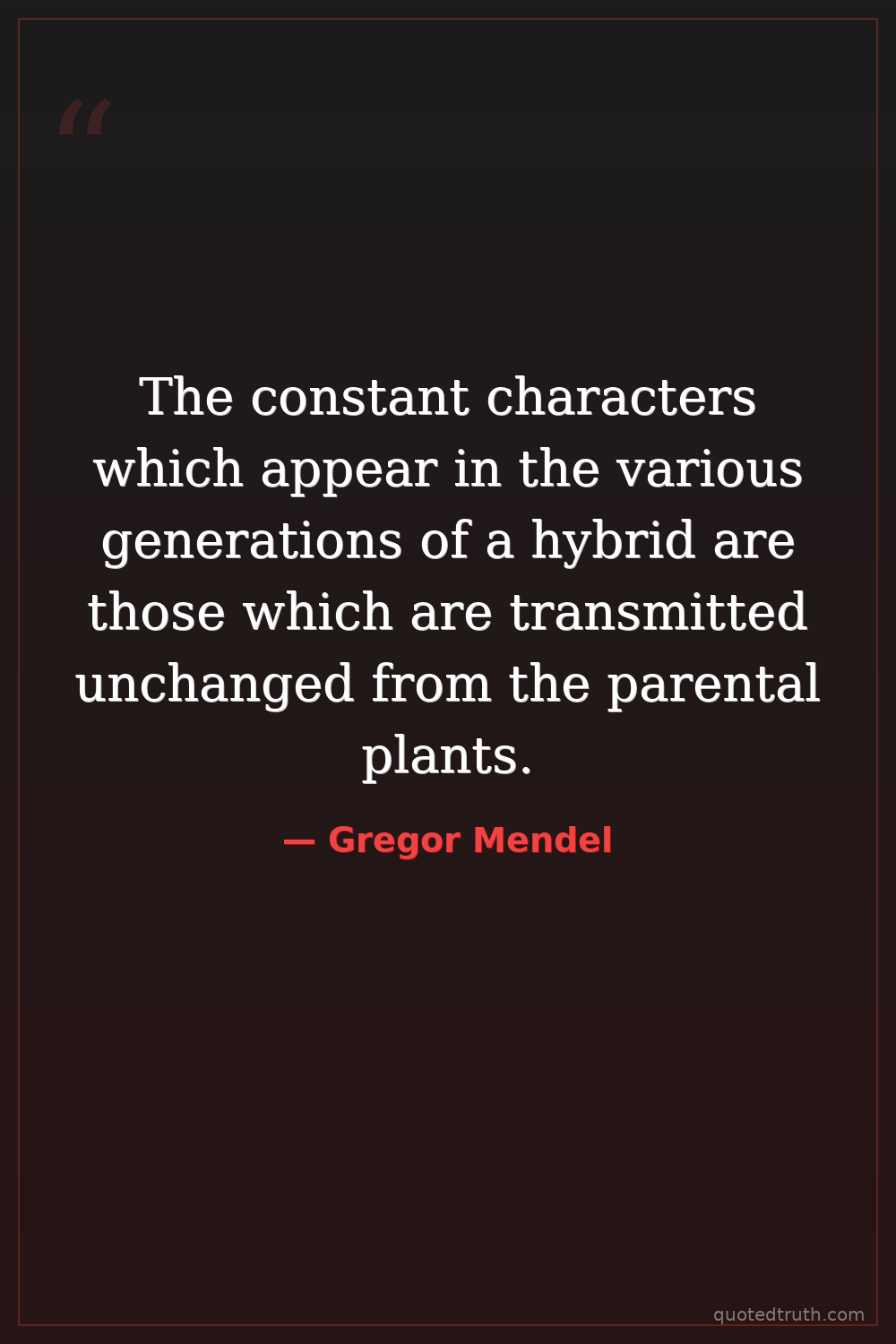
The constant characters which appear in the various generations of a hybrid are those which are transmitted unchanged from the parental plants.
The constant characters which appear in the various generations of a hybrid are those which are transmitted unchanged from the parental plants.
Click any product to generate a realistic preview. Up to 3 at a time.
* Initial load can take up to 90 seconds — revising the preview in another color is nearly instant.
"I hope that my experiments will furnish a new basis for the study of the history of the organic forms."
"It is willingly granted that by cultivation the origination of new varieties is favored, and that by man's labor many varieties are acquired which, under natural conditions, would be lost; but nothing…"
"Thus, on the average, among four plants two have the hybrid trait Aa, one the parental trait A, and the other the parental trait a. Therefore, 2Aa+ A +a or A + 2Aa + a is the empirical simple series f…"
"The garden is my kingdom, and the pea plants are my subjects."
"I am neither a botanist nor a physicist, but a humble servant of God who seeks to understand His laws."
Found in 1 providers: grok
1 source checked
When two different organisms crossbreed to produce hybrids, certain traits appear reliably across multiple generations — passed down exactly as they existed in the original parents, without mixing or dilution. Heredity isn't a blending process; some characteristics remain intact and discrete as they travel through generations. This distinguishes traits that are faithfully transmitted from those that seem to vanish temporarily in offspring before reappearing later.
Mendel spent eight years cultivating roughly 29,000 pea plants in his monastery garden at Brno, obsessively tracking traits like seed color and plant height across generations. A trained mathematician, he recognized statistical patterns others missed. This quote captures his core discovery: traits are particulate units, not blends. Largely ignored during his lifetime, his monk's patience and quantitative rigor earned him the title Father of Genetics — validated only after his 1884 death.
Mendel published in 1866, seven years after Darwin's evolution theory upended science. The prevailing model was blending inheritance — traits merged like paint across generations, which ironically undermined Darwin's natural selection by diluting favorable traits to oblivion. Mendel's discrete-unit model solved that puzzle, though neither man knew it. European natural science was rapidly professionalizing, yet Mendel's monastery setting and obscure regional journal kept his breakthrough hidden for 34 years.
AI-generated insights based on extensive research and information for context. Factual errors? Email [email protected].
Your cart is empty