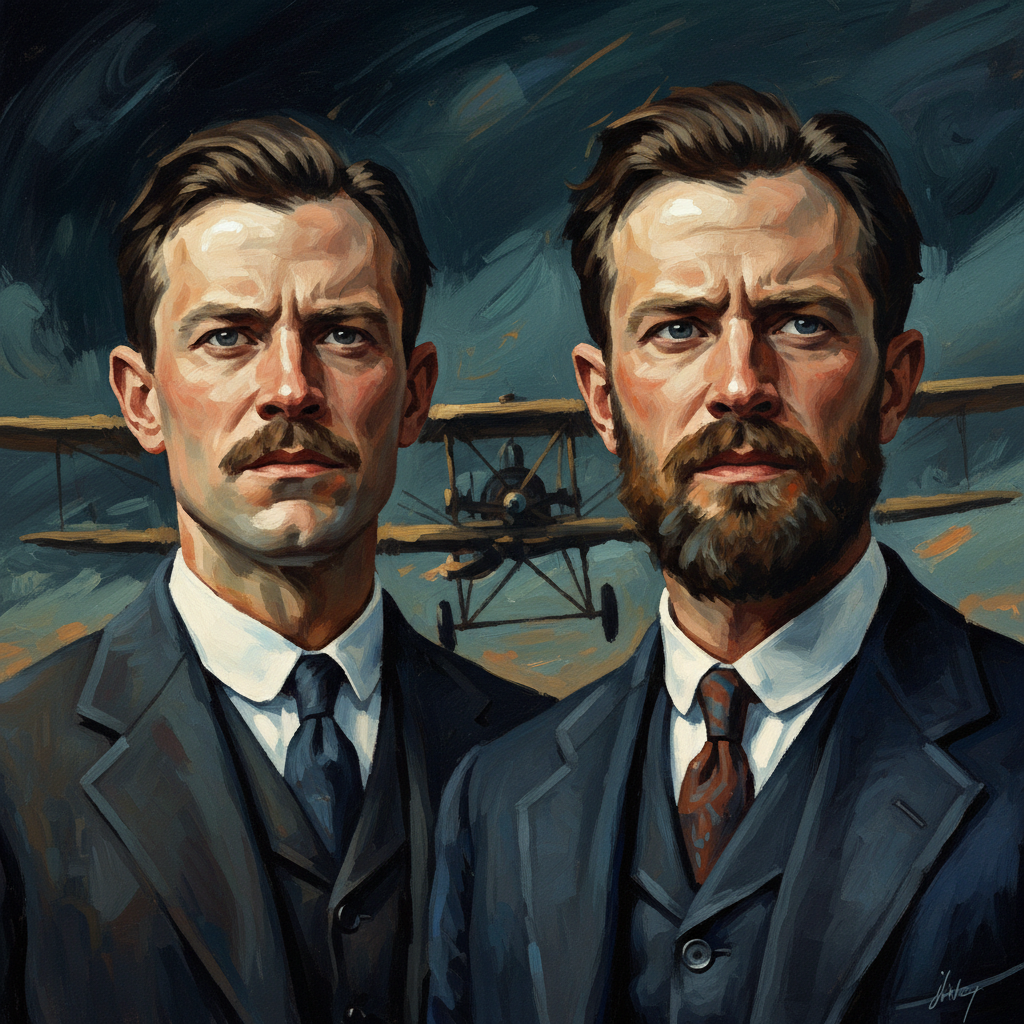
Wright Brothers (Orville & Wilbur) — "The desire for flight is the expression of a deep-seated human instinct."
The desire for flight is the expression of a deep-seated human instinct.
The desire for flight is the expression of a deep-seated human instinct.
Click any product to generate a realistic preview. Up to 3 at a time.
* Initial load can take up to 90 seconds — revising the preview in another color is nearly instant.
"The best dividends on the labor invested have invariably come from seeking more knowledge rather than more power."
"Often, after an hour or so of heated argument, we would discover that we were as far from agreement as when we started, but that each had changed to the other's original position."
"The machine was not built for speed, but for stability."
"The machine is a living thing, and must be treated as such."
"The aeroplane is not an invention, but a discovery."
American aviation pioneers who achieved the first sustained powered controlled airplane flight at Kitty Hawk, NC, on December 17, 1903. Closely associated with Octave Chanute (their gliding mentor and aeronautical correspondent). For an intellectual contrast, see Samuel Pierpont Langley, Smithsonian Institution Secretary and government-funded aviation researcher — Langley's Aerodrome crashed twice into the Potomac in October-December 1903 with $50,000 of War Department funding; the Wright Brothers' bicycle-shop empiricism beat Langley's institutional Big Science by 9 days. The most-cited example in engineering history of empirical-tinkerer beating institution-funded credentialism.
Found in 1 providers: grok
1 source checked
Wanting to fly isn't just a passing curiosity or modern ambition. It's wired into human nature itself, an ancient urge as fundamental as other core drives. People across every culture and age have looked upward and imagined escaping gravity. This pull toward the sky reflects something essential about being human: the refusal to accept physical limits and the instinctive reach toward freedom, exploration, and spaces beyond what we can currently touch.
The Wrights spent years obsessively studying birds, kites, and gliders at Kitty Hawk before their 1903 powered flight. Two bicycle mechanics from Dayton who never attended college, they saw flight not as a business opportunity but as a calling. Orville and Wilbur built their own wind tunnel, calculated their own lift tables, and risked their lives repeatedly. This quote captures why they persisted: flight wasn't invention to them, it was answering something primal humans had always wanted.
At the turn of the 20th century, prominent scientists publicly declared heavier-than-air flight impossible. Samuel Langley's government-funded attempts had crashed spectacularly weeks before Kitty Hawk. Yet the era also buzzed with mechanical optimism: automobiles, electricity, and telephones were transforming daily life. Balloonists and glider pioneers like Lilienthal had died pursuing the sky. The Wrights' 1903 achievement arrived into a world equally ready to dismiss flight as fantasy and desperate to believe human ingenuity could conquer any frontier.
AI-generated insights based on extensive research and information for context. Factual errors? Email [email protected].
Your cart is empty