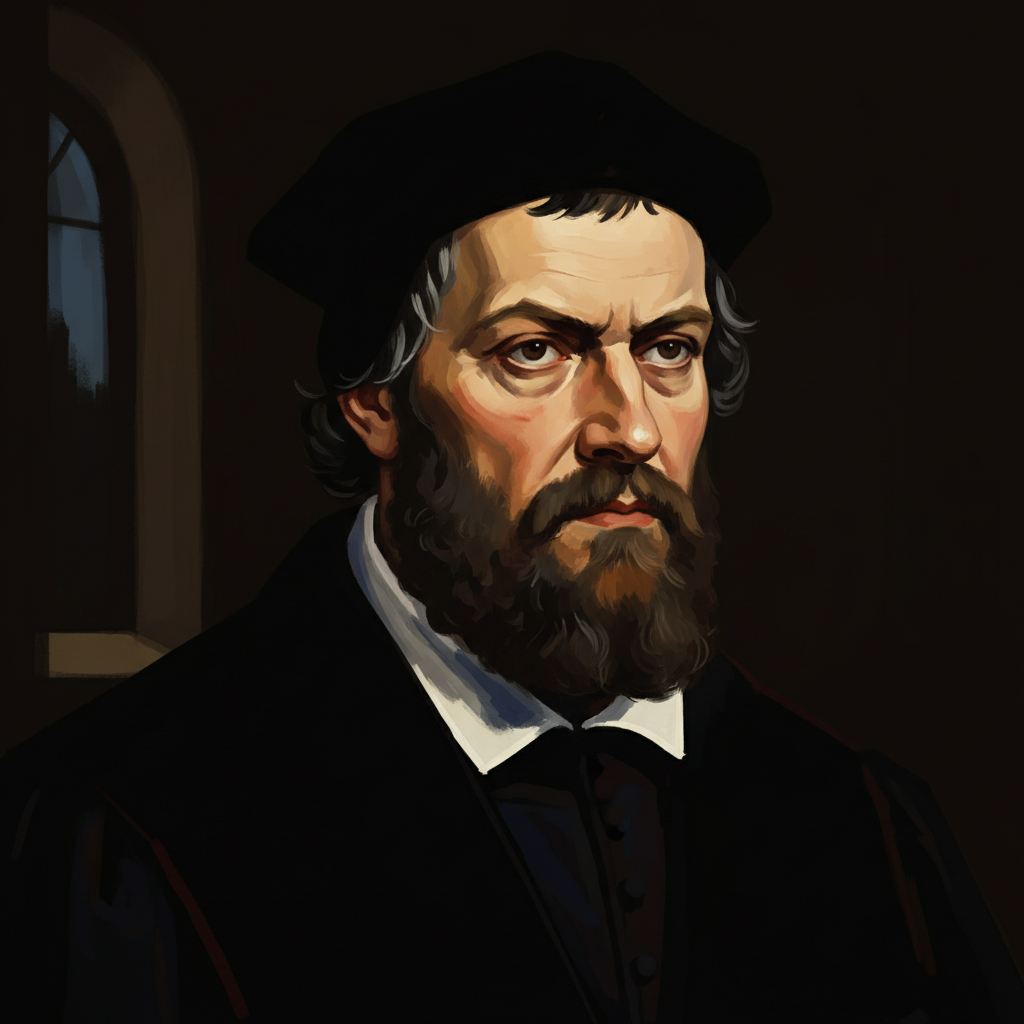
Martin Luther — "The Devil is a great artist, but he has no colors."
The Devil is a great artist, but he has no colors.
The Devil is a great artist, but he has no colors.
Click any product to generate a realistic preview. Up to 3 at a time.
* Initial load can take up to 90 seconds — revising the preview in another color is nearly instant.
"I'd rather be a pig in a sty than a friar in a monastery."
"The will is a beast of burden. If God mounts it, it wishes and goes as God wills; if Satan mounts it, it wishes and goes as Satan wills; Nor can it choose its rider... the riders contend for its posse…"
"I am a worm and no man."
"Beer is made by men, wine by God."
"He who would be a Christian must be a Jew."
German theologian whose 95 Theses (1517) launched the Protestant Reformation and broke the Catholic Church's monopoly on Western Christianity. Closely associated with Philipp Melanchthon (Lutheran systematizer) and John Calvin (later Reformer who built on Luther's break). For an intellectual contrast, see Pope Leo X, Renaissance pope (1513-1521) — Leo X's indulgence sales triggered Luther's break and Leo excommunicated him in 1521 — Luther's entire Reformation is structured as a direct answer to the indulgence-funded Vatican Leo represented.
Found in 1 providers: grok
1 source checked
Evil can imitate, distort, and counterfeit, but it cannot create anything genuinely new or beautiful. It has the skill to mimic truth and goodness, yet lacks the raw material to produce real value. Every deception is a hollow copy of something real, since malice depends on twisting what already exists rather than originating anything. Evil is parasitic, not generative, and its impressive craft ultimately traffics in borrowed, stolen, or counterfeit substance.
Luther, an Augustinian friar turned reformer, constantly warned congregants about Satan's cunning in his sermons, Table Talk, and pastoral letters. He described wrestling with the Devil personally, famously hurling an inkpot at him. Believing evil had no independent substance, only parasitic power over God's creation, Luther framed temptation as clever mimicry of truth. This aphorism captures his lifelong conviction that deception is skillful yet fundamentally empty.
In early modern Europe, belief in an active, scheming Devil permeated daily life, art, and theology. Luther's Reformation era (1517 onward) erupted amid indulgence sales, papal corruption, and printing-press-fueled pamphlet wars. Reformers accused Rome of spiritual counterfeiting, while Catholics branded Protestants as Satan's tools. Witch trials, plague, and apocalyptic anxiety sharpened the language of diabolical trickery, making a saying about Satan's artistry without substance immediately legible to sixteenth-century listeners.
AI-generated insights based on extensive research and information for context. Factual errors? Email [email protected].
Your cart is empty