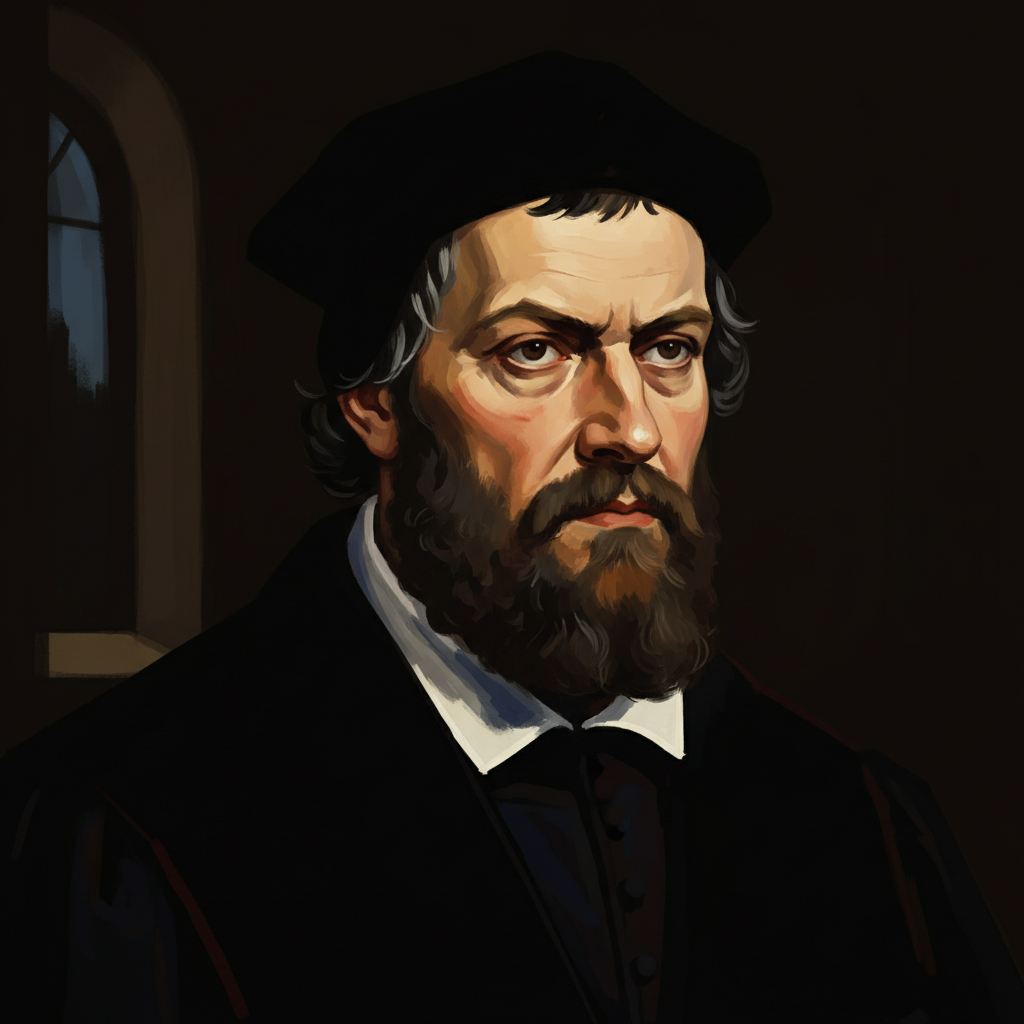
Martin Luther — "I'd rather be a pig in a sty than a friar in a monastery."
I'd rather be a pig in a sty than a friar in a monastery.
I'd rather be a pig in a sty than a friar in a monastery.
Click any product to generate a realistic preview. Up to 3 at a time.
* Initial load can take up to 90 seconds — revising the preview in another color is nearly instant.
"The more you read the Bible, the more you will love it; the more you love it, the more you will read it."
"We are saved by faith alone, but the faith that saves is never alone."
"God created the world, and he gave it to man, and he said, 'Be fruitful and multiply, and fill the earth and subdue it.'"
"The hair on my head is a fine work of art, but it is not necessary for salvation."
"He who lets himself be led by reason will never escape sin."
German theologian whose 95 Theses (1517) launched the Protestant Reformation and broke the Catholic Church's monopoly on Western Christianity. Closely associated with Philipp Melanchthon (Lutheran systematizer) and John Calvin (later Reformer who built on Luther's break). For an intellectual contrast, see Pope Leo X, Renaissance pope (1513-1521) — Leo X's indulgence sales triggered Luther's break and Leo excommunicated him in 1521 — Luther's entire Reformation is structured as a direct answer to the indulgence-funded Vatican Leo represented.
Found in 1 providers: gemini
1 source checked
The speaker would prefer living as a filthy, lowly animal over life as a cloistered monk. It's a blunt rejection of monastic existence, suggesting that confined religious life is more degrading, hypocritical, or spiritually empty than the crudest natural state. The comparison uses shock value to argue that institutional piety can be worse than honest brutishness, and that vows of seclusion corrupt rather than sanctify.
Luther spent years as an Augustinian friar before breaking with Rome, and he came to view monastic vows as spiritually worthless works-righteousness that distracted from salvation by faith alone. He eventually abandoned the cloister, married ex-nun Katharina von Bora, and urged monks and nuns to leave their orders. The earthy, scatological bluntness is classic Luther, who routinely used barnyard imagery to attack what he saw as religious hypocrisy.
In early 16th-century Europe, monasteries were wealthy, powerful institutions central to Catholic life, housing tens of thousands across Christendom. The Reformation Luther ignited in 1517 directly challenged monastic vows, clerical celibacy, and the idea that withdrawing from the world earned divine favor. Dissolution of monasteries followed across Protestant territories, redirecting lands and labor to secular use. Such a sharp attack on monastic life was inflammatory but captured the era's radical reassessment of medieval religious structures.
AI-generated insights based on extensive research and information for context. Factual errors? Email [email protected].
Your cart is empty