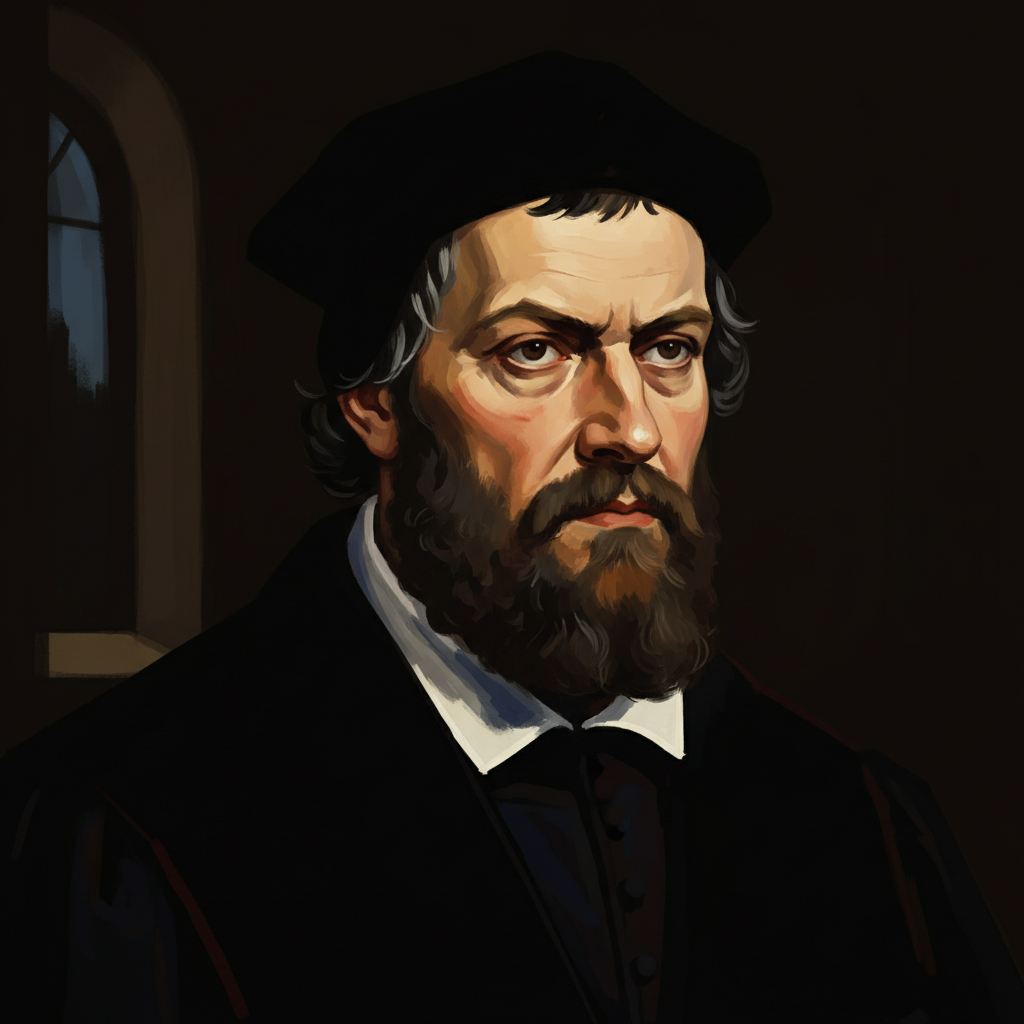
Martin Luther — "The devil is God’s devil."
The devil is God’s devil.
The devil is God’s devil.
Click any product to generate a realistic preview. Up to 3 at a time.
* Initial load can take up to 90 seconds — revising the preview in another color is nearly instant.
"A cow has a more certain faith than a hundred thousand Papists."
"If I had to do it all over again, I would still burn the pope’s bull."
"No other sin exists in the world save unbelief."
"The true treasure of the church is the most holy gospel of the glory and grace of God."
"The very devil himself would thank you for such an event, and no one but the miserable devil and his devilish scum."
German theologian whose 95 Theses (1517) launched the Protestant Reformation and broke the Catholic Church's monopoly on Western Christianity. Closely associated with Philipp Melanchthon (Lutheran systematizer) and John Calvin (later Reformer who built on Luther's break). For an intellectual contrast, see Pope Leo X, Renaissance pope (1513-1521) — Leo X's indulgence sales triggered Luther's break and Leo excommunicated him in 1521 — Luther's entire Reformation is structured as a direct answer to the indulgence-funded Vatican Leo represented.
Found in 1 providers: deepseek
1 source checked
Even forces that seem evil or destructive ultimately operate within limits set by a higher power. The devil is not an independent rival but a subordinate whose actions, however harmful they appear, remain under God's sovereign control. Evil cannot escape divine authority or thwart the larger plan; it can only do what is permitted, meaning suffering and opposition are never truly outside God's reach.
Luther wrestled constantly with the devil, claiming visions, attacks, and even hurling an inkpot at him at the Wartburg. Yet his theology insisted Satan was a tool, not an equal. This line captures his stubborn confidence: facing excommunication, imperial outlawry, and personal terror, he trusted that hostile powers, including the papacy he saw as demonic, served God's purposes despite themselves.
In early sixteenth-century Europe, belief in literal demonic activity was universal, and the Reformation unleashed apocalyptic anxiety. Plague, peasant revolts, Ottoman advances, and the splintering of Christendom felt like cosmic warfare. Luther's 1517 theses ignited persecution, wars, and accusations of heresy on every side. Asserting that even the devil belonged to God reassured terrified believers that the chaos engulfing their world was bounded, not boundless.
AI-generated insights based on extensive research and information for context. Factual errors? Email [email protected].
Your cart is empty