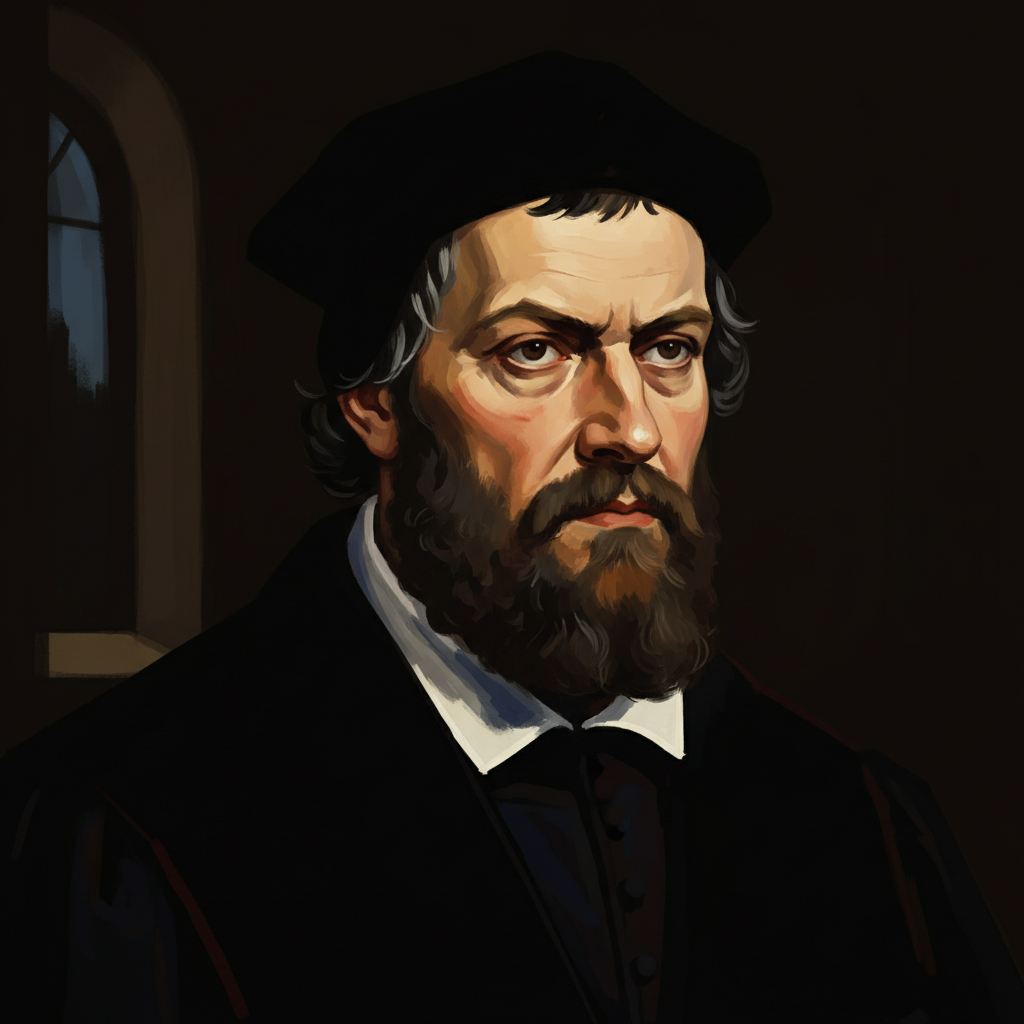
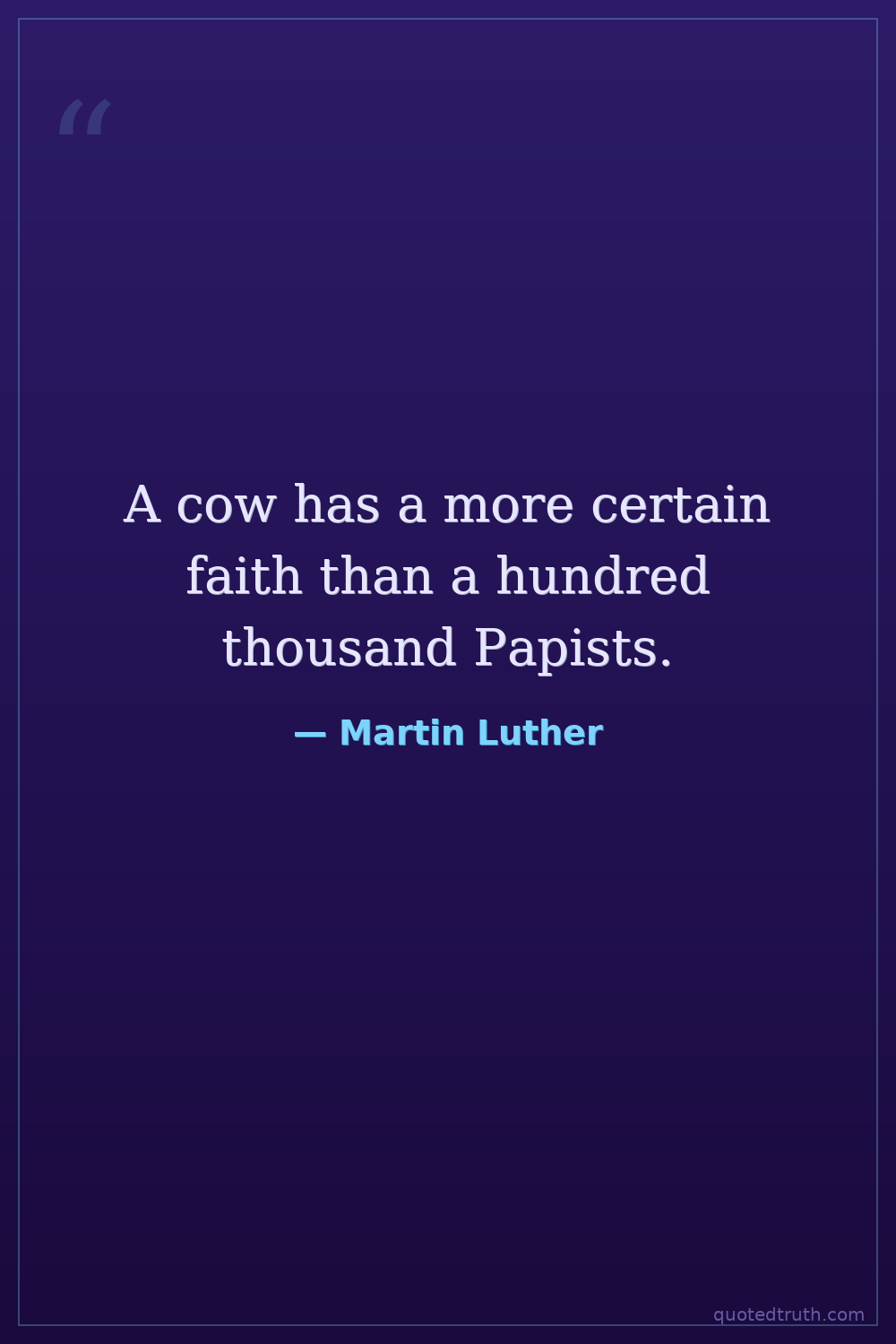
Martin Luther — "A cow has a more certain faith than a hundred thousand Papists."
A cow has a more certain faith than a hundred thousand Papists.
A cow has a more certain faith than a hundred thousand Papists.
Click any product to generate a realistic preview. Up to 3 at a time.
* Initial load can take up to 90 seconds — revising the preview in another color is nearly instant.
"The true treasure of the church is the most holy gospel of the glory and grace of God."
"To kill a peasant is not murder; it is helping to extinguish the conflagration. Let there be no half measures! Crush them! Cut their throats! Here, there, everywhere! Whoever can, strike, slay, stab, …"
"Kill them all, God will know his own."
"If you are a preacher of grace, then preach not a legal but a true and spiritual grace. If grace is true, you must bear a true and not a fictitious sin. God does not save those who are only fictitious…"
"In lying fashion you ignore what even children know."
German theologian whose 95 Theses (1517) launched the Protestant Reformation and broke the Catholic Church's monopoly on Western Christianity. Closely associated with Philipp Melanchthon (Lutheran systematizer) and John Calvin (later Reformer who built on Luther's break). For an intellectual contrast, see Pope Leo X, Renaissance pope (1513-1521) — Leo X's indulgence sales triggered Luther's break and Leo excommunicated him in 1521 — Luther's entire Reformation is structured as a direct answer to the indulgence-funded Vatican Leo represented.
Found in 1 providers: grok
1 source checked
Luther claims an ordinary cow demonstrates truer trust than vast numbers of Catholic loyalists. A cow relies instinctively on its provider without dispute or ritual, while Papists, in his view, pile up human traditions, indulgences, and papal decrees in place of simple reliance on God. The insult reduces institutional religion to something dumber than a grazing animal, arguing that genuine faith is direct trust, not credential-stacking or submission to clerical authority.
Luther staked his career on sola fide, faith alone, rejecting Rome's sacramental machinery after posting the 95 Theses in 1517. Excommunicated in 1521, he weaponized barnyard ridicule against the Pope throughout pamphlets and table talk, calling popes donkeys and worse. This quote fits his blunt German peasant rhetoric, his conviction that Scripture trumps hierarchy, and his lifelong war against what he saw as Rome's spiritually bankrupt certainty propped up by intimidation rather than trust.
Luther lived during Europe's religious earthquake, roughly 1483 to 1546. The printing press spread his tracts faster than Rome could suppress them, Charles V battled Protestant princes, and Tetzel's indulgence sales funded St Peter's Basilica. Peasants revolted in 1525, the Diet of Worms outlawed Luther in 1521, and Christendom fractured permanently. Polemic was public sport, crude barnyard insults were standard theological weapons, and every German household was forced to choose between Wittenberg and Rome.
AI-generated insights based on extensive research and information for context. Factual errors? Email [email protected].
Your cart is empty