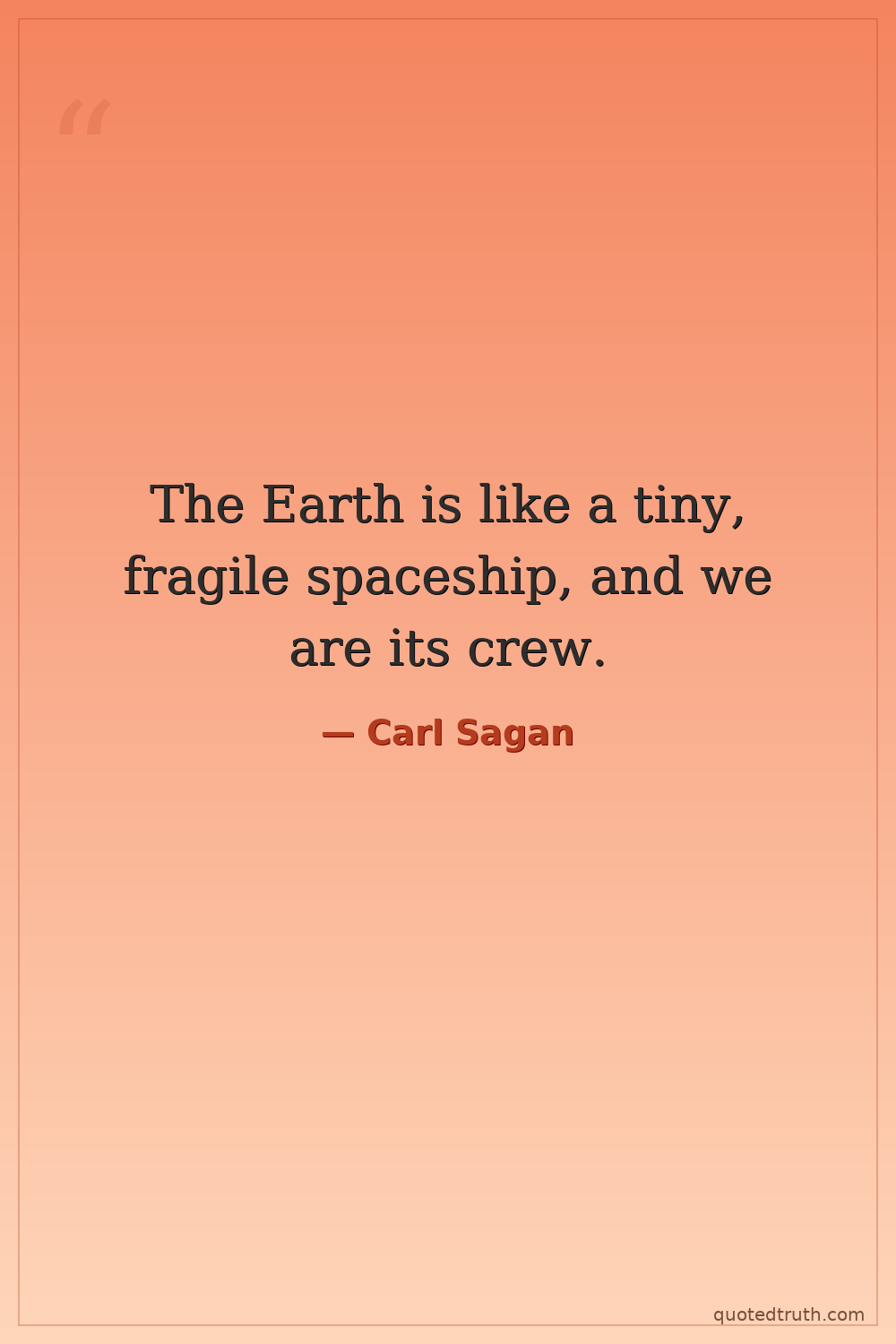
Carl Sagan — "The Earth is like a tiny, fragile spaceship, and we are its crew."
The Earth is like a tiny, fragile spaceship, and we are its crew.
The Earth is like a tiny, fragile spaceship, and we are its crew.
Click any product to generate a realistic preview. Up to 3 at a time.
* Initial load can take up to 90 seconds — revising the preview in another color is nearly instant.
"I would love to believe that when I die I will live again, that some thinking, feeling, remembering part of me will continue. But much as I want to believe that, and despite the ancient and worldwide …"
"For small creatures such as we the vastness is bearable only through love."
"Extraordinary claims require extraordinary evidence."
"We live in a society exquisitely dependent on science and technology, in which hardly anyone knows anything about science and technology."
"The cosmos is all that is or ever was or ever will be. Our feeblest contemplations of the Cosmos stir up a tingling sensation, a slight challenge for the nerves, a faint foreboding, as if we were appr…"
Found in 1 providers: grok
1 source checked
Earth is a closed system with finite resources, life support, and no backup destination. Like a spacecraft crew, humanity must actively manage its environment, resources, and survival—not through passive habit but deliberate stewardship. Neglect the ship's systems and everyone dies. There are no passengers, only crew members with shared responsibility for keeping the vessel functional.
Sagan spent his career making cosmic scale viscerally personal. His Pale Blue Dot photograph and Cosmos series repeatedly reframed Earth as precious and isolated against vast space. As a planetary scientist who studied Venus's runaway greenhouse effect, he understood existentially what planetary system failure looks like, making the spaceship metaphor scientifically grounded rather than poetic abstraction.
Sagan worked during the Cold War and early environmental movement, when nuclear annihilation and ecological collapse were simultaneous existential threats. The Apollo program had just given humanity its first view of Earth from space—a revelation that galvanized environmentalism. The first Earth Day launched in 1970. Space exploration made the planet's smallness and vulnerability suddenly, undeniably visible.
AI-generated insights based on extensive research and information for context. Factual errors? Email [email protected].
Your cart is empty