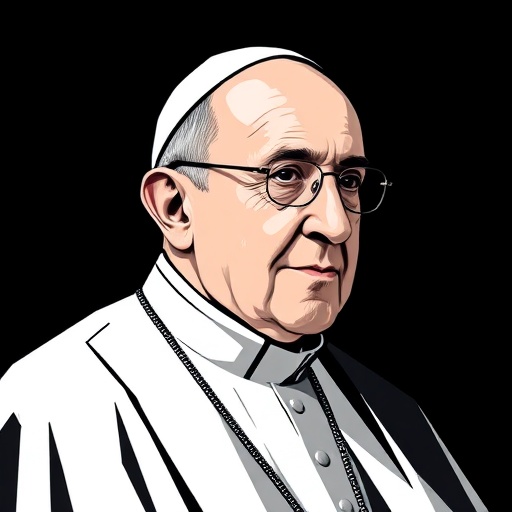
Pope Francis — "The economy should be at the service of mankind, not mankind at the service of t…"
The economy should be at the service of mankind, not mankind at the service of the economy.
The economy should be at the service of mankind, not mankind at the service of the economy.
Click any product to generate a realistic preview. Up to 3 at a time.
* Initial load can take up to 90 seconds — revising the preview in another color is nearly instant.
"A closed heart is a sick heart."
"Sometimes I have to take a tranquilizer to sleep. I keep calm. If I have a problem, I write it down on a piece of paper and give it to St. Joseph. Now he sleeps on it! And I sleep too. It’s a good way…"
"A person once asked me, in a provocative manner, if I approved of homosexuality. I replied with another question: 'Tell me: when God looks at a gay person, does he endorse the existence of this person…"
"The greatest evil that can happen in the Church is spiritual worldliness."
"The devil enters through the pockets."
First Latin American and Jesuit pope (2013-), who has steered the Catholic Church toward pastoral inclusion on LGBTQ pastoral care, divorced Catholics, and climate. Closely associated with Pope John XXIII (the Vatican II reformer pope) and Cardinal Walter Kasper (his theological ally on pastoral reform). For an intellectual contrast, see Cardinal Raymond Burke, American traditionalist cardinal, former head of the Vatican Apostolic Signatura — Burke is the public face of Catholic traditionalism that views Francis's pastoral approach as doctrinally dangerous — he has formally challenged Amoris Laetitia and other Francis reforms.
Found in 1 providers: grok
1 source checked
Economic systems exist to improve human lives and wellbeing, not the reverse. When markets, profit motives, or financial institutions become ends in themselves, people get treated as instruments or expendable inputs. True economic health means measuring success by how well ordinary people live, not by GDP growth or shareholder returns alone.
Jorge Mario Bergoglio grew up in Argentina amid devastating financial crises, poverty, and inequality. As a Jesuit priest serving Buenos Aires slums, he witnessed capitalism's failures firsthand. His apostolic exhortation Evangelii Gaudium explicitly condemned trickle-down economics and 'throwaway culture,' making economic justice central to his papacy rather than peripheral.
Francis became Pope in 2013 amid the aftermath of the 2008 global financial crisis, rising inequality, austerity protests across Europe, and Occupy movements worldwide. Debates raged about whether markets served people or vice versa. Tech monopolies, gig economy exploitation, and billionaire wealth concentration made this tension between human dignity and economic logic acutely visible.
AI-generated insights based on extensive research and information for context. Factual errors? Email [email protected].
Your cart is empty