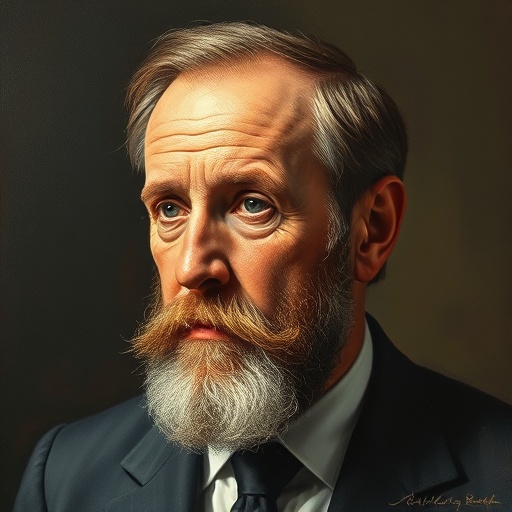
Niels Bohr — "It is not the job of science to tell us how the world is, but what we can say ab…"
It is not the job of science to tell us how the world is, but what we can say about it.
It is not the job of science to tell us how the world is, but what we can say about it.
Click any product to generate a realistic preview. Up to 3 at a time.
* Initial load can take up to 90 seconds — revising the preview in another color is nearly instant.
"The quantum postulate implies that any observation of atomic phenomena will involve an interaction with the agency of observation which is not negligible."
"The meaning of our words is always context-dependent."
"The meaning of life is that it stops."
"The world is full of wonders, and science is the key to unlocking them."
"The meaning of life does not consist in the mere fact of existing, but in the power of perceiving and making known our existence, and that of others."
Similar to his 'Physics is not about how the world is' quote, reflecting his philosophical stance.
Date: Approx. 1930s
EducationalFound in 1 providers: grok
1 source checked
Science does not deliver an unfiltered picture of reality itself. Instead, it gives us reliable statements, predictions, and descriptions about what we observe and measure. The world as it truly is sits behind our experiments, and we only ever access it through the language of models, equations, and repeatable results. Science succeeds when those statements work, not when they claim to expose ultimate truth.
Bohr built quantum theory around exactly this humility. His atomic model and later complementarity principle held that electrons, waves, and particles cannot be pictured as everyday objects; physicists can only describe what experimental setups reveal. He famously sparred with Einstein, who wanted an objective reality beneath the math, while Bohr insisted physics speaks about measurements, not hidden things-in-themselves. The quote distills his Copenhagen interpretation in one sentence.
Bohr worked through the early twentieth-century quantum revolution, when classical certainty collapsed under radioactivity, relativity, and the uncertainty principle. The 1927 Solvay Conference, the rise of Heisenberg and Schrodinger, and debates over wave-particle duality forced scientists to question whether physics described nature directly or only experiments. World wars, Bohr's escape from occupied Denmark, and the Manhattan Project also pressed scientists to clarify the limits and responsibilities of their knowledge.
AI-generated insights based on extensive research and information for context. Factual errors? Email [email protected].
Your cart is empty