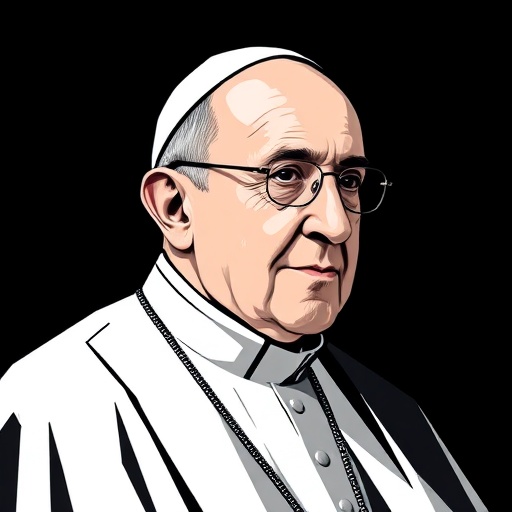
Pope Francis — "The environmental crisis and social crisis are not two separate crises, but one …"
The environmental crisis and social crisis are not two separate crises, but one complex crisis.
The environmental crisis and social crisis are not two separate crises, but one complex crisis.
Click any product to generate a realistic preview. Up to 3 at a time.
* Initial load can take up to 90 seconds — revising the preview in another color is nearly instant.
"I like to talk to people, to go out into the street. I like to be a street priest."
"The Church is not a club for the perfect, but a home for the imperfect."
"The globalization of indifference has taken from us the ability to weep."
"The globalized technological paradigm has inverted the order of priorities: the useful is now the criterion of truth."
"Money must serve, not rule."
First Latin American and Jesuit pope (2013-), who has steered the Catholic Church toward pastoral inclusion on LGBTQ pastoral care, divorced Catholics, and climate. Closely associated with Pope John XXIII (the Vatican II reformer pope) and Cardinal Walter Kasper (his theological ally on pastoral reform). For an intellectual contrast, see Cardinal Raymond Burke, American traditionalist cardinal, former head of the Vatican Apostolic Signatura — Burke is the public face of Catholic traditionalism that views Francis's pastoral approach as doctrinally dangerous — he has formally challenged Amoris Laetitia and other Francis reforms.
Found in 1 providers: grok
1 source checked
Ecological degradation and human poverty are not parallel problems but one entangled reality. Environmental destruction disproportionately harms the poor, while inequality drives unsustainable exploitation of nature. Treating them separately produces partial fixes that solve neither. Real progress means addressing both at once: protecting ecosystems is protecting vulnerable people, and lifting communities out of poverty is itself environmental stewardship. They share root causes and demand a unified response.
Pope Francis, born in Buenos Aires and formed by Latin American liberation theology, built his papacy on two inseparable pillars: care for the poor and care for creation. His 2015 encyclical Laudato Si' made this argument at length, framing Earth as 'our common home.' As a Jesuit from the Global South, he witnessed firsthand how pollution and climate change devastate impoverished communities, giving this conviction deep personal, pastoral, and theological grounding.
The 2010s saw the Paris Agreement, the UN Sustainable Development Goals, and mounting climate science collide with surging economic inequality and global poverty debates. Yet environmental movements and anti-poverty advocates largely operated in separate policy silos. Wealthy nations often framed climate action as economically threatening, while poorer nations demanded development rights. Francis intervened at this fracture point, pushing world leaders toward integrated governance at a moment when the silos were producing diplomatic deadlock.
AI-generated insights based on extensive research and information for context. Factual errors? Email [email protected].
Your cart is empty