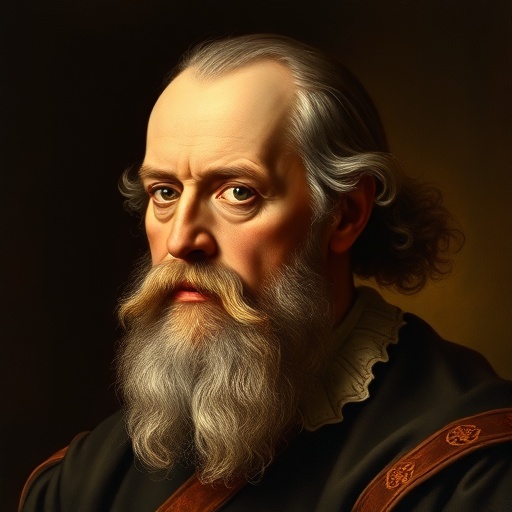
Galileo Galilei — "The error of the senses is not less, but rather greater, if we try to correct th…"
The error of the senses is not less, but rather greater, if we try to correct them by reason without experience.
The error of the senses is not less, but rather greater, if we try to correct them by reason without experience.
Click any product to generate a realistic preview. Up to 3 at a time.
* Initial load can take up to 90 seconds — revising the preview in another color is nearly instant.
"You cannot teach a man anything; you can only help him find it within himself."
"I hold it to be an error to believe that the truths of faith and the truths of science are contradictory."
"It is a beautiful and admirable thing to know how to demonstrate the truth."
"I do not believe that the same God who has given us senses, reason and intellect would have us abandon their use."
"Who would set a limit to the mind of man? Who would dare assert that we know all there is to be known?"
Found in 1 providers: grok
1 source checked
Relying on pure reason alone to fix faulty sense data makes things worse, not better. You need actual hands-on experience and experiment to correct what your senses get wrong. Abstract reasoning without empirical testing doesn't refine perception — it compounds the original mistake by adding unfounded assumptions on top of unreliable raw observation.
Galileo built his career on empirical observation — his telescope, inclined plane experiments, and astronomical discoveries all prioritized measured experience over scholastic reasoning. He fought Aristotelian philosophers who reasoned from first principles without testing. This quote encapsulates his foundational method: trust corrected observation over armchair logic, which defined his conflict with Church authority and academic traditionalists.
In early modern Europe, Aristotelian scholasticism dominated — scholars derived knowledge through logical deduction from accepted authorities, not experimentation. The Scientific Revolution Galileo helped ignite challenged this. His era saw the printing press spread ideas, navigational demands push practical astronomy, and Catholic orthodoxy resist empirical challenges to geocentrism, making his insistence on experience over pure reason genuinely revolutionary and dangerous.
AI-generated insights based on extensive research and information for context. Factual errors? Email [email protected].
Your cart is empty