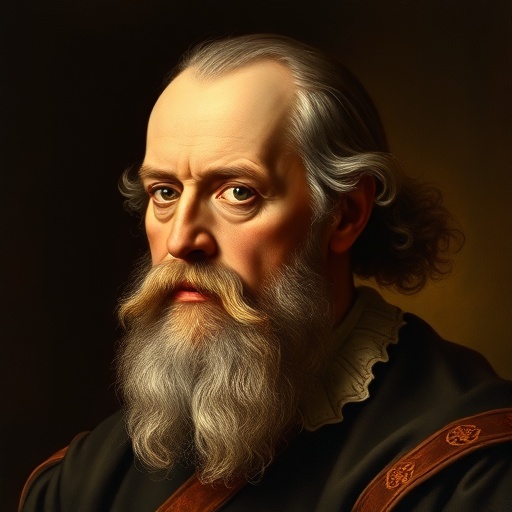
Galileo Galilei — "You cannot teach a man anything; you can only help him find it within himself."
You cannot teach a man anything; you can only help him find it within himself.
You cannot teach a man anything; you can only help him find it within himself.
Click any product to generate a realistic preview. Up to 3 at a time.
* Initial load can take up to 90 seconds — revising the preview in another color is nearly instant.
"I have loved the stars too fondly to be fearful of the night."
"The universe is an immense, eternal, and infinite work, which can be understood only by the one who created it."
"Where the senses fail us, reason must step in."
"I do not think it is necessary to believe that the same God who gave us our senses, our reason, and our intellect, also intended us to forego their use."
"I hold the sun to be situated motionless in the center of the revolution of the celestial orbs while the earth revolves around the sun."
Found in 2 providers: deepseek,grok
2 sources checked
Knowledge cannot be poured into a person from the outside; genuine understanding only emerges when someone actively discovers and internalizes ideas through their own reasoning and experience. External instruction merely creates the conditions for that internal discovery. True learning is self-generated, not passively received from an authority figure.
Galileo championed empirical observation and mathematical reasoning over blind acceptance of Aristotelian doctrine. He spent his life demonstrating that individuals must observe, measure, and reason for themselves rather than defer to ancient authorities or the Church. His famous experiments with motion and his telescopic observations modeled exactly this philosophy: see it yourself, reason it yourself.
In the early modern period, European knowledge was overwhelmingly transmitted through scholastic authority — Aristotle mediated by Church theologians. The Renaissance and Scientific Revolution were beginning to challenge this model, asserting that individuals could investigate nature directly. Galileo's conflicts with the Inquisition embodied this collision between institutional authority as the source of truth and individual empirical inquiry.
AI-generated insights based on extensive research and information for context. Factual errors? Email [email protected].
Your cart is empty